Introduction
A worn die starts producing marginal parts. A strip fails to advance. A coil of the wrong material gets loaded. None of it is dramatic at first, and if nobody sees it, the press keeps running until the result is a crashed die, a bin of scrap, or an unsafe condition.
Andon addresses that gap. This guide covers what Andon is, how it works, the main system types, the benefits it can deliver, and how US manufacturers can evaluate an approach for pressroom and metal-stamping operations.
Key Takeaways
- Andon is a signal tied to a defined response, not just a colored light.
- Start with the simplest system that works, from manual cords to sensor-triggered and connected setups.
- Benefits include faster response, less downtime, earlier defect containment, and better data.
- Results depend on clear triggers, response owners, stop rules, training, and a blame-free culture.
What Is an Andon System and How Does It Work?
According to the Lean Enterprise Institute (LEI), Andon is visual management that shows operating status and signals abnormalities. The Japanese word translates to "lamp." Toyota UK renders it as "sign" or "signal."
Andon is closely tied to Jidoka, the Toyota Production System principle of building quality into the process and stopping to fix defects. Jidoka is the philosophy. Andon is the mechanism that exposes a condition and calls for help.
Components of an Andon system
- Activation method: cord, push button, HMI command, sensor or PLC signal
- Local light or stack light
- Andon board or screen
- Audible or digital notification where needed
- Event record for later analysis
Keep three things separate. The signal identifies a condition. The assigned responder controls it. The record feeds containment, root-cause work and improvement.
The typical Andon response cycle
- Someone recognizes a deviation from the expected condition.
- The signal is activated.
- The event is acknowledged.
- A first responder arrives.
- The responder decides whether work continues or stops.
- The issue is contained.
- Restart is authorized.

A call for help, an immediate stop and a fixed-position stop are different designs. In LEI's assembly-line example, a fixed-position stop lets the line run until cycle end if the problem isn't solved, while correction before then permits continued operation. That is not a press-stop prescription. The right choice depends on safety, quality, equipment and process risk.
Andon colors and status communication
Common conventions, per IDEC's summary of IEC 60204-1:2016 for indicator lights:
| Color | Typical meaning |
|---|---|
| Green | Normal |
| Yellow | Abnormal or impending critical condition |
| Red | Emergency or hazardous, immediate action |
| Blue | Mandatory operator action |
| White | Neutral, monitoring |
Meanings vary by facility, so document them and train everyone. Pair color with text, symbols, position or sound rather than relying on color alone. That keeps status clear for operators with color-vision differences and in poor visibility.
Types of Andon Systems
Andon systems are grouped by activation method and digital maturity. Many plants combine categories.
Traditional manual Andon
Cords, pull switches, push buttons, flags, lamps and paper logs. This suits small shops, pilots, low-automation equipment and lines where responders are close by.
- Pro: low complexity and infrastructure
- Con: little automatic data, manual classification, weak history
Semi-automatic and hybrid Andon
Operators initiate alerts while sensors, machine signals or PLC inputs change lights, boards or event states. One example is an operator help call combined with automatic machine-stop, die-protection, guard or material signals.
Keep verified machine status distinct from an operator's request for assistance. "Semi-automatic" is a descriptive label, not a standardized class.
Automatic Andon
Sensors, controls, machine logic or vision systems trigger an alert when a predefined abnormal condition occurs. Validate thresholds first. Otherwise you get nuisance alarms, duplicate notifications and alerts nobody can act on.
Emerson's alarm-rationalization guidance, written for process industries, covers chattering alarms, deadbands and on/off delays.
Digital and connected Andon
Digital boards, industrial monitors, mobile notifications, dashboards, timestamps, reason codes and escalation workflows. These setups often link to ERP, MES and OEE systems. Benefits include multi-line visibility, remote access, automatic records and traceability.
Connectivity alone doesn't deliver predictive maintenance or improvement.
Choosing the right type
| Manual | Hybrid | Automatic | Digital | |
|---|---|---|---|---|
| Activation | Operator | Operator plus signals | Sensor or control | Either, routed by software |
| Visibility | Local | Local, some board | Local or board | Multi-line, remote |
| Data capture | Manual | Partial | Automatic | Automatic, timestamped |
| Integration | None | Limited | Machine controls | MES, ERP, OEE |
| Maintenance burden | Low | Moderate | Moderate to high | Highest |
| Scalability | Low | Moderate | Moderate | High |
| Best fit | Pilots, small shops | Mixed equipment | Well-defined faults | Multi-line plants |
Select using these questions:
- What abnormality are you detecting?
- Where are responders?
- How fast is production, and how severe are the safety and quality risks?
- What controls already exist?
- What data do you need?
- What implementation resources do you have?
Benefits of Andon Systems
These are operational outcomes that appear when a signal connects to a reliable response process. The technology alone doesn't cause improvement.
Faster response and reduced downtime
Immediate visibility shortens the gap between an abnormality and the right support, so small interruptions don't grow into extended downtime.
Published results are case-specific. A supplier case study from Allied Motion reported a 10% improvement in response time and issue resolution within months of a connected Andon going live, though baselines weren't disclosed and process changes accompanied it.
Treat it as an example, not a benchmark. No universal response-time or downtime-reduction figure exists. Set your own baseline first.
Quality at the source
Signaling a deviation before product advances supports containment and limits scrap, rework and downstream inspection. Stamping examples include:
- A die-protection event, such as failed strip advance
- Incorrect material
- Tooling wear
- A dimensional concern
- A press-control abnormality
Andon identifies and escalates the condition. It doesn't prove root cause.
Productivity and equipment utilization
Event records and reason codes expose patterns in minor stops, recurring press interruptions, changeover problems and material shortages. Trustworthy data also feeds OEE availability and performance analysis.
OEE is Availability x Performance x Quality. OEE.com rejects any single ideal benchmark for every company. Reconcile Andon data with production, quality and maintenance records before making business decisions.
Real-time visibility and communication
A light, board or notification gives operators, supervisors, maintenance, quality and production control a shared view. Defined escalation paths keep operators at their stations instead of hunting for help, and let leaders prioritize competing events across lines.
Frontline involvement and continuous improvement
A clear, supported way to raise abnormalities strengthens problem visibility, provided leaders respond constructively. LEI's account of NUMMI describes workers promised help within their work cycle, with pulls becoming routine.
Fewer alerts don't automatically mean better performance. A Toyota veteran quoted by LEI describes frequent pulls positively because small problems get fixed before they grow. Judge call frequency alongside response quality, recurrence, observed behavior and evidence that people still report problems.
Implementing an Andon System
Start with one process, line or problem family where the expected condition is clear, the abnormality is observable and a responder can realistically help. The Lean Enterprise Institute (LEI) favors defined teams and boundaries. Hourly boards or red bins may come before continuous Andon when foundations are still weak.
Define triggers, ownership and response rules
Document these before choosing hardware or software:
- The normal condition and the actionable trigger
- What each signal means
- First responder, backup and escalation point
- Containment action
- Stop authority
- Reset criteria and restart authority
Write separate rules for safety-critical abnormalities, quality risks, equipment faults, material shortages and requests for assistance. Not every signal deserves the same response.
Train people and establish a supportive culture
Operators, supervisors, maintenance, quality and engineering all need to know when to activate Andon, how to protect the process while waiting, how to acknowledge a call and how to escalate or close it.
Leadership must investigate the condition, not blame the person who raised it. The Shingo Institute describes psychological safety as speaking candidly without fear of punishment. Toyota expects cord-pulling and responds with help, not blame.
Pilot, measure and improve
Before scaling, test:
- Visibility and audibility
- Network reliability
- Simultaneous calls
- Unavailable responders
- Event reset, stop logic and restart authorization
After the pilot, review:
- Nuisance alerts and unanswered calls
- Repeat events and downtime by cause
- Response and restoration time
- Containment results and recurrence
Low call volume is never the sole success measure.

Applying Andon to Metal Stamping and Measuring Results
The same principles apply across mechanical punch-press job shops, automotive and appliance stamping plants, press rebuilders, machinery OEMs and maintenance contractors. A simple local signal can grow into multi-line digital visibility.
Pressroom use cases
Practical triggers include:
- Press stoppage
- Brake or clutch-control abnormality
- Die-protection activation
- Guard or safety-device concern
- Tooling issue or material shortage
- Quality deviation or missed production condition
- Maintenance assistance request
Andon should route each issue to the right function. It does not replace required safeguards. OSHA 1910.217 requires guards or properly applied point-of-operation devices on mechanical power presses. An Andon call or control-system stop is not lockout/tagout under OSHA 1910.147.
Relevant technology and product context
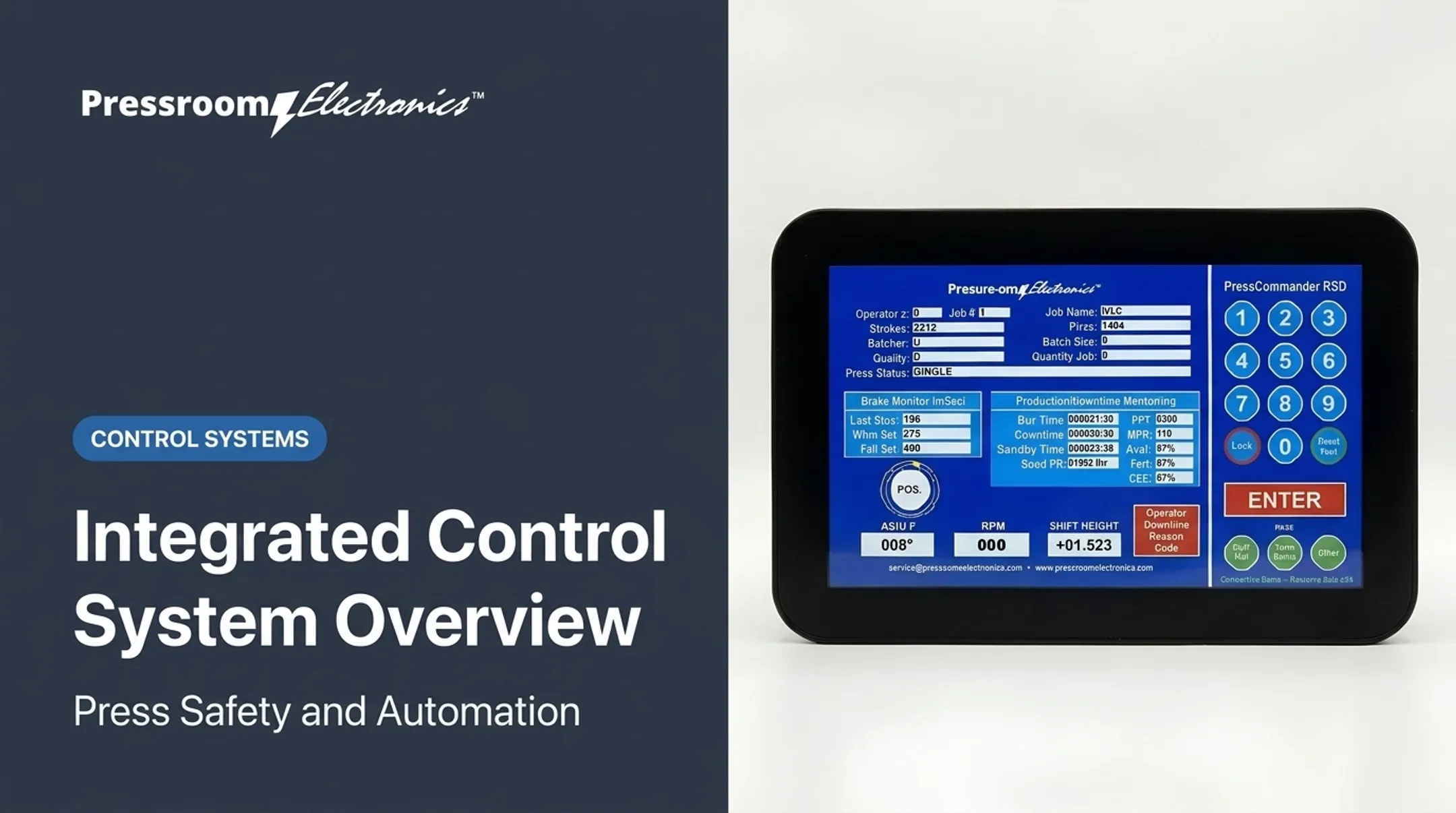
Pressroom Electronics doesn't sell a dedicated Andon platform. Its pressroom controls can be sources of status and abnormality data: press controls, brake monitoring, die protection, guarding, tonnage monitoring and custom programming.
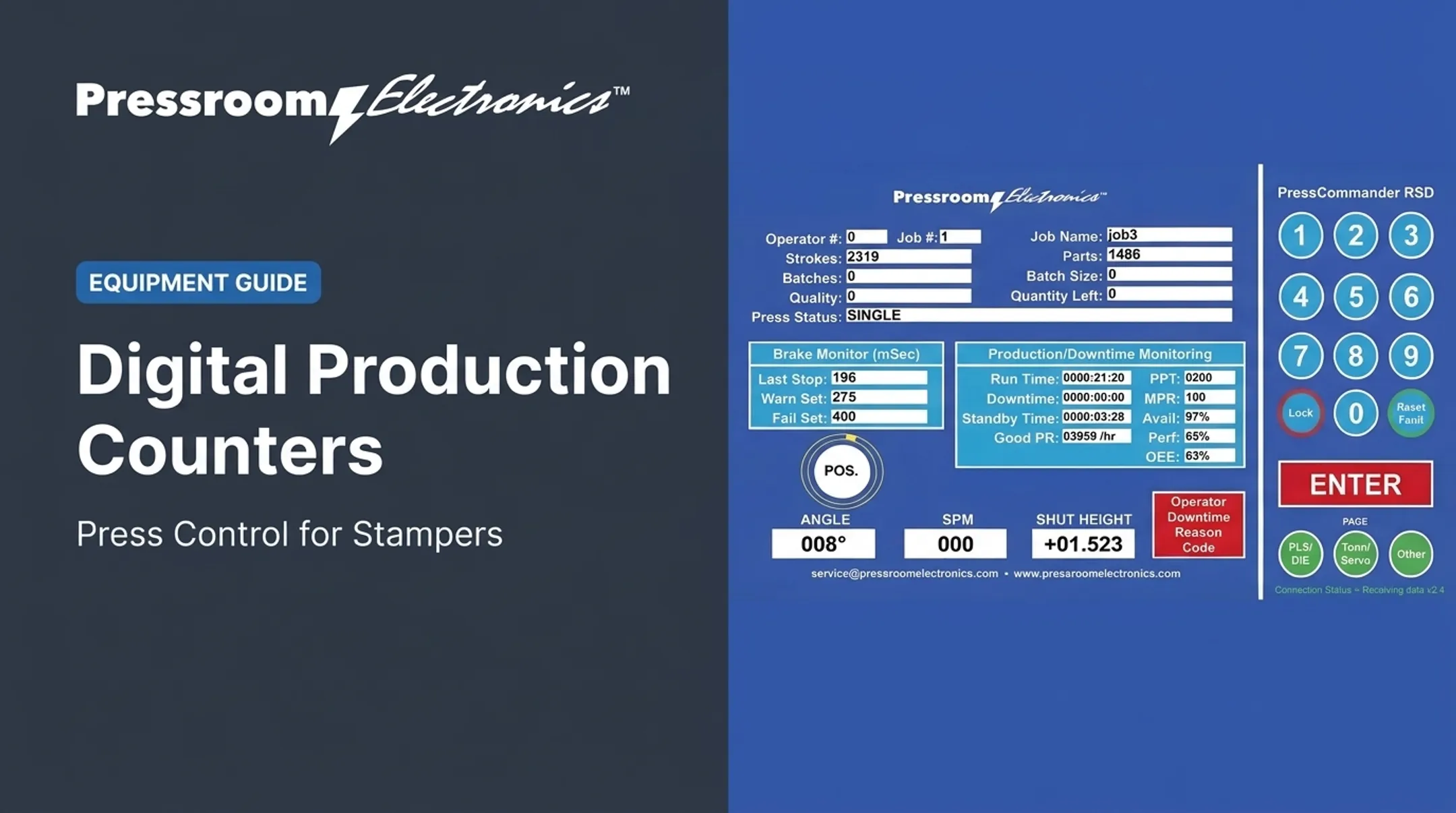
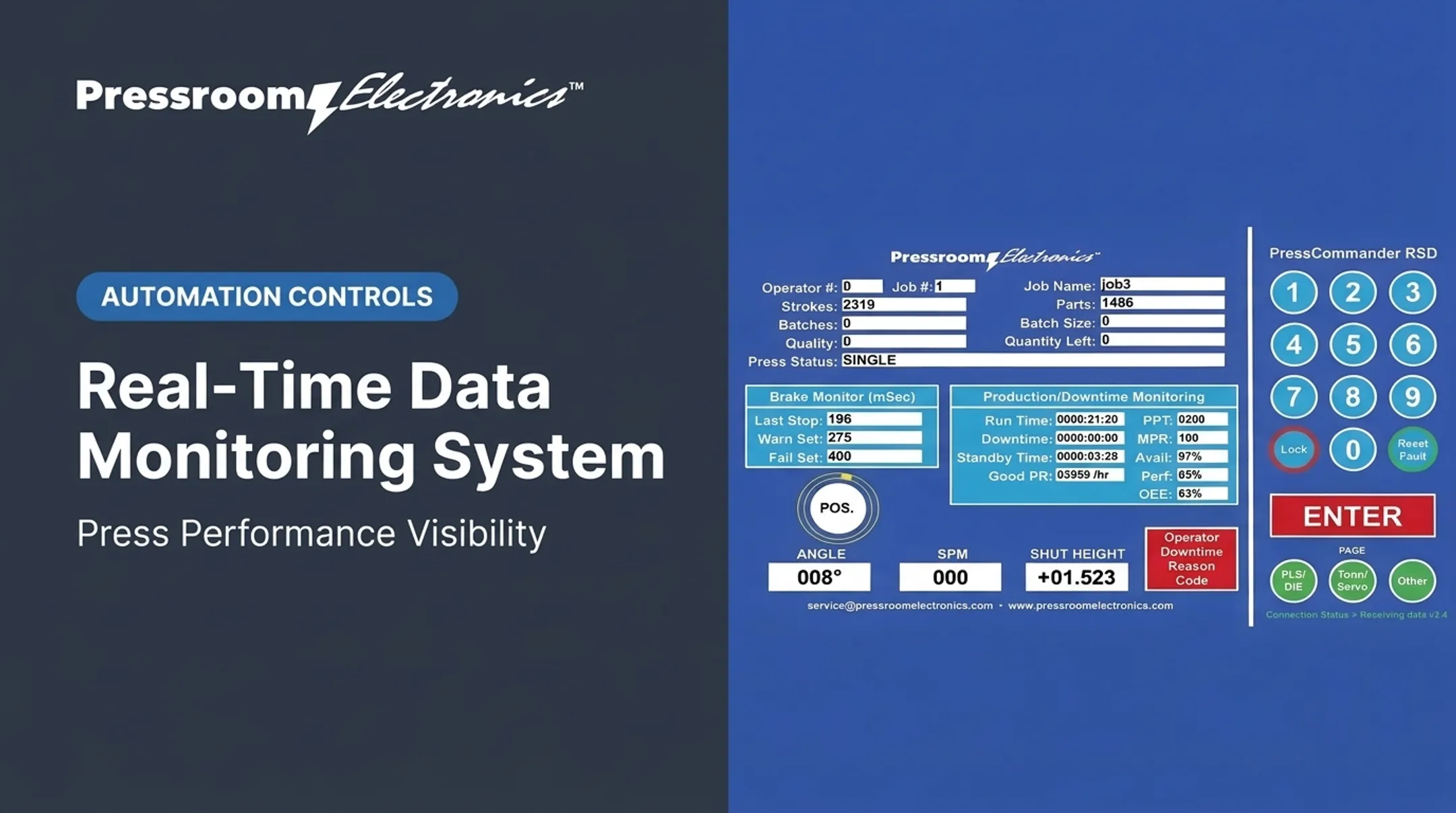
Its Production & Downtime Monitoring System supports up to 20 customizable downtime codes. Codes can be activated by touchscreen or automatically from machine-circuit signals through an I/O interface board. The system records data automatically into Excel files, and Ethernet links support remote monitoring.

Before adding a separate Andon layer, check whether existing controls can supply reliable signals, reason codes, timestamps and escalation data. If you're evaluating pressroom control and monitoring requirements, talk with Pressroom Electronics.
A MetalForming case at ODM Tool & Mfg. shows the pattern: electrical signals capture runtime and part counts, operators enter downtime reasons, and email or text alerts fire when downtime exceeds expectations. Payback came in under three months. This is downtime monitoring, not Andon-only evidence.
Metrics and review cadence
Track a balanced set:
- Event frequency by category and location
- Response and restoration time
- Downtime minutes and repeat abnormalities
- Quality containment, scrap and rework
- Maintenance recurrence and material interruptions
- Relevant OEE inputs
Andon data shows where and when to investigate. It doesn't explain why. Use a Gemba review, 5 Whys, A3 or another suitable method to verify cause.
Conclusion
An Andon system earns its keep when it turns an abnormal condition into visible ownership, fast containment, informed escalation, and lasting improvement.
Start small. Map one press or production area, list its key expected conditions and abnormality triggers, define who responds, and pick the simplest signal technology that supports that process reliably.
Frequently Asked Questions
What is the purpose of Andon?
Andon makes abnormalities or operating status visible and summons the right response. That helps protect safety, quality and production flow.
What is an Andon system?
It's a visual, audible or digital signaling and response system. It may include cords, buttons, lights, boards, sensors, notifications and event records.
What is an Andon cord?
A manual activation method an operator uses to request help or signal an abnormality. A button or switch can serve the same purpose, and pulling doesn't necessarily stop the line.
What do the different colors of Andon lights mean?
Commonly, green is normal, yellow signals attention and red means stopped or critical. Each facility must define, document and train its own standard.
What is an Andon board?
A display showing the location and status of production events or operating conditions. It may also show targets, downtime, reason codes or escalation status.
What is Andon in Lean Six Sigma?
Andon is a Lean visual management and escalation tool, defined by ASQ as a real-time status and response aid. It exposes abnormalities, supports built-in quality and supplies event data for structured improvement.