Introduction
An electrical control panel is where power, protection, logic, communication, and operator control meet to run industrial machinery. Open the door and you may find dozens of devices, each with a different job.
That's the challenge. If you can't tell what each device does or how it connects to its neighbors, troubleshooting turns into guesswork. Equipment selection and upgrades suffer too.
This guide covers the main component groups, panel types, enclosure considerations, and selection factors. It also traces how a panel moves power and control signals to the machine, with examples from press and forming applications.
Key Takeaways
- A control panel combines power distribution, protection, logic, communication, operator interfaces, and safety devices.
- Core parts include disconnects, breakers or fuses, transformers, PLCs, contactors, drives, HMIs, and enclosures.
- Match components to ratings, environment, fault current, heat, safety needs, and expansion room.
- Press applications add clutch/brake control, brake monitoring, and die protection.
What Is an Electrical Control Panel?
An electrical control panel is an enclosure or assembly that houses devices used to distribute power, control machinery, monitor conditions, and protect people and equipment. According to UL's industrial control panel overview, an industrial control panel is an assembly of at least two power or control components. Panel certification does not certify the complete machine.
Control Panel vs. PLC Panel
A PLC panel uses a programmable logic controller as its primary control device. Not every control panel does. A simple motor starter panel may rely only on relays, contactors, and pushbuttons.
Common Panel Types
These are functional labels, not separate certification categories:
- Machine control panels sequence machine operations
- Motor control panels switch and protect motors
- PLC panels center on a programmable controller
- Process control panels handle analog and digital process I/O
- Safety control panels monitor safety inputs and command safe responses
One panel often combines several of these roles. A press control, for example, handles sequencing, motor starting, and safety monitoring in one enclosure.
Essential Components of an Electrical Control Panel
Incoming Power and Circuit Protection
Power enters through the main disconnect, which isolates the panel. Downstream, each protective device has a distinct job:
- Circuit breakers and fuses provide short-circuit protection
- Overload relays protect motors from sustained overcurrent, and don't replace branch short-circuit protection
- Surge protective devices limit overvoltage exposure
Eaton's UL 508A design guide keeps these functions separate: disconnecting, operational switching, short-circuit protection, and overload protection.
Transformers, Power Supplies, and Distribution
Control transformers step line voltage down to control voltage. Pressroom Electronics' PCS-2000 and Model 3200SS, for example, reduce 480/240 VAC to a 120 VAC secondary. Customers on 208 V or 550 V systems consult the factory.
DC power supplies convert AC to 24 VDC for control equipment. Terminal blocks and distribution blocks then route power to multiple circuits in an organized way.
Logic, Relays, and Contactors
The PLC's CPU runs the program. Input modules read sensors and switches; output modules command valves, solenoids, lights, and starters. Remote I/O extends those channels over industrial networks.
Relays typically switch low-power control signals. Contactors handle higher-current loads like motors, and a motor starter pairs a contactor with overload protection.
Drives and Network Hardware
A variable frequency drive controls motor speed continuously. A soft starter only ramps a motor up to full speed and gives no continuous reduced-speed operation. Ethernet switches and remote I/O carry diagnostics and data between devices.
Operator Interface and Safety Devices
- HMIs show status, messages, and diagnostics from the PLC
- Pushbuttons, selector switches, and indicator lights give direct operator control
- Safety relays monitor E-stops, interlocks, and light curtains, then command a stop
NFPA 79 describes three stop categories: 0 removes power immediately, 1 stops in a controlled way and then removes power, and 2 stops in a controlled way with power remaining available.
How Electrical Control Panel Components Work Together
The Power Path
Power flows from the incoming supply through the disconnect and protection devices. It then passes through transformers or power supplies and distribution terminals before reaching control circuits and motor loads.
The Control Path
Field sensors and switches feed PLC inputs. The program applies logic and interlocks, then PLC outputs drive relays, contactors, drives, and valves. In Siemens' S7-1200 documentation, the controller updates outputs, reads inputs, then runs the program in a cycle. That sequence is product-specific, not a universal timing rule.

HMI and Network Exchange
The HMI and network gear exchange data with the PLC. Operators view status, change permitted settings, acknowledge faults, and watch production. Password or keyed-selector protection limits who can change settings.
Wiring Practices That Pay Off Later
- Terminal blocks give every field connection a clear landing point
- Wire numbers matching the schematic make circuits traceable
- Wire ducts keep conductors organized
- Separating power and signal wiring reduces interference
A Press Example
A press control layers specialized functions onto standard components. OSHA 1910.217 requires the stop control to override other controls, disengage the clutch, and apply the brake. Under specified conditions, it also requires control reliability and a brake monitor that checks stopping performance on each stroke.
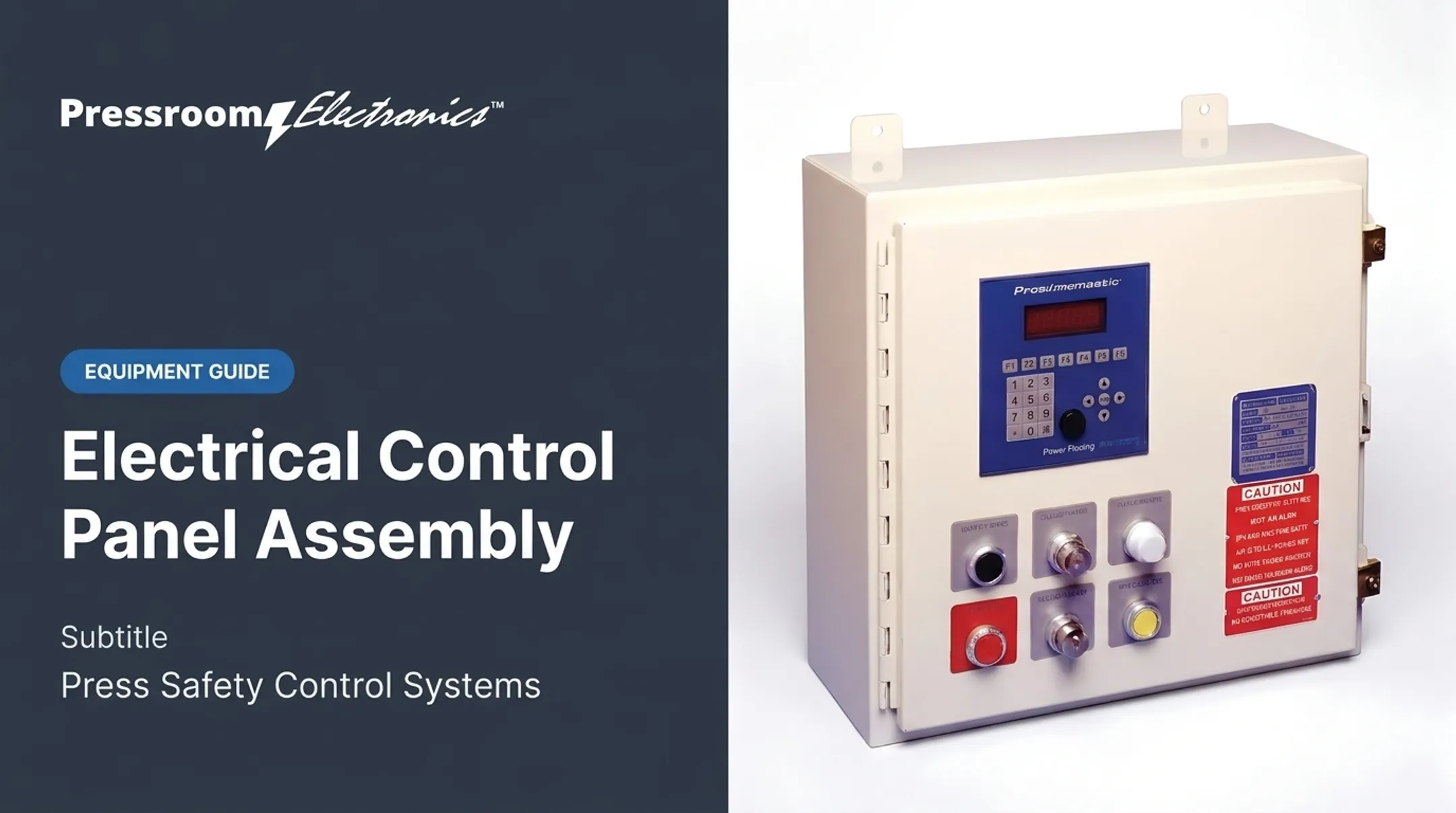
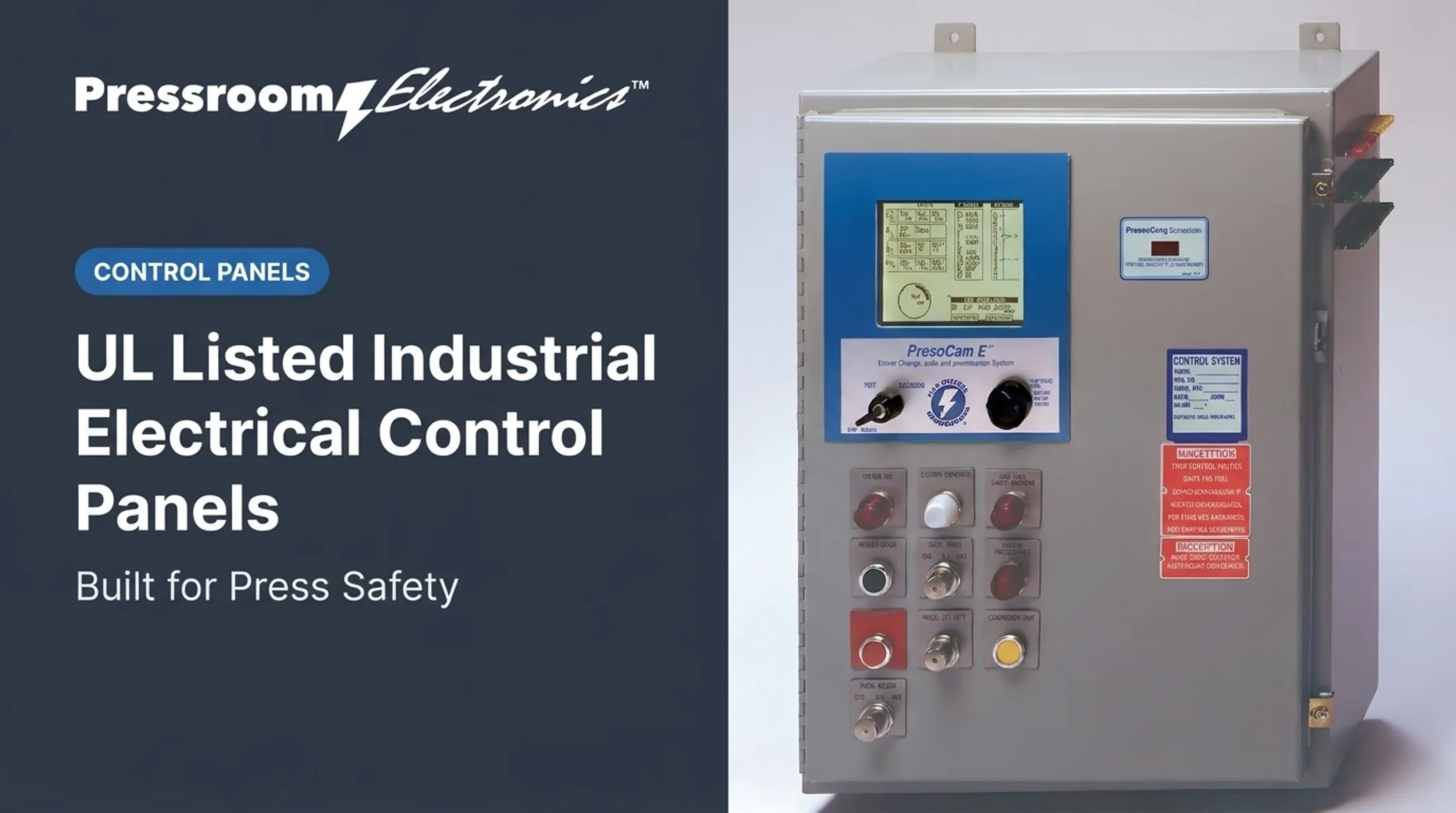
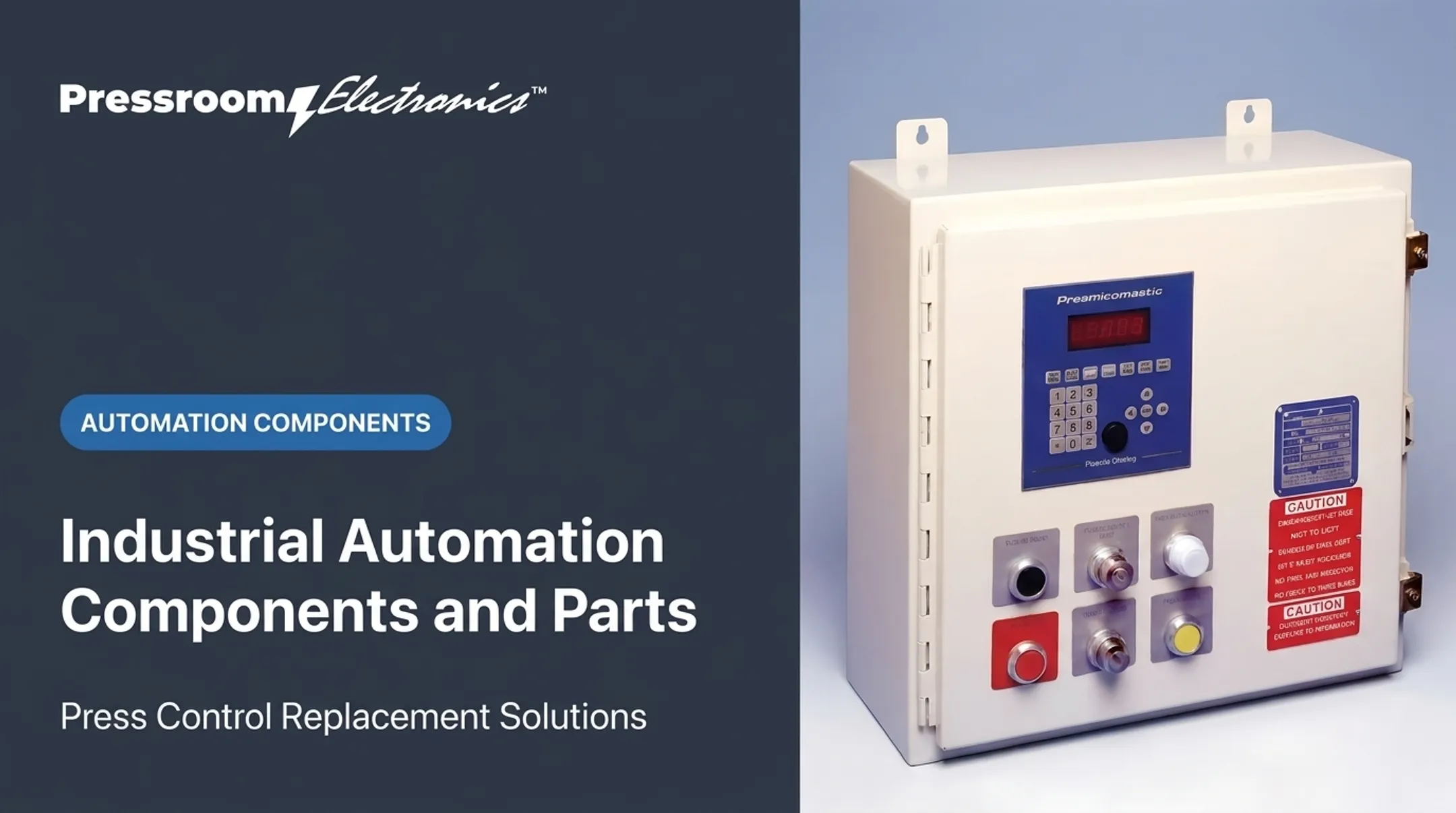
Pressroom Electronics' PressCommander shows how this looks in hardware: dual logic power supplies, two force-guided safety relays, six die-protection inputs, and optional Ethernet. Its PCS-2000 adds a time-based brake monitor, ground-fault detector, and keyed Off-Inch-Single-Continuous selector. Die protection monitors the process and tooling. It is not personnel safeguarding.
Enclosures and Physical Support Components
Purpose and Ratings
The enclosure keeps people away from live parts and shields components from dust, moisture, oil, impact, and heat. Match the rating to the site:
| NEMA Type | Typical protection |
|---|---|
| 1 | Indoor, falling dirt, access to hazardous parts |
| 3R | Rain, sleet, snow (not hose-down) |
| 4 / 4X | Windblown dust, splashing and hose-directed water; 4X adds corrosion resistance |
| 12 | Indoor falling dirt, circulating dust, dripping noncorrosive liquids |
| 13 | Indoor dust, spraying water, oil, noncorrosive coolant |
Hazardous locations need specifically certified enclosures. IP ratings and NEMA Types are not interchangeable, since NEMA also covers corrosion, icing, and construction. Verify the requirement for your installation.
Internal Support Hardware
- Backplate mounts components. Pressroom's Model 3200SS uses a 17 × 18 inch backplate
- DIN rail secures terminals and small devices
- Wire duct organizes conductors
- Grounding provisions bond the panel to ground
- Cable-entry hardware seals penetrations
- Fans, filters, or coolers manage heat
Sizing for Real Life
Don't size the enclosure to the initial bill of materials alone. Allow for component spacing, heat dissipation, wire-bending room, service access, and expansion. Pressroom's PCS-2000-SFP fits a 12 × 14 × 8 inch NEMA 12 box but excludes the transformer, starters, and disconnect. The standard PCS-2000 starts at 20 × 20 × 8 inches and grows with options.

How to Choose and Maintain Electrical Control Panel Components
Selection Checklist
- Voltage and current ratings
- Load type and control voltage
- Short-circuit current rating (SCCR)
- Environmental exposure and heat generation
- Communication needs
- Replacement availability
- Compatibility with the full panel design
Available fault current must not exceed the panel's SCCR. A breaker's interrupting rating alone does not establish assembly SCCR, as Siemens' SCCR whitepaper explains.
Applicable US Requirements
Relevant documents may include the National Electrical Code (local adoption varies), NFPA 79 for industrial machinery, UL 508A for panel construction, and OSHA rules. Editions change, so confirm current requirements with qualified professionals and the authority having jurisdiction.
Maintainability
- Label devices and wires clearly
- Keep schematics current, with an as-built documentation package
- Document settings
- Keep terminals accessible
- Leave spare capacity where appropriate
Inspection and Testing
Typical checks include:
- Visual inspection
- Grounding and protective-bonding continuity
- Point-to-point wiring verification
- PLC I/O verification
- Safety-circuit checks
- Functional testing
Apply lockout/tagout before servicing. Pushbuttons and selector switches are not energy-isolating devices.
On presses, test the entire safety system at the start of every shift. The press should not run if the earth-ground conductor is disconnected.
When a Standard Panel Isn't Enough
Some applications need more than general-purpose parts:
- Press lines with specialized clutch/brake requirements
- Aging mechanical punch presses
- Complex die protection
- Guarding and brake monitoring
- Production-data needs
Pressroom Electronics designs customized press controls with integrated monitoring, safety, and automation, including factory programming and remote field upgrades. Not every project needs the same solution, so a consultation can confirm what fits your press.

Frequently Asked Questions
How do electrical panels work?
A panel receives incoming power, protects and distributes it, and processes control inputs. It then sends commands to machine loads through PLCs, relays, contactors, and drives.
What is a control panel in electrical?
It's an assembly that controls, monitors, and protects a machine or system while distributing power to it.
What are the different types of electrical control panels?
Common types are machine control, motor control, PLC, process control, and safety control panels. A single industrial panel can combine several functions.
What are the essential components of a control panel?
Essential components include the enclosure, disconnect, circuit protection, transformer or power supply, terminal blocks, PLC, relays, contactors, drives, HMI, network gear, wiring infrastructure, and safety devices.
What is a PLC panel?
A PLC panel is a control panel built around a programmable logic controller. It houses I/O modules plus power and communication hardware, and connects to the field devices it monitors.
What is the purpose of an enclosure?
It houses and supports components while protecting people from electrical contact. It also shields devices from dust, moisture, heat, and impact.