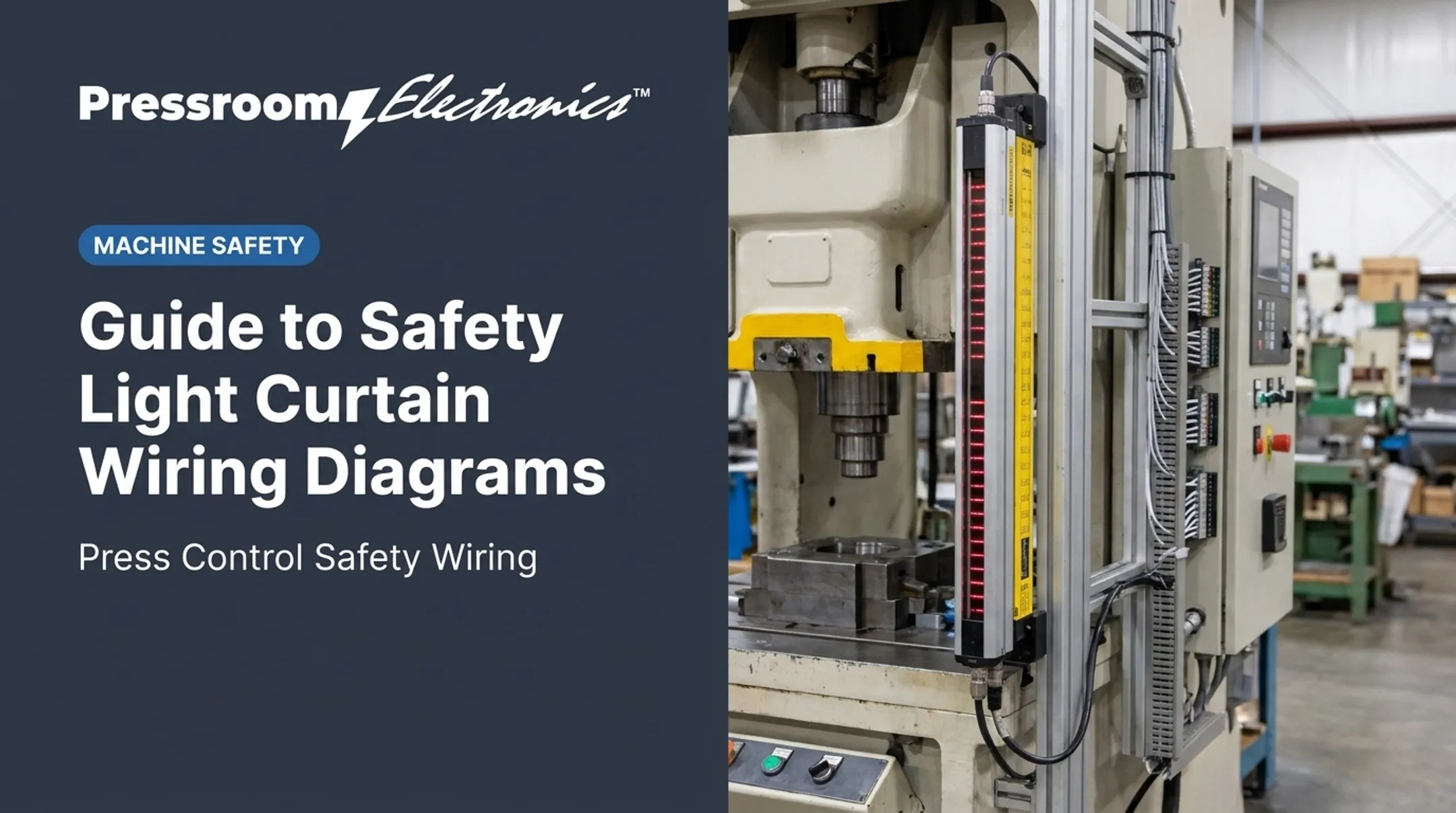
Introduction: Muting Light Curtains and the Safety Function
A light curtain has to stop hazardous motion when a person enters. But a pallet, blank, or finished part also has to cross the same opening without halting production every cycle.
Muting solves that conflict. It is a temporary, automatic, and monitored suspension of a defined safety function under controlled conditions. It is not a manual override, and it is not permission to walk in.
This article covers how muting works, which sensor arrangements exist, what U.S. standards say, how to validate a system, and where muting ends and bypassing begins. It also separates conveyor-style material flow from mechanical power press rules, because OSHA treats them very differently.
Key Takeaways
- Muting is a controlled, automatic suspension of one safety function, never a bypass.
- Independent sensors, sequence checks, and timing separate expected material from a person.
- Risk assessment sets sensor placement, device type, safety distance, and control architecture.
- Validate, document, and revalidate after any change to machine, material, speed, or guarding.
What Is Muting in a Safety Light Curtain?
In normal operation, the light curtain detects an intrusion, sends a signal through safety logic, and the machine stops hazardous motion. Muting suspends only that specified stop function, only under predetermined conditions. The overall guarding design must still keep a person from reaching the hazard during the muted interval.
Muting, Bypassing, and Ordinary Interruption
- Ordinary interruption: the curtain sees something and the machine stops.
- Muting: automatic suspension, triggered by a validated sensor sequence.
- Bypass: manually initiated suspension. Banner's LPM, for example, allows a bypass of up to 5 minutes, but that is product-specific behavior.
Why "Muting Light Curtain" Can Mislead
The curtain rarely mutes itself. The function may rely on external photoelectric sensors, integrated sensors, a safety relay, a safety PLC, or dedicated logic. A general-purpose sensor or standard PLC should never be treated as safety-rated muting control by default.
Why Applications Need Muting
Expected material must cross guarded openings in many places:
- Conveyor and pallet transfer
- Automated loading and unloading
- Packaging lines
- Robotic cells
- Pressroom feed and transfer points
Without muting, every load breaks the field and trips a stop. Muting cuts those nuisance stops, keeps material moving, and improves machine utilization. It does not replace proper guarding around the opening.
Muting Versus Blanking and Non-Muting Operation
Non-muting operation keeps the normal protective response whenever the field is interrupted.
Blanking handles interruptions differently from muting:
- Fixed blanking ignores specified occupied beams, and Banner's devices lock out if the taught object moves or is removed
- Floating blanking accepts moving interruptions and raises the minimum detectable object size
- Muting uses a detection sequence to recognize expected passage and temporarily suspends protection
Terminology varies by manufacturer, and fixed blanking, floating blanking, partial muting, and pattern recognition carry different safety implications. Confirm exact behavior in the device manual.
How the Muting Safety Function Works
Muting briefly suspends the light curtain’s protective field so material can pass, while the safety system still confirms the passage is legitimate.
Typical components include:
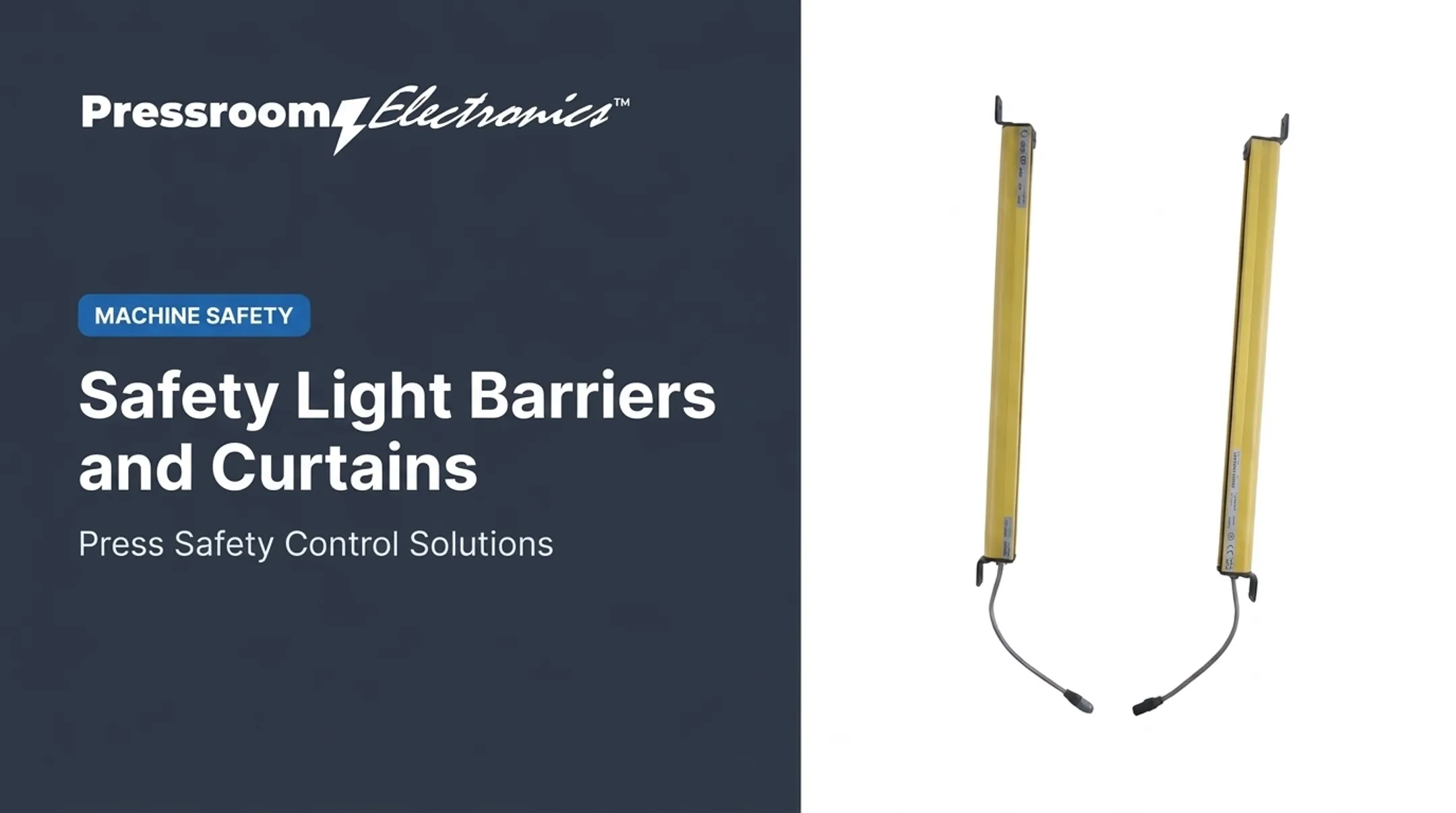
- Safety light curtain or other electrosensitive protective device
- Two or more muting sensors
- Safety-rated logic: relay, safety PLC, or integrated controller
- Machine stop outputs
- Reset controls and status indication
- Auxiliary guarding where needed
Along the material path, a simple layout runs:
- Infeed path
- Muting sensors 1 and 2
- Light curtain line
- Muting sensors 3 and 4 (if used)
- Hazardous area behind the curtain
Pressroom Electronics' #130 Mute-Out shows the architecture at work in a press context. It uses 3 limit switches cross-checked every cycle, two separate Light Guard inputs, two captive-contact outputs, and watchdog timers that drop the output relays if the microprocessor stops responding.
The Typical Muting Sequence
- Normal state. The curtain is active, and no muting request exists.
- First sensor detects. Approaching material trips sensor 1.
- Second sensor confirms. An independent sensor confirms the expected material, direction, or timing.
- Controller evaluates. The safety logic checks the order and timing. A wrong order, missing signal, or invalid timing prevents muting or causes a safe stop.
- Passage. Material crosses the field while muting is active and the opening is arranged to block human access.
- Muting ends. It ends when material clears the sensors, the sequence completes, or a monitored timeout expires. Normal protection returns.

Human–Material Differentiation and Anti-Circumvention
Sensors must be placed so a person cannot easily reproduce the sequence meant for the load. Foreseeable misuse includes:
- Walking alongside, ahead of, or behind a pallet
- Riding on a pallet
- Reaching around the opening
- Using a shiny object to redirect infrared light
Rockwell's GuardShield manual, for instance, specifies sensor spacing above 250 mm in its four-sensor arrangement so a person's leg cannot trigger both at once. That figure is arrangement-specific. Detect the load, not just the pallet.
Countermeasures include:
- Crossed beams
- Partial muting
- Extra sensors
- Mechanical barriers
- Swing doors
A muting lamp helps diagnostics but does not make an arrangement safe. SICK requires a status indication and recommends a visible lamp, though a lamp is not universally required by standards.
Timing, Speed, and Material Dimensions
The muting window depends on maximum material length, transfer speed, sensor spacing, stopping behavior, and a safety margin.
SICK's four-sensor guidance gives these spacing relationships, where v is material speed and L3 is material length:
- L1 ≥ v × 2 × 0.100 s
- L1 < 0.4 m
- L2 − L1 > 0.5 m
- L2 < L3

Consider a load that is too long, too slow, or stalled. It should trigger a timeout, not hold muting open. Rockwell notes that conveyor stoppage can trigger a synchronization or maximum-muting timeout, along with related diagnostics. Default values such as 4 seconds for synchronization and 5 minutes for maximum muting are product settings, not universal limits.
Validate timing on the actual application. Reassess when product size, speed, transfer equipment, or sequencing changes.
Fault Response and Safe Restart
Expect a safe response to:
- Sensor misalignment or blocked sensors
- Broken wiring or power loss
- Invalid sequencing or controller faults
- A load dwelling in the opening too long
Clearing the curtain should not automatically restart hazardous motion unless the risk assessment and control design explicitly allow it. Banner's latch mode, for example, requires clear beams and a manual reset, and initiation stays separate. Rockwell's AT165 documents a key-actuated, time-limited override followed by reset and a separate motor start.
Diagnostics, fault codes, and indicators help maintenance find the cause quickly, which removes the temptation to defeat the system.
Safety Requirements and U.S. Standards
Start with a risk assessment, not a product. Identify hazardous motion, access points, material, human behavior, stopping time, required risk reduction, and which other safeguards remain effective during muting.
Then determine the required performance level or safety integrity target. Confirm that the curtain, controller, outputs, and final switching devices work as a complete safety-related control system.
OSHA Requirements for Light Curtains
29 CFR 1910.212 requires guarding that prevents body access to the danger zone during the operating cycle, and lists electronic safety devices as one method. It is performance-oriented. A light curtain or manufacturer certification does not make a machine compliant on its own.
Mechanical power presses fall under 1910.217 (press brakes and hydraulic/pneumatic presses are excluded by (a)(5)). Key points:
- Presence sensing must stop downstroke motion when the field is occupied.
- It cannot be used on full-revolution-clutch machines.
- A failure must not defeat stopping and must inhibit the next stroke.
- Upstroke muting is permitted for parts ejection, circuit checking, and feeding.
- OSHA's 1998 interpretation states that muting after completion of the upstroke violates (c)(3)(iii)(d).
Review the hazard assessment, guarding, installation, training, inspection, and maintenance with a qualified safety professional.
Applicable Standards
- ANSI B11.19-2019: performance requirements for safeguarding and risk reduction.
- ANSI B11.1-2009 (R2020): mechanical power press requirements.
- IEC 61496-1/-2:2020: design and testing of electrosensitive protective equipment and light curtains.
- ISO 13849-1:2023 and -2:2012: control-system design and validation.
- IEC 62061:2021+AMD1:2024+AMD2:2026: machinery control-system design.
- IEC 62046:2026: selection, positioning, configuration, commissioning, and updated muting requirements.
- ISO 13855:2024: safeguard positioning.
These are not interchangeable, and compliance with one does not prove the whole machine is safe. A machine-specific C-type standard may add requirements.
Minimum Safety Distance and Stopping Performance
The curtain must sit far enough away that the machine finishes stopping before a person reaches the hazard.
- OSHA press formula: Ds = 63 in/s × Ts, with Ts measured at about 90 degrees of crankshaft rotation.
- Banner's formula: Ds = K × (Ts + Tr) + Dpf, with Dpf = 3.4 × (S − 7) in mm.
- ISO 13855:2024: S = (K × T) + D_DS + Z, with K of 2000 mm/s for upper limbs or 1600 mm/s for walking.

Also prevent reaching over, under, around, or through the field. On stamping equipment, use measured brake and clutch stopping performance, not a nominal value.
Validation, Records, and Change Management
Test at minimum:
- Normal flow and empty opening
- Wrong-direction travel and irregular loads
- Stalled loads and timeout
- Sensor failure and power loss
- Curtain interruption during muting
- Unexpected restart
- Access attempts around or behind the load
Keep the risk assessment, drawings, safety calculations, configuration files, test results, maintenance instructions, training records, and change history. A universal retention period under ANSI B11.19 is unclear, so set one with your safety professional.
Banner's manual calls for daily checkouts and checks every six months, plus commissioning checks after changes. Repeat validation after changes to the curtain, sensors, controls, tooling, material, speed, stopping performance, or guarding.
Muting Configurations and Light Curtain Selection
| Arrangement | Use |
|---|---|
| Two-sensor crossed (X) | Entry and exit, either sensor first |
| Two-sensor sequential (L) | Exit only |
| Four-sensor parallel (T) | Entry and exit, bidirectional |
Selection depends on several layout factors:
- Material size and shape
- Travel direction and conveyor geometry
- Access paths, sensor visibility, and speed
- How well the layout resists a person reproducing the mute sequence
Sketch the application before you buy: sensor heights, spacing, beam geometry, material path, opening, and hazard.
Type, Resolution, and Functionality
Type 2 and Type 4 are IEC 61496 device classes. Type 4 has more demanding fault detection. SICK's deTec lists Type 2 at PL c/SIL 1 and Type 4 at PL e/SIL 3, but that is not an automatic rating for the complete system. The choice follows the risk assessment.
Type is not the same as PL or SIL. Category 2 and 4 are control categories, not ESPE types.
Resolution must fit the body part protected. SICK lists 14 mm for fingers and 30 mm for hands. Account for reach-over and reach-through when you set the mounting height and protected field.
Integrated Muting, External Sensors, and Alternatives
- Integrated muting (such as Banner's LPM) is compact, but sensor synchronization requirements still apply.
- External sensors with a relay or safety PLC (Rockwell AT165, AT190) give more layout flexibility and need application-specific validation.
- Partial or dynamic muting (such as Omron F3SG-RA) can suppress the full zone, then a partial zone sized to the workpiece. Document and validate these modes separately.
The simplest architecture is not necessarily the safest. Choose the one that meets protection goals and resists foreseeable misuse.
Implementing, Validating, and Maintaining a Muting System
Installation checklist:
- Curtain alignment and stable, impact-protected mounting
- Sensor positioning and reflection control
- Wiring and environmental conditions
- Safety controller configuration
- Reset location outside the hazard, with visible diagnostics
Routine maintenance:
- Clean lenses
- Check alignment and mounting
- Inspect cables and connectors
- Verify sequence and timing
- Test safety outputs
- Document faults instead of defeating the system
The same discipline applies to software settings. Muting parameters should never change casually. Any configuration change should trigger a documented review of the risk assessment and validation.
Applying Muting to Metal Stamping and Pressroom Safety Systems
Press projects must coordinate muting with clutch/brake controls, brake monitoring, die protection, guarding, material handling, and restart logic.
OSHA's upstroke allowance covers feeding and ejection, not unrestricted material-triggered muting. Where required, each-stroke brake monitoring inhibits the next stroke when deterioration invalidates the safety distance.
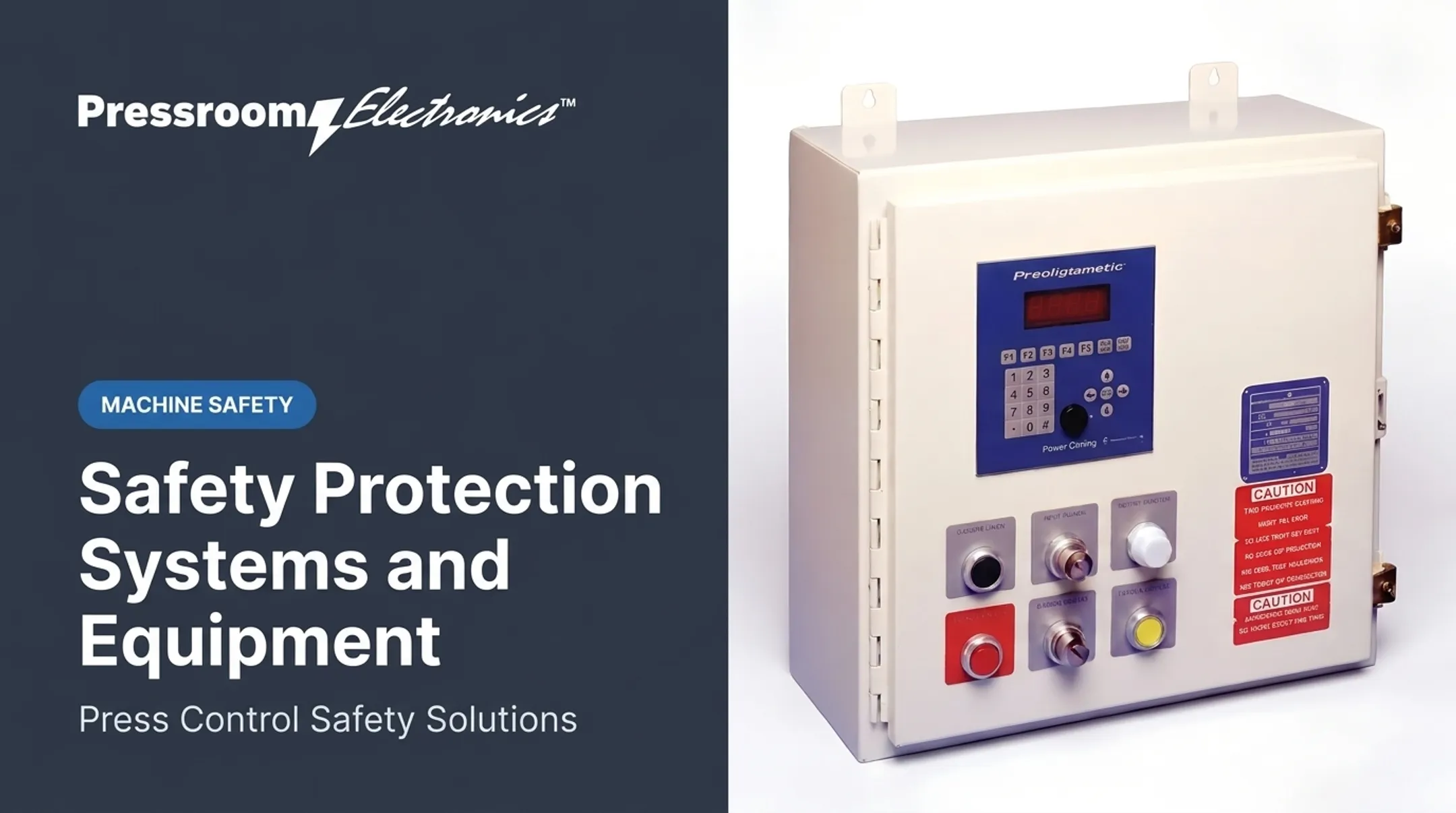
Pressroom Electronics designs and manufactures press controls, brake monitors, die protection, and guarding in the USA, including mute-out packages. Confirm product documentation before assuming any specific unit supports a particular muting function.

A practical path:
- Define the material-flow case.
- Document hazards and measured stopping performance.
- Select a safety-rated architecture.
- Have qualified personnel review and validate the installation.
Frequently Asked Questions
What is the purpose of a light curtain?
It detects a person or object entering a protected area and sends a safety signal to start a machine response, such as stopping. That works only with correct selection, placement, integration, and validation.
What are the OSHA standards for light curtains?
General machine guarding falls under 29 CFR 1910.212, and mechanical power presses under 1910.217. Exact requirements depend on the machine, hazard, installation, and current interpretation.
What is the difference between type 2 and type 4 light curtain?
They are device performance classes under IEC 61496, with Type 4 used for more demanding risks. Choose by risk assessment, and don't confuse type with PL or SIL.
What is blanking on a light curtain?
Blanking ignores specified beams under defined conditions. Muting temporarily suspends protection to pass controlled material. Confirm exact behavior in the device manual.
What is a muting sensor?
It detects expected material and feeds safety-rated muting logic. One sensor alone may not discriminate adequately, so placement, sequencing, timing, and anti-circumvention measures depend on the application.