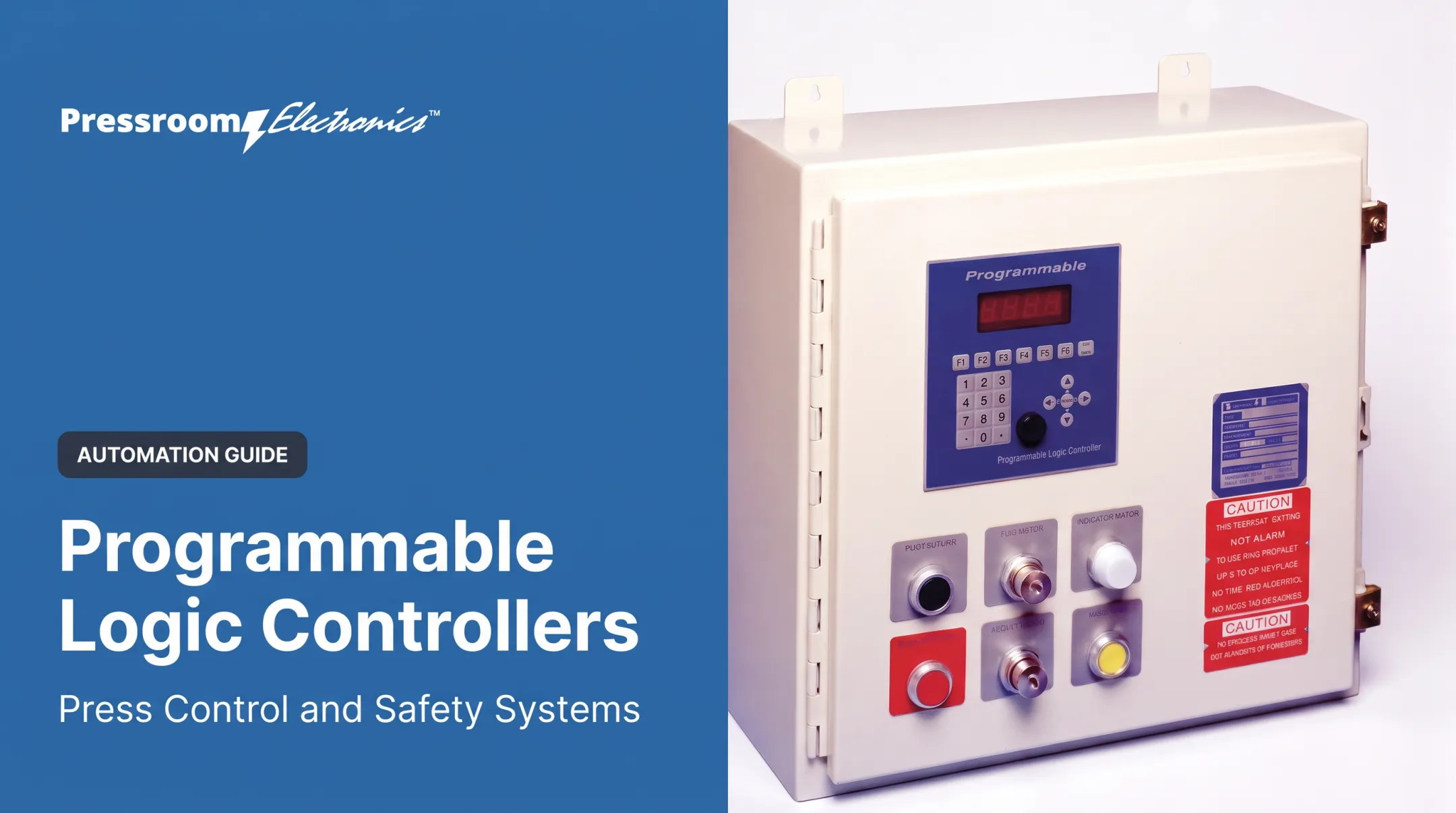
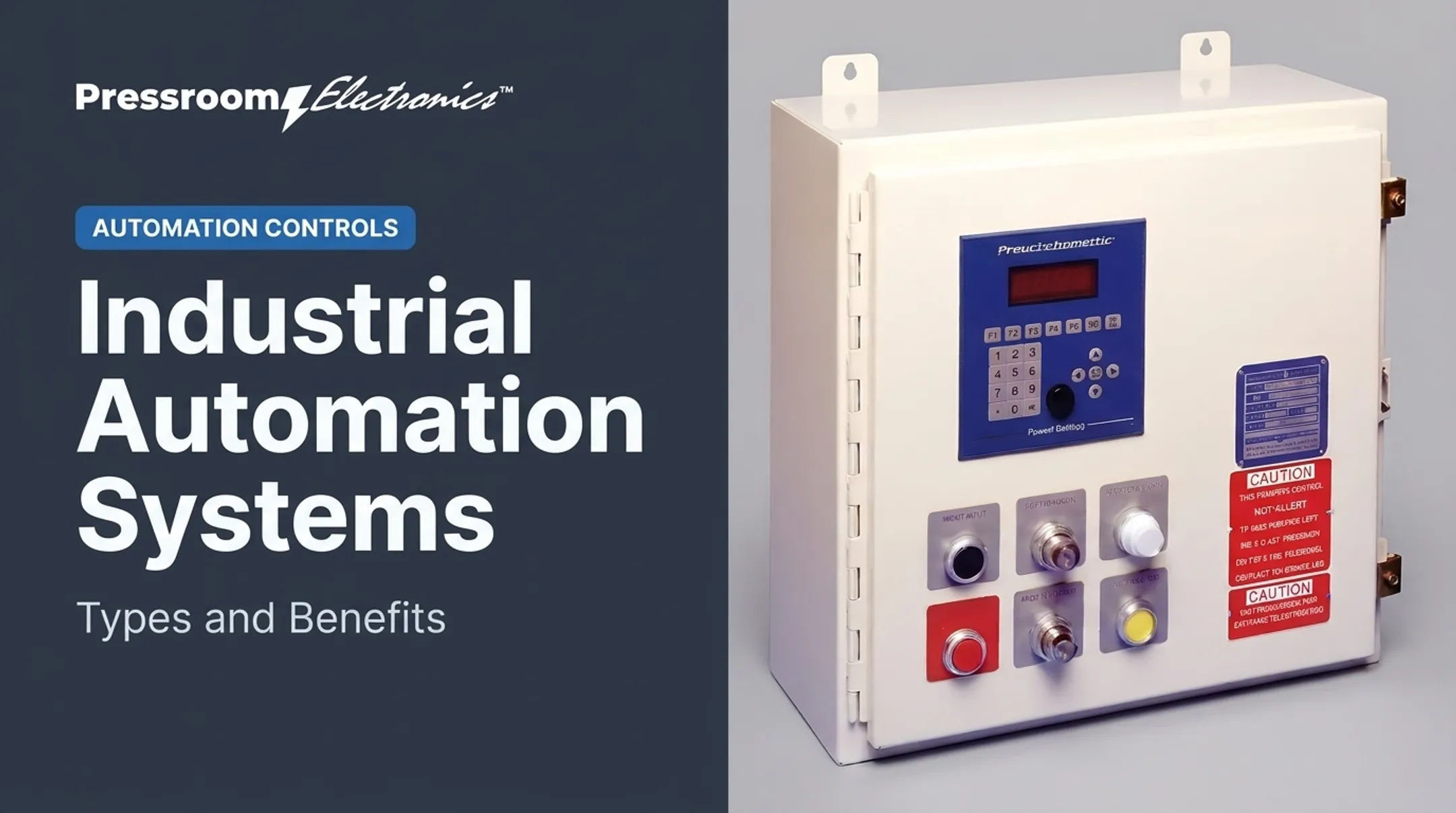
An industrial process control system does that job. It uses connected hardware and software to measure operating conditions, compare them with target setpoints, and adjust equipment automatically or under operator oversight.
This guide covers system types, control loops, core components, applications, and how to evaluate and modernize a system in a U.S. plant.
Key Takeaways
- Process control holds a desired condition steady despite disturbances and changing demand.
- Sensors, controllers, HMIs, networks, and final control elements all have to work together.
- PLCs, DCS, SCADA, and PC-based systems play different roles; pick by process, scale, and legacy equipment.
- Instrumentation, alarms, cybersecurity, training, and usable data matter as much as the controller.
What Are Industrial Process Control Systems and How Do They Work?
NIST's OT security guide describes an industrial control system as components acting together to achieve an objective, such as manufacturing or transporting matter or energy. Process control keeps outputs within a desired range by manipulating inputs.
A timer or relay sequence runs steps blindly. Process control measures actual conditions and adjusts based on feedback.
The basic control loop
- A sensor measures the controlled variable.
- A transmitter sends the signal, often standardized 4-20 mA.
- The controller compares it with the setpoint.
- The controller calculates a correction and sends a command.
- A final control element (valve, motor, actuator, clutch, or brake) changes the process.

Typical loops look like these in practice:
- A heater adjusts temperature
- A valve holds pressure in range
- A pump meters flow
- On a mechanical press, a clutch/brake control manages slide motion using shaft-position feedback
What process control is not
- Automation executes tasks; process control adds feedback correction.
- Statistical process control analyzes variation using control charts. It monitors; it doesn't close a physical loop.
- MES and production monitoring put machine data in context across shifts, machines, and orders.
Reactive and predictive control
PID feedback reacts to measured error. Model predictive control uses a process model, constraints, and expected future behavior to act before error grows.
Main Types of Industrial Process Control Systems
Industrial process control systems are grouped two ways: by production process (discrete, continuous, batch) or by architecture and strategy. Both views help when you specify equipment.
Discrete, Continuous, and Batch Processes
- Discrete: individual parts and machines such as automotive assembly, appliance lines, metal stamping, packaging, conveyors, and robots
- Continuous: uninterrupted flows such as chemical reactions, refining, water treatment, and power generation
- Batch: recipe-driven production where materials, steps, timing, and conditions are controlled and recorded per batch
NIST cites automobile assembly as a PLC-controlled discrete example. ISA-88 supplies the models and terminology for batch work.
Control System Architectures
| Architecture | Typical role |
|---|---|
| PLC | Local machine and sequence control |
| PAC | Flexible control blending PLC, PC, and motion capabilities |
| DCS | Plant-wide coordination of localized controllers at one site |
| SCADA | Supervision and data gathering over distributed or long-distance assets |
| Industrial PC | Real-time control, computation, or visualization on PC platforms |
SCADA mainly supervises. PLCs and DCS controllers execute logic. They often run together rather than compete.
Control Strategies and When to Use Them
Open-loop control issues commands without checking results. Closed-loop control measures and corrects, so it is preferred wherever disturbances exist.
- Feedback: corrects after error appears, like holding tank temperature.
- Feedforward: measures a disturbance first, like adjusting heat when inlet flow changes.
- Cascade: one controller's output sets another's setpoint, like temperature controlling a steam-flow loop.
- Ratio: holds variables in fixed proportion, like blending two ingredients.
PID in plain terms: proportional responds to present error, integral clears accumulated error and offset, derivative reacts to rate of change (and can amplify noise). Tuning is always system-specific.
Advanced methods such as model predictive control need reliable models, good data, adequate computing, and qualified engineers. Rockwell's Fluorsid case reports more than a 50% cut in raw-material losses, a site-specific result rather than a promise.
System Selection Perspective
Match the system to these factors:
- Process type and number of loops
- Required response time
- Safety requirements
- Geographic distribution
- Data needs and expansion plans
- Workforce skills
- Compatibility with legacy equipment
Core Components of an Industrial Process Control System
Control is a chain from measurement to decision to action. A weak link, such as a drifting sensor or a sticky valve, limits accuracy no matter how good the controller is.
Sensors, Transmitters, and Instrumentation
Sensors detect temperature, pressure, level, flow, position, speed, force, vibration, or composition. Transmitters convert readings into standard analog or digital signals. HART, for example, layers digital communication over a 4-20 mA signal.
Selection factors:
- Measurement range and accuracy
- Response time
- Environmental exposure
- Process compatibility
- Calibration needs
- Installation location and maintenance access
Controllers, I/O, and Control Logic
PLCs, DCSs, PACs, and industrial PCs read inputs through I/O modules, run logic or algorithms, enforce interlocks, and command field devices.
Plain-language terms:
- Setpoint: the target value
- Permissive: a condition that must be true before something starts
- Interlock: a condition that blocks or stops an action, such as a guard door open
- Emergency state: the defined safe condition after a trip
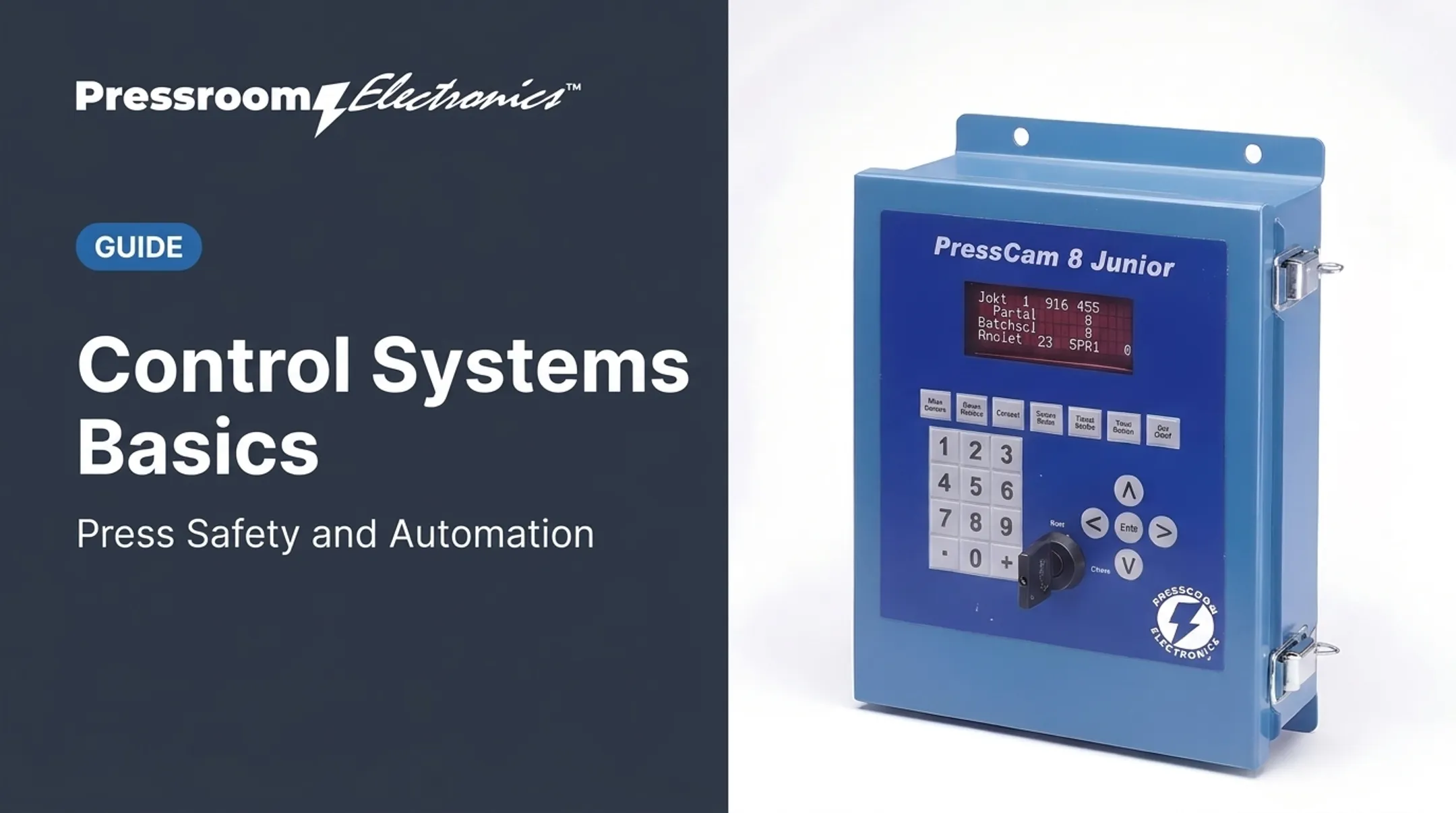
On a press, a resolver gives absolute shaft position. Pressroom Electronics' PressCam 8 monitors that position, runs programmable limit switch outputs, and cross-checks the resolver with two 16-bit computers.
Final Control Elements
Valves, pumps, motors, variable-frequency drives, heaters, dampers, robotic devices, and clutch/brake assemblies physically change the process. Sizing, response time, wear, mechanical condition, and fail-safe behavior decide whether a command produces the intended result. Confirm fail-safe positions against the specific device and application.
HMI, SCADA, Alarms, and Operator Interaction
HMIs and SCADA platforms show real-time values, trends, alarms, equipment states, and setpoints, and let operators act.
Alarms need discipline. One ISA-hosted alarm benchmark presentation cites roughly 6-12 alarms per hour per operator and under 1% of time in flood as workload targets, not legal limits. Good practice includes:
- Prioritize alarms by consequence
- Require acknowledgement and define escalation
- Keep event history
- Write operator response procedures
Industrial Networks, Data, and Integration
Protocols such as EtherNet/IP, PROFINET, OPC UA, and Modbus link field devices, controllers, HMIs, historians, MES, and enterprise systems. They are distinct technologies, not interchangeable names.
Time-stamped, contextual data supports troubleshooting, traceability, maintenance, and root-cause work. Shared time sources let teams correlate events across devices.
Cybersecurity basics, per NIST and CISA guidance:
- Separate corporate and OT networks, using a DMZ
- Apply least-privilege access
- Test backups
- Control configuration changes
- Remove public-internet exposure; protect necessary remote access with VPN and phishing-resistant MFA
Benefits and Industrial Applications of Process Control Systems
Effective process control delivers:
- Process stability and consistent quality
- Less rework and better throughput
- Fewer unplanned stops and safer operation
- Energy awareness and better decisions
Published cases show the range, though none are guarantees. Bentley Mills reported 15.2% lower energy intensity and $53,000/year savings after boiler-control upgrades. Siemens reported over 50% less downtime at Century Aluminum after a drives retrofit.

Results depend on measurement quality, tuning, maintenance, operator response, and data interpretation. Automation alone doesn't deliver them.
Industrial Applications
- Automotive: PLC control of discrete assembly
- Appliance: automated foaming lines for refrigerator cabinets
- Metal stamping: monitoring such as double-sheet detection
- Food and beverage: dryer stabilization with model predictive control
- Chemical: advanced control to reduce raw-material loss and variability
- Water treatment: flow, quantity, and pressure
- Power generation: hydropower flow and pressure, with DCS coordinating output to demand
Example: Press Control in Metal Stamping
Pressroom Electronics applies these principles to mechanical and pneumatic/hydraulic presses. Its portfolio includes:
- Resolver- and rotary-cam-based clutch/brake controls
- Brake monitoring, die protection, and guarding
- Tonnage monitoring and production monitoring
The LT-1900 measures stopping time in milliseconds and warns when it exceeds the setpoint. OSHA's press rule requires point-of-operation safeguarding, so production control and safeguarding must be treated separately.
Its Production & Downtime Monitoring System adds programmable reason codes and custom reporting. Teams can investigate downtime causes, allocate resources, track machine utilization, and tie machine events to plant goals.
How to Evaluate, Implement, and Modernize an Industrial Process Control System
Start with an audit and measurable goals
Audit the plant against a clear checklist, and keep an accurate asset inventory:
- Unstable process variables and recurring quality problems
- Manual interventions and safety risks
- Downtime patterns and obsolete parts
- Instrumentation gaps and integration needs
Then set measurable objectives against a baseline, such as fewer nuisance alarms, faster recovery, better traceability, or higher machine utilization.

Implementation beyond hardware
- Validate instrumentation so sensors and transmitters match field conditions
- Document control narratives and I/O before any logic changes
- Tune loops (oscillation isn't always a tuning problem; check valves and disturbances too)
- Test interlocks and alarm behavior, including factory and site acceptance testing
- Write standard operating procedures for normal and fault conditions
- Train operators and maintenance staff on the new sequences
- Assign change-management ownership so updates stay controlled
Modernization options
| Approach | Tradeoff |
|---|---|
| Phased retrofit | Lower risk and downtime; slower |
| Gateway or edge integration | Keeps legacy controllers; adds a dependency |
| Controller replacement | Better maintainability; needs rewiring and testing |
| Partial machine upgrade | Targets weak points; leaves others aging |
| Full replacement | Most expandable; highest cost and downtime |
Safety and cybersecurity from day one
Build these controls in from the start:
- Safeguarding and emergency stops
- Access control and network segmentation
- Backups, patching procedures, and secure remote support
Mechanical presses fall under OSHA 1910.217 and ANSI B11.1; lockout/tagout under 1910.147 applies during servicing. A control upgrade doesn't by itself establish compliance, so verify current requirements with qualified professionals.
Pressroom Electronics offers factory programming and remote field upgrades, with custom functions delivered through encrypted files via onboard USB. That is one path for press modernization. No single upgrade path fits every plant.
Conclusion: Building a More Stable and Visible Industrial Operation
Industrial process control combines measurement, logic, communication, actuation, and human oversight to keep production in range.
Start with the process problem and the outcome you want. Then choose the architecture, instrumentation, strategy, safety provisions, and integration approach that fit your equipment and people.
Frequently Asked Questions
What are the three main types of process control systems?
Discrete, continuous, and batch are the common process-based categories. PLC, DCS, and SCADA are architecture labels, not the same three types.
What is the difference between PCs and DCS?
Here "PCs" means PC-based industrial control, a computing and runtime approach, such as multiple real-time runtimes on one PC. A DCS is a distributed architecture with localized controllers under supervisory coordination. Redundancy and scalability depend on the specific design, not the label.
What is PLC in instrumentation?
A programmable logic controller receives signals from instruments, runs programmed logic or control functions, and sends commands to actuators and other equipment.
What is SPC in Six Sigma?
Statistical process control uses control charts to separate common-cause from special-cause variation. It analyzes data over time and doesn't automatically adjust equipment like a real-time control loop.
What is industrial process control?
It is the measurement and automatic or supervised adjustment of process variables to maintain safety, quality, consistency, and productivity within defined limits.