Introduction
A punch press stops mid-shift. Nobody notices for twenty minutes. By then the line behind it is starved, a die may be damaged, and maintenance is hunting for a cause nobody recorded.
Unplanned stops hurt everywhere. Siemens' 2024 downtime study put the cost at $2.3 million per hour in large automotive plants. A single press costs less, but the pattern holds.
Remote machine monitoring gives authorized teams timely visibility into press status, alarms, utilization, and operating conditions from outside the production area. This article covers the benefits, the risks of going without it, and how stamping plants and machine builders can implement it well.
Key Takeaways
- Monitoring turns press data into timely decisions for production, maintenance, and service.
- Reason codes show why a press stopped, not just that it stopped.
- Gains include faster troubleshooting, better utilization, and condition-based maintenance.
- Success needs compatible signals, secure access, clear ownership, and alert workflows.
What Is Remote Machine Monitoring?
Remote machine monitoring is the collection, transmission, visualization, and analysis of machine data from a location away from the equipment. It can draw on press controls, sensors, gateways, industrial networks, or cloud dashboards.
What Gets Monitored on a Stamping Press
Typical data includes:
- Run, idle, stopped, and alarm states
- Stroke, cycle, and production counts
- Downtime duration and programmable reason codes
- Press speed
- Brake and clutch signals, where the equipment supports them
- Die-protection events
Minitab's machine monitoring guide notes that a stop signal alone may not say whether the press was waiting for material or held for a quality decision. Operator input supplies that context.
Monitoring Is Not Remote Control
Monitoring provides visibility, alerts, records, and analysis. It does not replace safety-critical control. Guarding, control reliability, and energy isolation remain governed by approved control logic, permissions, lockout/tagout procedures, and the applicable OSHA (1910.217, 1910.147) and ANSI B11.1 requirements. Pushbuttons and selector switches are not energy-isolating devices.
The Basic Data Flow
- A press control or sensor produces a signal.
- A controller or optional gateway collects it.
- A secure network carries it to a dashboard.
- An alert reaches the responsible person.
- A defined response follows and gets recorded.

A gateway isn't always required. Some PLCs can publish data directly, so architecture varies by equipment.
Key Advantages of Remote Machine Monitoring
Real-Time Visibility
Picture a multi-press line where press four slows from a steady rate to a crawl at 10:15. With monitoring, the supervisor sees the slow cycle within minutes. Without it, the problem surfaces in an end-of-shift report.
Reason Codes That Explain Downtime
Reason codes separate material shortages, die changes, setup delays, tooling problems, safety stops, quality holds, and equipment faults. Definitions must be consistent across shifts, or the reports mislead.
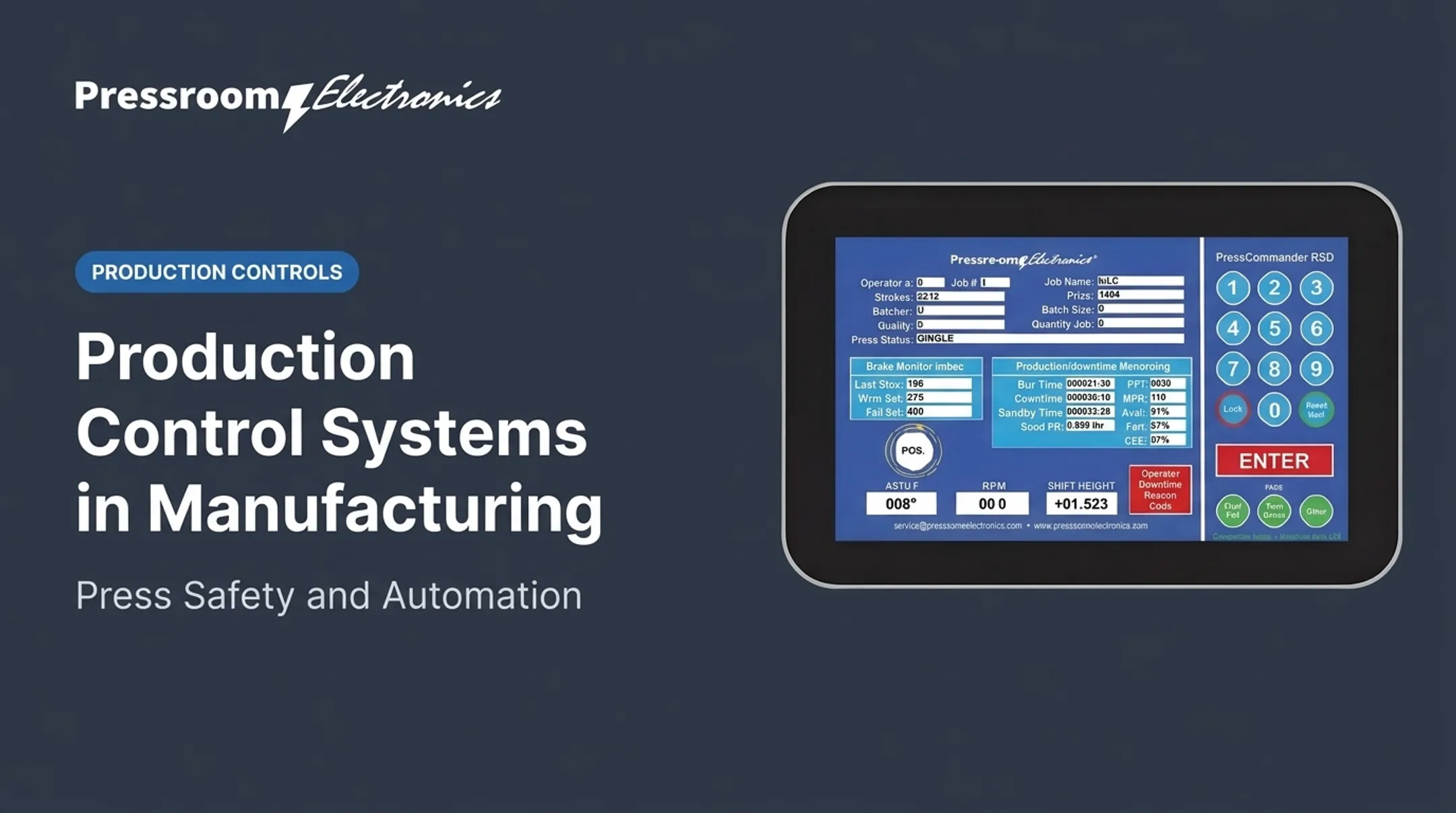
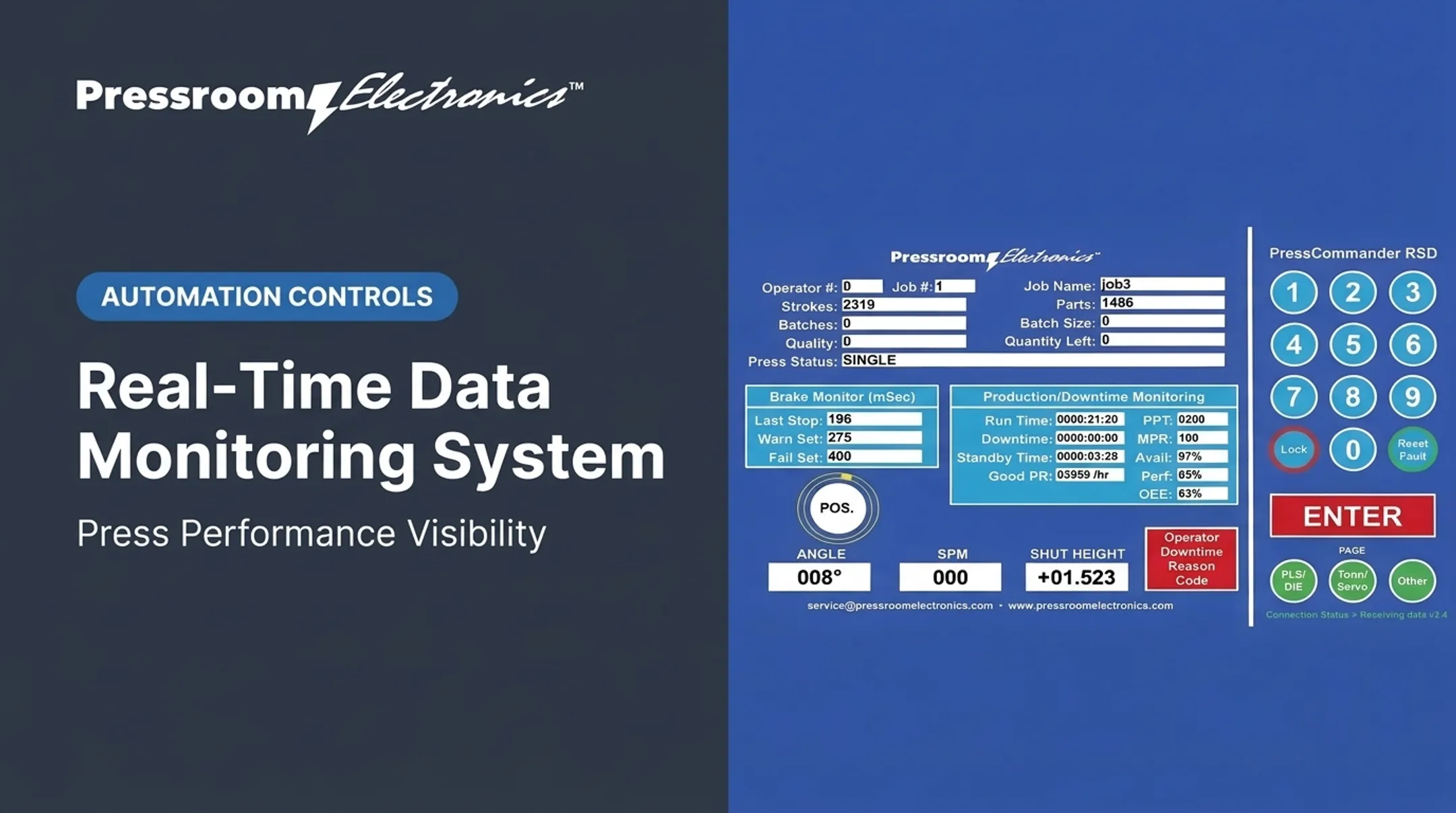
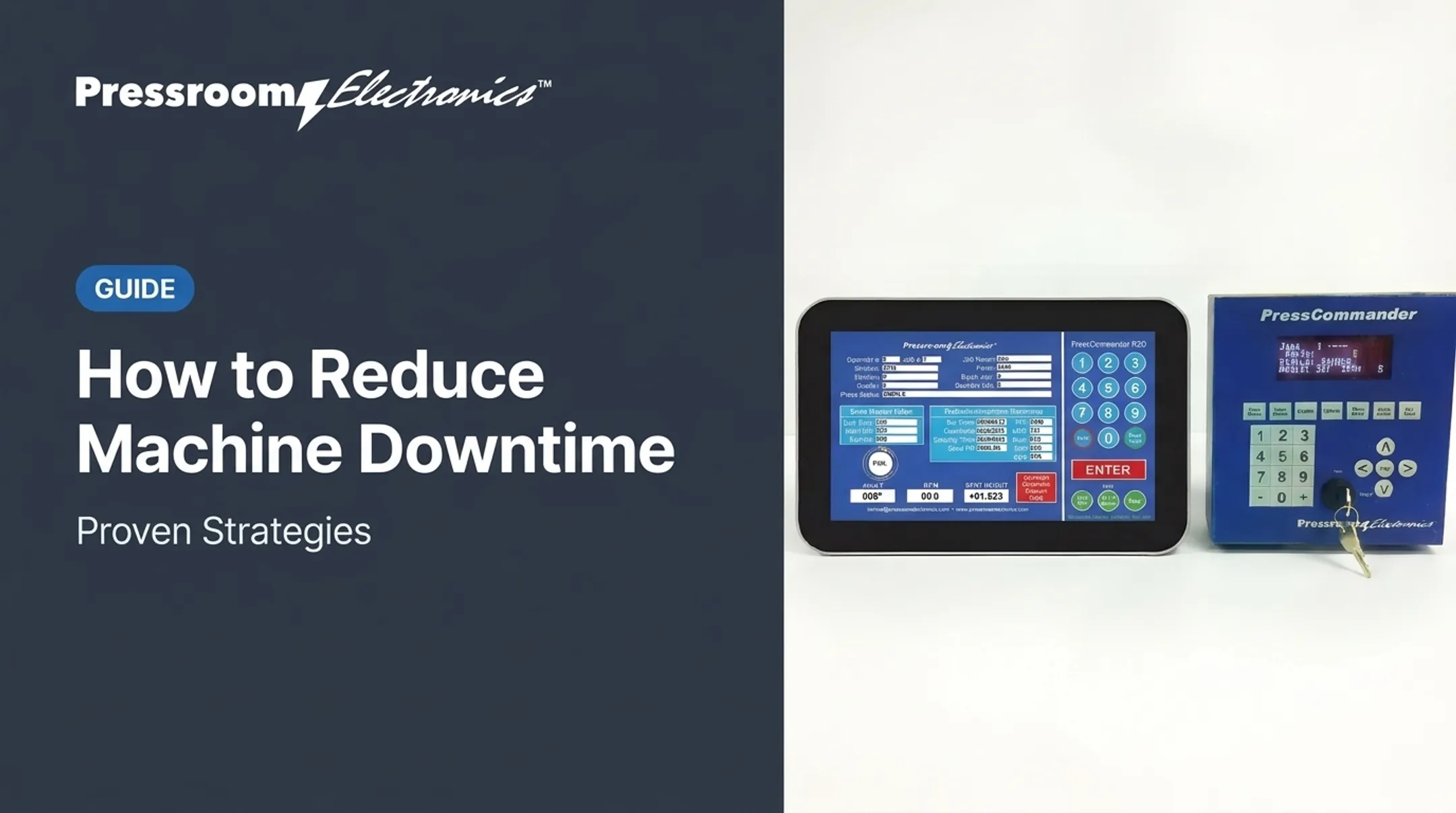
Pressroom Electronics' PressCommander production monitoring, for example, supports 20 user-programmable downtime codes. Operators activate them from the touchscreen, or machine-circuit signals trigger them automatically. A Brake Fault or Die Fault counts as downtime without anyone typing a thing.
Productivity and Resource Allocation
With shared data, managers can:
- Compare utilization across presses and shifts
- Send maintenance to the highest-impact problem first
- Spot recurring bottlenecks without relying on floor walks or operator memory
- Track OEE (availability × performance × quality)
Maintenance That Gets Ahead of Failures
The terms get mixed up, so here are IBM's distinctions:
- Preventive: scheduled, time-based inspection and replacement.
- Condition-based: sensors indicate when maintenance is needed.
- Predictive: condition data is analyzed to forecast likely failure.
A threshold alarm alone is not a forecast. NIST's maintenance survey found that half of the respondents who spent less on reactive maintenance had 52.7% less unplanned downtime. That's an association, not proof that monitoring alone caused it.
An ifm case shows the practical side. An alert flagged an abnormally hot linkage on a stamping press, and onsite inspection found an off-center die overloading a bushing. Monitoring found the problem; people still fixed it.
Value for OEMs, Rebuilders, and Service Contractors
Field data supports faster diagnostics, warranty documentation, service planning, and, where equipment and permissions allow, remote field upgrades. Not every fault can be diagnosed or repaired remotely, and no one should promise otherwise.
What Happens When Remote Machine Monitoring Is Missing
Without monitoring, information arrives late and incomplete:
- Downtime is discovered after the fact
- Causes stay unclear, so the same faults repeat
- Dispatching is inefficient
- Machines and shifts are hard to compare
Manual logs make this worse. When operators log inconsistently, equipment failure blurs into setup time, die changes, material delays, safety stops, and quality holds.
Improvement efforts then chase the wrong problem. Minitab notes that repeated short stops and slow cycles are far less visible than major breakdowns.
Over time, plants face reactive maintenance, missed production, and avoidable service travel. Machine builders end up with weak warranty evidence and designs based on assumptions rather than field data.
Downtime is expensive, though the numbers need context. An ABB survey of 3,215 maintenance professionals put median industrial downtime at about $125,000 per hour, with a metals-sector median near $71,000.

These figures measure downtime exposure across industries. They don't isolate what missing monitoring costs a stamping press.
How to Get the Most Value from Remote Machine Monitoring
Start With One Question and One Press
Pick a defined goal: recurring downtime, utilization, service response, or validating die-protection and brake-monitoring events. Choose a representative press or line and record baseline numbers before expanding.
Audit Compatibility and Data Quality
Before buying anything, identify:
- Controller outputs and available machine states
- Sensors needed for counts, quality, and job context
- Network requirements
- Legacy-equipment limits
- Where reason-code context must come from
Build Security and Governance In
CISA's OT guidance calls for removing assets from public internet exposure where possible, phishing-resistant multifactor authentication, least privilege, and IT/OT segmentation. NIST SP 800-82 adds encryption for data in transit and warns that remote access must not undermine safety controls. Define:
- User roles and authentication
- Data ownership
- Permitted remote access
- What happens when connectivity drops
- Who owns updates and incident response
Turn Alerts Into Owned Workflows
An alert nobody owns is noise. For each one, define who receives it, what triggers it, how it's acknowledged, when it escalates, and what evidence gets recorded for maintenance history and root-cause analysis.

Where Pressroom Electronics Fits
Stamping plants, press rebuilders, and OEMs evaluating monitoring can consult Pressroom Electronics about customized press controls, brake monitoring, die protection, guarding, production monitoring, and remote field upgrades. These are separate product categories, and not all of them perform the same monitoring function. The company also offers on-site consultants for implementation, including shop-floor coaching and daily review meetings.
Measure the Results
Compare baseline against post-deployment results using:
- Unplanned downtime
- Mean time to repair (MTTR)
- Utilization and response time
- Recurring alarm frequency
- Maintenance cost
- Scrap tied to equipment events
Be careful with benchmarks. A MachineMetrics case reported 17% higher availability at a printing company, but it came from monitoring plus maintenance execution, not monitoring alone. Use outside figures as context, and trust your own baseline.
Conclusion
Remote monitoring is valuable because it gives teams time and evidence to act before a small interruption becomes a larger production or service problem. It doesn't repair presses or deliver material, but it shows where to send people.
Evaluate it around your actual press signals, safety requirements, maintenance workflows, and business goals. Contact Pressroom Electronics to discuss customized press-control and production-monitoring requirements.
Frequently Asked Questions
What is a remote monitoring system?
It combines machine signals, sensors or controllers, connectivity, dashboards, alerts, and authorized users to observe equipment from another location.
How does remote machine monitoring work?
Press controls or sensors send signals through a gateway or network to a monitoring platform. A dashboard displays them, alerts fire, and maintenance or production responds.
What can be monitored on a stamping press?
Machine state, cycle and production counts, alarms, downtime reasons, die-protection events, and brake or clutch signals where supported. Validate each data point before relying on it.
What is the difference between remote machine monitoring and predictive maintenance?
Monitoring collects and displays machine data. Predictive maintenance analyzes that data to forecast when intervention may be needed.
How can manufacturers implement remote machine monitoring securely?
Use access controls, network segmentation, encryption, and defined permissions. Assign data ownership and vendor responsibilities, plan for connectivity loss, and keep monitoring separate from safety-critical control.