Introduction
Most pressrooms find out about a problem after it has already cost them. A brake drifts out of limits, a punch breaks, or a press sits idle for an hour with nobody sure why. By the time someone checks, the shift is half gone.
Unplanned downtime in U.S. manufacturing is estimated at $18.1 billion annually, according to NIST. Remote monitoring moves press and production data out from behind the machine guard and puts it in front of the people who can act.
This article covers how monitoring and control systems work, and how they differ from condition monitoring and remote access. It also explains what they mean for uptime, safety, and maintenance in U.S. stamping operations.
Key Takeaways
- A remote monitoring system combines press data, sensors, connectivity, dashboards, and alerts for authorized remote viewing.
- Monitoring reports status; remote control adds commands and demands tighter security and safety procedures.
- Reason codes and utilization data move teams from firefighting to root-cause analysis.
- The best system fits your existing presses, supports safe operation, and gives data people can act on.
What Is a Remote Monitoring System and Control?
A remote monitoring system is hardware and software that collects operating and production data, sends it to an authorized interface, and presents it for analysis and alerts. Where designed and permitted, it also allows remote intervention.
System Layers
- Machine level: press controls, sensors, brake monitors, die-protection inputs, guarding, and production counters
- Connectivity and edge: components that collect, filter, store, and transmit pressroom data
- Software: dashboards, alerts, user permissions, and reports
Four Terms That Get Mixed Up
- Condition monitoring: tracks equipment health over time
- Remote monitoring: makes that information available away from the machine
- Remote access: lets an authorized user connect to a system
- Remote control: permits specific commands or adjustments
They overlap, but they are not interchangeable. Define each separately when writing requirements or assigning safety responsibility.
What a Stamping Operation Can Monitor
Typical signals include machine state, cycle activity, production counts, downtime, faults, utilization, brake status, and die-protection events. Wintriss names three core data types: count, machine state, and reason code.
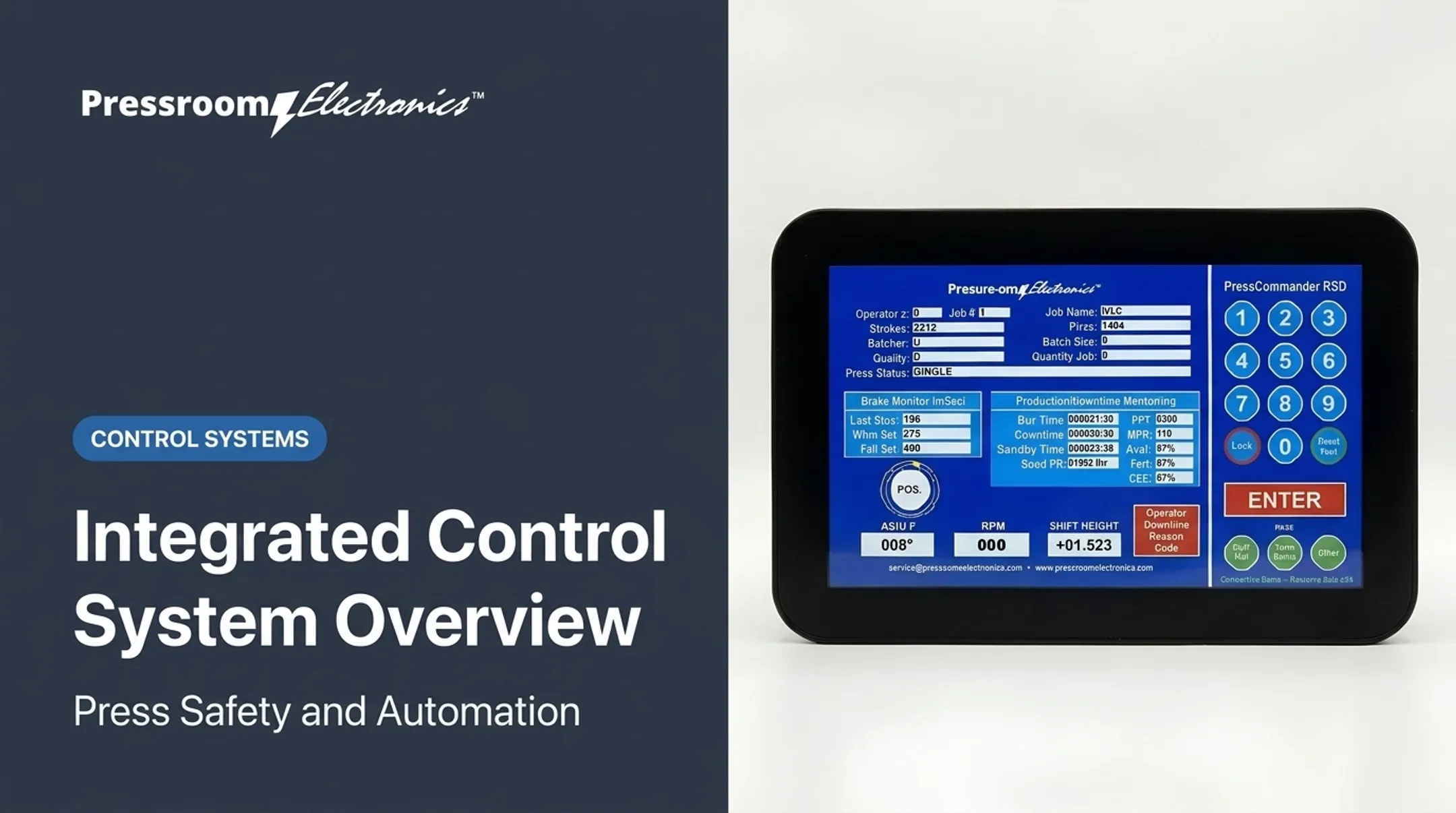
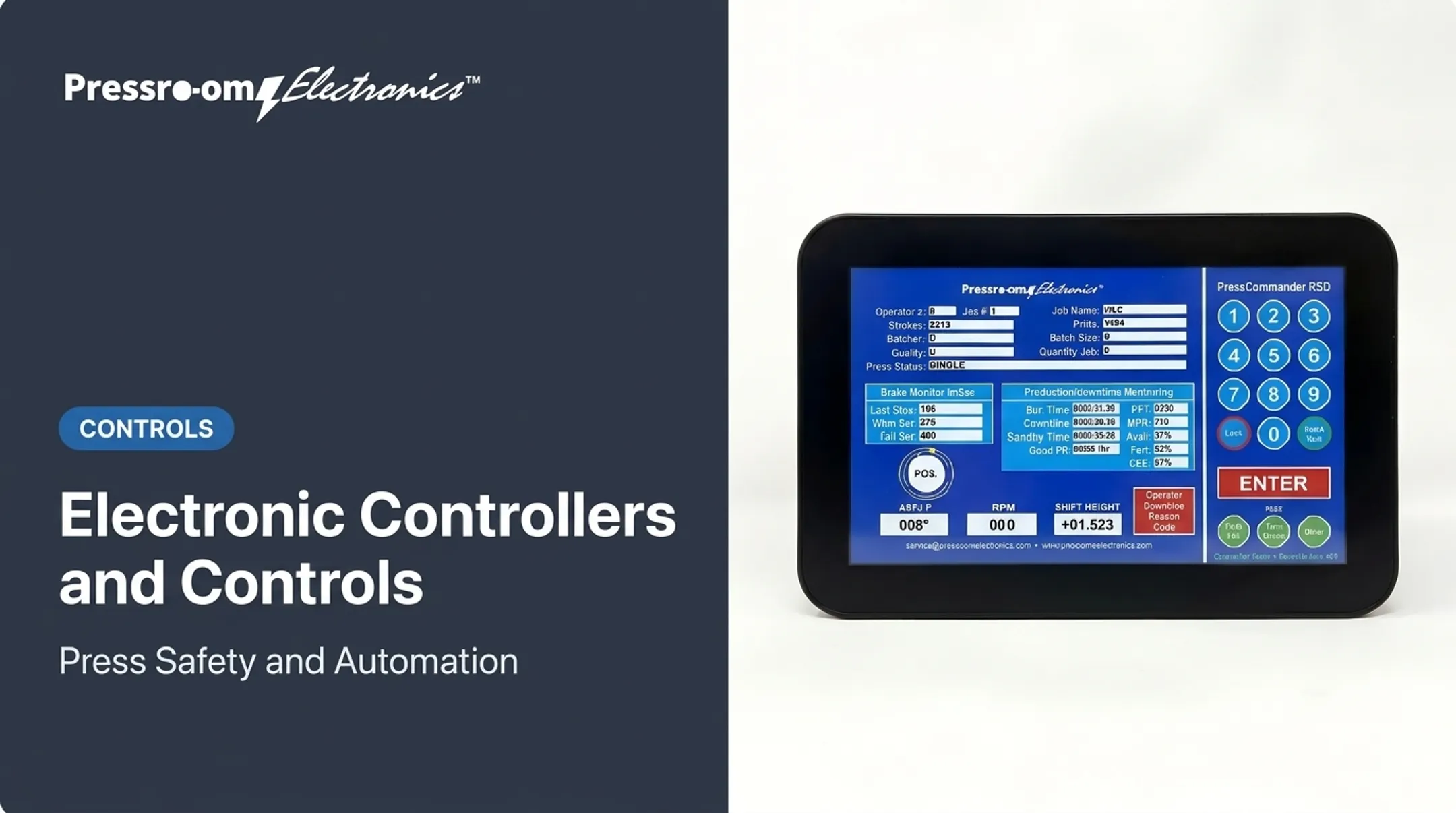
Reason codes matter most. They turn an unexplained "machine down" into a material issue, tooling problem, setup delay, quality hold, or equipment fault. Pressroom Electronics' Production & Downtime Monitoring System supports up to 20 customizable downtime codes, set manually at the touchscreen or automatically from machine-circuit signals.
Visibility Versus Control
A dashboard can show a press condition without letting anyone change it. Any remote command should be limited to approved functions, assigned to named users, and logged. Emergency stops and required safeguards must stay effective at all times.
How Does a Remote Monitoring and Control System Work?
From Sensor to Screen
Sensors and press controls capture events at the machine. A controller or gateway consolidates that data, including from older equipment. Data is stored locally or centrally, then displayed to approved users.
Compatibility is never universal. Common industrial protocols include OPC UA, MQTT, Modbus, and EtherNet/IP, but confirm which interfaces your chosen system supports on your specific presses.

Good data needs discipline:
- Clear timestamps and machine identification
- Shift context
- Consistent names for events and reason codes
- Local buffering for connection drops (limited by timeout and buffer capacity, so ask the vendor)
Alerts and Dashboards
Thresholds, downtime events, and fault signals trigger alerts through supported channels. Dashboards show current status, trends, utilization, and downtime causes across one or many presses.
Prioritize alerts. Operators learn to ignore a flood of notifications, and ISA alarm management guidance notes that overload impairs response.
Monitoring Versus Control in Daily Use
A controlled example: a technician reviews a fault, confirms the local machine state, then performs a permitted reset only if plant procedure allows it. With Pressroom Electronics' Remote Status Monitor, remote fault reset requires an unlock code, and partial unlocking blocks changes to the STOP angle and brake monitor setpoints.
Remote control must never bypass guarding, e-stops, or lockout/tagout. Recommended safeguards:
- Role-based permissions and multi-factor authentication
- Encrypted communications and network segmentation
- Regular software updates and audit logs
- A documented approval process for remote commands
NIST SP 800-82 Rev. 3 and CISA guidance both call for these practices on remote operational technology access.
Turning Data Into Action
Every alert needs a defined response: operator verification, maintenance assessment, tooling inspection, or escalation to an engineer. Data only pays off when reason codes, dashboards, and procedures match real plant workflows.
One published case: remote video and data helped identify tooling wobble in an automated press-brake cell, and the cell was running again 10 minutes later. That was a single integrator-reported incident, not an average.
Benefits of Remote Monitoring and Control for Metal Stamping
Less Unplanned Downtime, Faster Root Cause
Real-time fault data exposes recurring problems sooner. Historical reason codes separate equipment faults from setup, material, tooling, and operator delays.
NIST's survey found that respondents with less reactive maintenance reported 52.7% less unplanned downtime. That is an association from a small comparison group, not a guaranteed result of monitoring.
In one stamping case, a Tier 1 automotive supplier monitoring a rebuilt transfer press noticed one linkage running 20°F hotter than the others. Investigation traced the temperature gap to an off-center die.
Productivity and Resource Allocation
Managers can compare planned and actual output, spot bottlenecks, and send maintenance to the highest-impact issue. Pressroom Electronics systems support performance tracking, globally accessible production data, and alignment of daily operations with long-term goals. Its consulting includes Daily Review Meetings built on system-reported downtime.
Maintenance Planning and Utilization
Reacting to a breakdown is expensive. Brake stopping times, fault history, and trends let you schedule inspections instead. The Time Based Brake Monitor measures stopping time every stroke and offers a brake warning for scheduling maintenance.
Monitoring supports condition-based maintenance only when signals are appropriate and interpreted correctly. It will not predict every failure.
Track before-and-after indicators:
- Unplanned downtime
- Maintenance response time
- Repeat faults
- Service travel
- Machine utilization
Safety and Compliance
Remote visibility lets maintenance staff prepare before approaching equipment. It does not replace physical guarding, inspections, lockout/tagout, or training. OSHA 1910.147 states that control-circuit devices are not energy-isolating devices.
Pressroom Electronics states that its controls exceed OSHA 1910.217 and ANSI B11.1-2009 (R2020).
Quality and Continuous Improvement
Correlating downtime reasons, tooling events, counts, and quality holds exposes recurring process problems. CAS Dataloggers reported that monitoring a hydraulic stamping press at an automotive manufacturer caught broken punches immediately and flagged worn tooling before failure, reducing scrap and downtime. Consistent records also help shift handoffs and engineering reviews.

Common Applications on a Pressroom Floor
Job Shops With Aging Mechanical Presses
Small and mid-size stampers can get visibility into press status, downtime reasons, counts, and brake events without replacing every machine. Ernst kept a 630-ton transfer press and upgraded its controls, drives, and tonnage monitoring, then reported at least a 5% OEE improvement.
Feasibility depends on press design, available signals, existing controls, and electrical condition.
High-Volume Automotive and Appliance Plants
Priorities center on multi-press visibility and fast response when faults repeat:
- Multi-press dashboards and cross-shift comparisons
- Die-protection events and quality holds
- Escalation of repeat faults across lines
Centralized visibility protects expensive tooling and coordinates maintenance across lines.
Rebuilders, OEMs, Distributors, and Service Contractors
These groups use configurable controls, monitoring components, and authorized remote support to standardize or service customer equipment. Pressroom Electronics, for example, supplies systems built for metal stamping and forming:
- Press controls and production monitoring
- Brake monitoring and die protection
- Machine guarding packages
PressCommander is not for use on full-revolution presses and must be installed by qualified personnel.
How to Choose and Implement a Remote Monitoring and Control System
Start With the Problem
Document the use case: recurring downtime, poor cross-shift visibility, difficult troubleshooting, travel costs, or inconsistent reporting. Then set a baseline from your existing records, using one consistent method.
Baseline measures to track:
- Utilization and unplanned downtime
- Response time and repeat faults
- Output, changeovers, and scrap
- Service visits
Purdue MEP's Digital Manufacturing Playbook recommends documenting pre-implementation performance and comparing against it.
Evaluation Checklist
Check each of these:
- Compatibility with existing and legacy press controls
- Data granularity and programmable reason codes
- Alert configuration and dashboard usability
- Historical reporting and export options
- User permissions and audit trails
Ask vendors about:
- Cybersecurity and software updates
- Behavior during lost connectivity and local operation
- Backups and remote command handling
- Separation of monitoring from safety-critical controls
Request a demo on your actual press and fault conditions, not a generic software walkthrough.
Pilot, Then Scale
Start with one press or cell where the problem is clear. Map data points, then test alerts with operators and maintenance staff.
Before expanding, validate:
- Alarm accuracy
- User access
- Data retention
- Network resilience
- Local safety functions
- Training and response procedures
Evaluate total cost of ownership, not just purchase price. If you are weighing a custom press-control or production-monitoring upgrade, contact Pressroom Electronics to discuss application requirements, integration needs, and the right mix of controls, monitoring, brake monitoring, die protection, or guarding.

Frequently Asked Questions
How much does remote monitoring cost?
Cost varies with machine count and type, sensors, connectivity, software, integration, cybersecurity, training, support, and whether remote control is included. Compare total cost of ownership to expected operational value rather than a generic price.
What is remote monitoring equipment?
Typical components include sensors, press controls, brake monitors, die-protection devices, gateways, network equipment, dashboards, alerting software, and secure access tools. The exact mix depends on the machine and use case.
What is the best remote monitoring software?
Rank options on equipment compatibility, data quality, alerting, reporting, security, permissions, and scalability. Test any platform with real press data and actual downtime scenarios.
Does Medicare pay for remote monitoring?
Medicare reimbursement relates to healthcare remote patient and therapeutic monitoring, not industrial equipment. For press monitoring, focus on equipment, software, integration, and operating costs.
Can remote monitoring control industrial equipment?
Some systems support authorized remote control or access, depending on the equipment and design. Interlocks, e-stops, guarding, lockout/tagout, role-based permissions, and plant procedures must never be bypassed.
Is remote monitoring secure for manufacturing equipment?
It can be, with access control, multi-factor authentication, encryption, segmentation, patching, audit logs, and fail-safe behavior. Complete a formal cybersecurity and safety review before connecting production equipment.