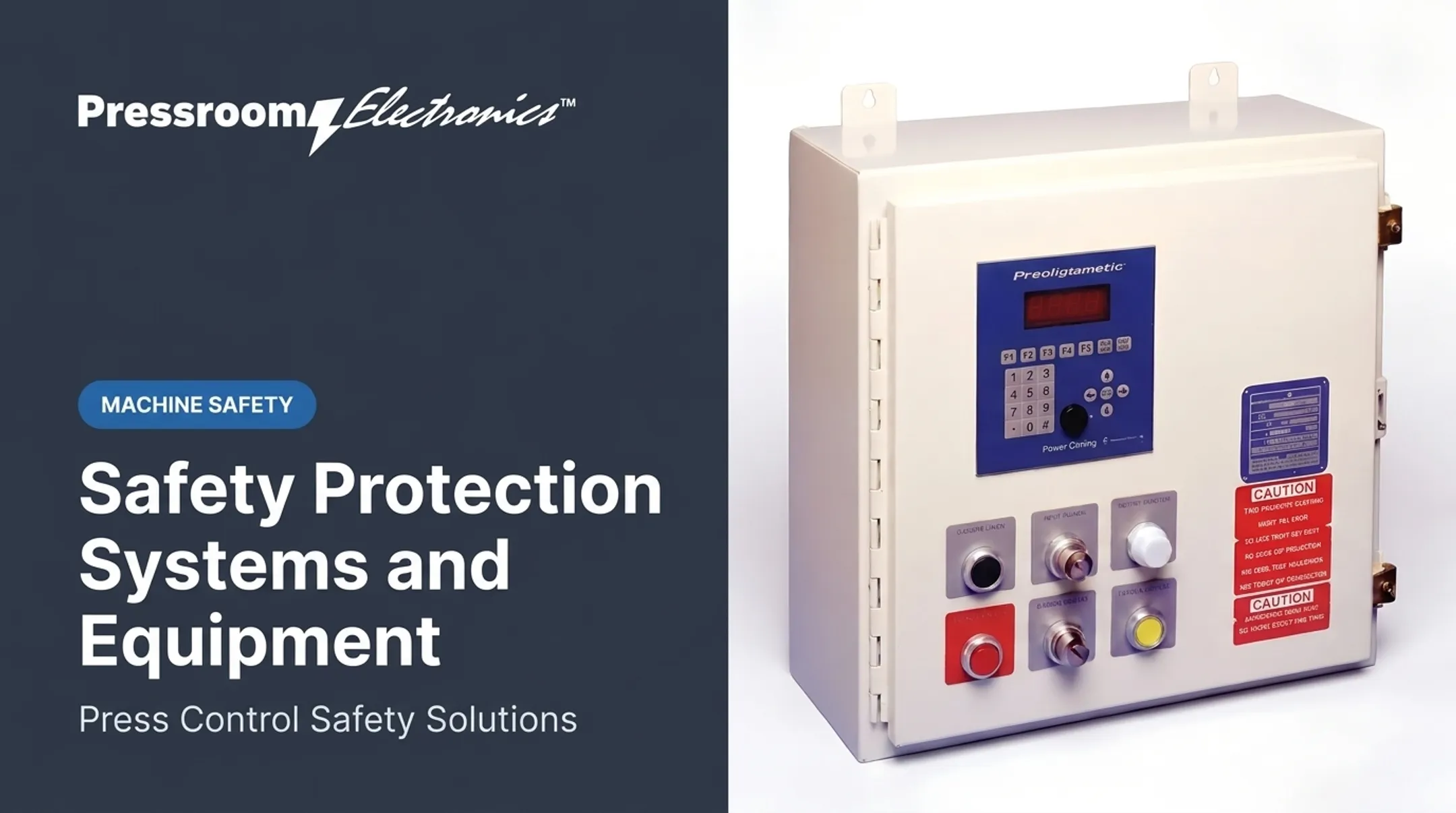
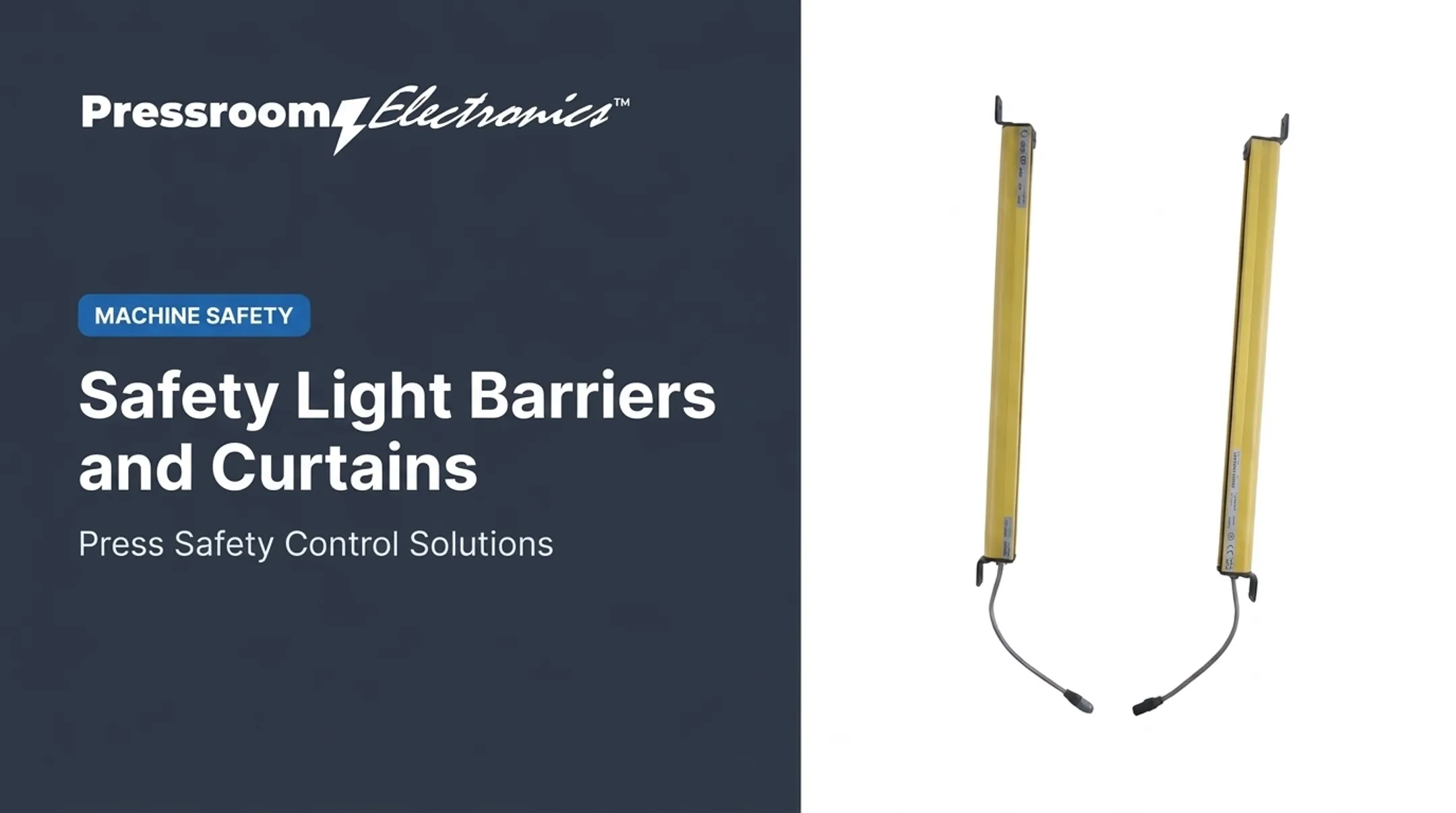
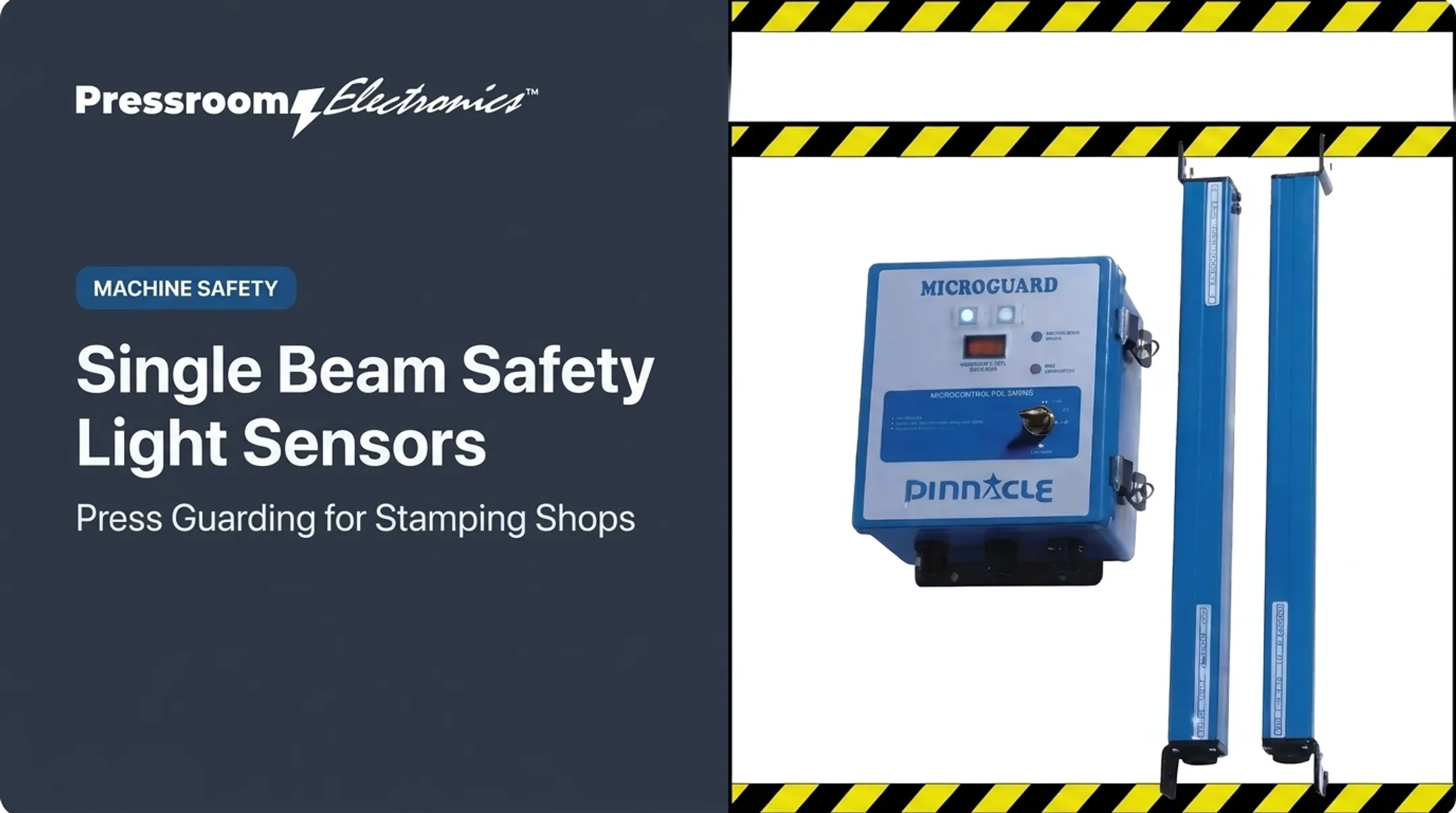
Pick the wrong one and you get access gaps, nuisance stops, awkward maintenance, and wasted installation money. Enforcement data shows guarding is still a problem: preliminary FY2026 figures put machine guarding (1910.212) at No. 10 on OSHA's list, with 1,072 citations. That counts citations, not injuries, but it shows how often guarding falls short.
This guide compares the two technologies, shows where each fits, and gives you a checklist to bring to your safety professional.
Key Takeaways
- A light curtain forms a beam-based protective plane; a scanner creates programmable protective and warning fields.
- Choose curtains first for close point-of-operation guarding and finger or hand detection.
- Prefer scanners for irregular areas, robot cells, AGVs, and perimeters.
- Resolution, stopping time, safety distance, access routes, environment, and lifecycle cost drive the choice.
Light Curtain Sensors vs Safety Laser Scanners: Quick Comparison
Published specifications show the contrast. These are specific products, not technology-wide benchmarks.
| Attribute | SICK deTec4 light curtain | SICK microScan3 scanner |
|---|---|---|
| Safety classification | Type 4, PL e | Type 3, PL d |
| Detection capability | 14 mm | Selectable 30 to 200 mm |
| Geometry | 2,100 mm protective height | 275-degree scan angle |
| Range | 20 m | 5.5 m protective; 40 m warning |
| Response time | 22 ms uncoded | 95 ms |

Don't treat the scanner's 40 m warning range as a safety-rated range. Compare exact configurations, because settings change response time: the same deTec4 family lists 80 ms for one 14 mm configuration.
Detection method and coverage
A light curtain pairs an aligned transmitter and receiver to form a linear infrared field across an opening. Breaking the field sends a stop signal through the safety control system.
A scanner works from a single device. It measures time of flight of reflected light pulses, and software-defined fields monitor a two-dimensional area rather than one beam plane.
Protection geometry and typical hazard
- Curtains: fixed openings, press access points, infeed and outfeed locations.
- Scanners: perimeters, irregular layouts, robot cells, AGV routes.
Resolution, response time, and safe distance
For both devices, resolution, response time, and machine stopping time determine whether a hand, finger, or body is detected before the hazard is reached. For scanners, also weigh approach speed, mounting position, and the size of the object that must be detected.
Installation and flexibility
A curtain needs aligned mounting, wiring, and possibly mirrors, but gives a predictable plane. A scanner has a simpler single-device layout, but field definition around fixed obstacles and access paths takes engineering and validation.
Material flow and controls integration
Curtain packages may offer muting, blanking, pattern recognition, reset, and external device monitoring. These functions vary by model, so confirm them in the documentation.
Scanners offer warning fields, protective fields, field switching, and safe restart. The microScan3 can provide 8 fields and 8 monitoring cases. Its reset releases the restart interlock but must not itself start the machine.
Environment, maintenance, and total cost
Neither technology wins universally. Banner warns that severe smoke and dust can degrade optical efficiency. Reflective surfaces can cause bypass in curtains, and scanner manuals address reflections, sunlight, and strobes. Neither has a proven cost or lifespan advantage across all sites. Use manufacturer documentation and a site test plan.
What Are Light Curtain Sensors and Safety Laser Scanners?
What Is a Safety Light Curtain Sensor?
A safety light curtain is a safety-rated electro-sensitive protective device with an emitter, receiver, and multiple beams. It detects intrusion into a defined field. It is not a general-purpose photoelectric sensor.
Variables that affect safe application:
- Resolution and protective height
- Sensing range and response time
- Device type and reset behavior
- Calculated minimum safety distance
Pinnacle Systems curtains from Pressroom Electronics are Type 4 / Category 4, made in the USA, with 0.5-inch or 1.0-inch beam spacing for finger, hand, arm, and body guarding. Applicable requirements include OSHA 1910.212 and 1910.217, ANSI B11.1, and ANSI B11.19. Verify current editions for your application.
Used well, curtains allow close operator access, fast point-of-operation detection, and ergonomic loading. Muting or blanking must be risk-assessed and validated. They are not shortcuts around guarding.
Use Cases of Safety Light Curtain Sensors
Curtains suit hazards concentrated along a plane:
- Mechanical punch presses and stamping lines
- Press infeed and outfeed openings
- Assembly stations and packaging openings
- Conveyor transfer points
A curtain alone may fall short with multiple uncontrolled access routes, large irregular floor areas, or blind spots. OSHA 1910.217 requires guards on every point-of-operation entry the sensing device doesn't cover. Fencing or other methods may be needed.
What Is a Safety Laser Scanner?
A safety laser scanner is a safety-rated, time-of-flight device that scans a configurable area. Separate warning and protective fields can signal approach, slow equipment, or stop it.
Factors to evaluate include:
- Scan angle and field shape
- Detection resolution and response time
- Mounting orientation and field switching
- Reflective or obstructed surfaces
- Safety outputs, reset behavior, and control compatibility
Use Cases of Safety Laser Scanners
Scanners fit robot cells, material-handling areas, AGVs, AMRs, transfer stations, and irregular workspaces. A Mills CNC case study describes a microScan3 guarding a robot-served machining cell.
Limits need engineering review. A scan plane doesn't stop someone reaching over, crawling under, or walking around the field. Manufacturer guidance typically calls for supplementary physical guarding. Test for dust, steam, reflections, occlusion, approach speed, stopping distance, and safe restart.

Light Curtain Sensors vs Safety Laser Scanners: What Is Better?
Neither. Decide from the full application:
- Hazard and the person's approach
- Smallest body part to detect
- Stopping time and required safety distance
- Access routes and material movement
- Space, environment, and controls
- Validation and lifecycle cost
Choose a safety light curtain when:
Evaluate a curtain first for a fixed press or machine opening where fine resolution, close point-of-operation protection, predictable coverage, and frequent operator interaction matter.
Muting, blanking, or pattern recognition can support material transfer, but only when the device, control logic, sensors, and risk assessment support it. Blanking changes effective detection capability, so testing and positioning must reflect that.
Press rules add limits. OSHA 1910.217 prohibits presence-sensing devices on full-revolution-clutch presses and as the means of initiating slide motion. It permits muting on the upstroke for ejection, circuit checking, and feeding.
Choose a safety laser scanner when:
Evaluate a scanner first for a large or irregular area, robot cell, or AGV route where warning and protective zones must be programmed around equipment and traffic.
Flexibility doesn't remove the work. You still calculate minimum safety distance, control access around the field, manage reflections and obstructions, and verify the whole safety-related control system.
Consider a combined or alternative safeguarding strategy
Many plants mix methods:
- A curtain at the operator opening
- A scanner for area or vehicle access
- Fencing, interlocked gates, or safety mats where one optical device can't control every route
Pressroom Electronics supplies curtains, safety mats, area guarding, and interlocked fencing alongside press controls.

Bring this checklist to your integrator or safety professional:
- Machine stopping time (measured, not assumed)
- Hazard dimensions and approach direction
- Required resolution
- Product flow and muting needs
- Environmental exposure
- Reset location
- Existing controls
- Validation plan
- Maintenance ownership
Real-World Examples and Case Studies
Published evidence is thinner than vendors imply. Named US stamping installations with published numerical downtime, reset, or floor-space results are hard to find, so the examples below are not US press studies.
- Omron engine-casting line: an unnamed manufacturer swapped older curtains for F3SG-SR units using a conversion bracket and cable, avoiding rewiring. Downtime was reported shortened, with no number.
- Omron purlin stacker: a metal-forming application needing 55 ft of protected range used fixed blanking for setup. No quantified outcome was published.
- Mills CNC robot cell: a microScan3 guards a robot-served machining cell, with space and productivity benefits described but not measured.
- Brainware door-trim testing: a Pilz PSENscan system reportedly ran its cycle about one third faster than the envisioned 23 seconds. That is a complete-system result, not scanner-only causation.
The pattern: curtains show up where the opening is fixed and known; scanners where the work area changes shape or equipment moves. Each decision still rested on risk assessment and validation.
Metal stampers, press rebuilders, and safety contractors planning a pressroom upgrade can contact Pressroom Electronics at 800-937-4334 to discuss integrating guarding with press controls and brake monitoring.
Conclusion
Light curtains fit defined, close point-of-operation guarding. Scanners fit programmable area protection and mobile or irregular hazards. Neither is a universal winner.
Base final selection on:
- A documented risk assessment
- A safe-distance calculation
- Applicable US requirements
- Control-system validation
- Realistic maintenance and production needs
Measure stop time at the machine's fastest speed with its heaviest die at the 90-degree downstroke position, and recalculate when stopping performance changes.
Frequently Asked Questions
What are the different types of light sensors?
General-purpose photoelectric sensors come as through-beam, retro-reflective, and diffuse-reflective. Safety light curtains are built for personnel safeguarding. The right choice depends on the detection and safety function required.
How does a light sensor work?
It detects light that is interrupted, reflected, or returned. A safety curtain uses multiple beams with safety-rated outputs. A laser scanner measures reflected laser pulses to monitor a protective field.
What is the difference between a safety light curtain and a safety laser scanner?
A curtain has a fixed beam plane and fine point-of-operation detection. A scanner covers a programmable two-dimensional area. Check response time, resolution, and safe distance for your application.
Which is better for protecting a punch press?
A light curtain is often evaluated first for a defined press opening and close hand or finger protection. Confirm through a machine-specific risk assessment, stopping-time calculation, and OSHA 1910.217 requirements.
Can a safety laser scanner replace a light curtain?
It depends on the application. Compare resolution, approach direction, field geometry, response time, access around the device, environment, and whether the scanner meets the complete safety function.
How do you calculate minimum safety distance for an optical safety device?
OSHA's press formula is Ds = 63 in/s × Ts; ANSI B11.19 adds control, device response, brake-monitor, and penetration-depth terms. Use verified stop-time data and a qualified safety professional, not a generic distance.