Introduction
Every machine on a plant floor depends on one decision-making layer. The controller reads sensors, safety devices, and operator commands, then tells motors, valves, and clutches what to do. When it fails, production stops.
"Controller" is not one device. PLCs, PACs, industrial PCs, motion controllers, robot controllers, and safety controllers all carry the label. The cost of getting it wrong is high: Siemens and Senseye's 2024 downtime study estimates $2.3M per hour for large automotive manufacturers.
This guide covers controller types, how they work, how to choose one, where they apply, and what matters in metal stamping.
Key Takeaways
- Match the controller to I/O needs, response time, communications, safety, environment, and growth plans.
- Treat a PLC as one controller type among several, not the default choice.
- Evaluate the whole system, including programming, support, and lifecycle, not just processor speed or price.
- Plan for stamping-specific functions such as brake monitoring and die protection.
What Is an Industrial Automation Controller?
What the term means
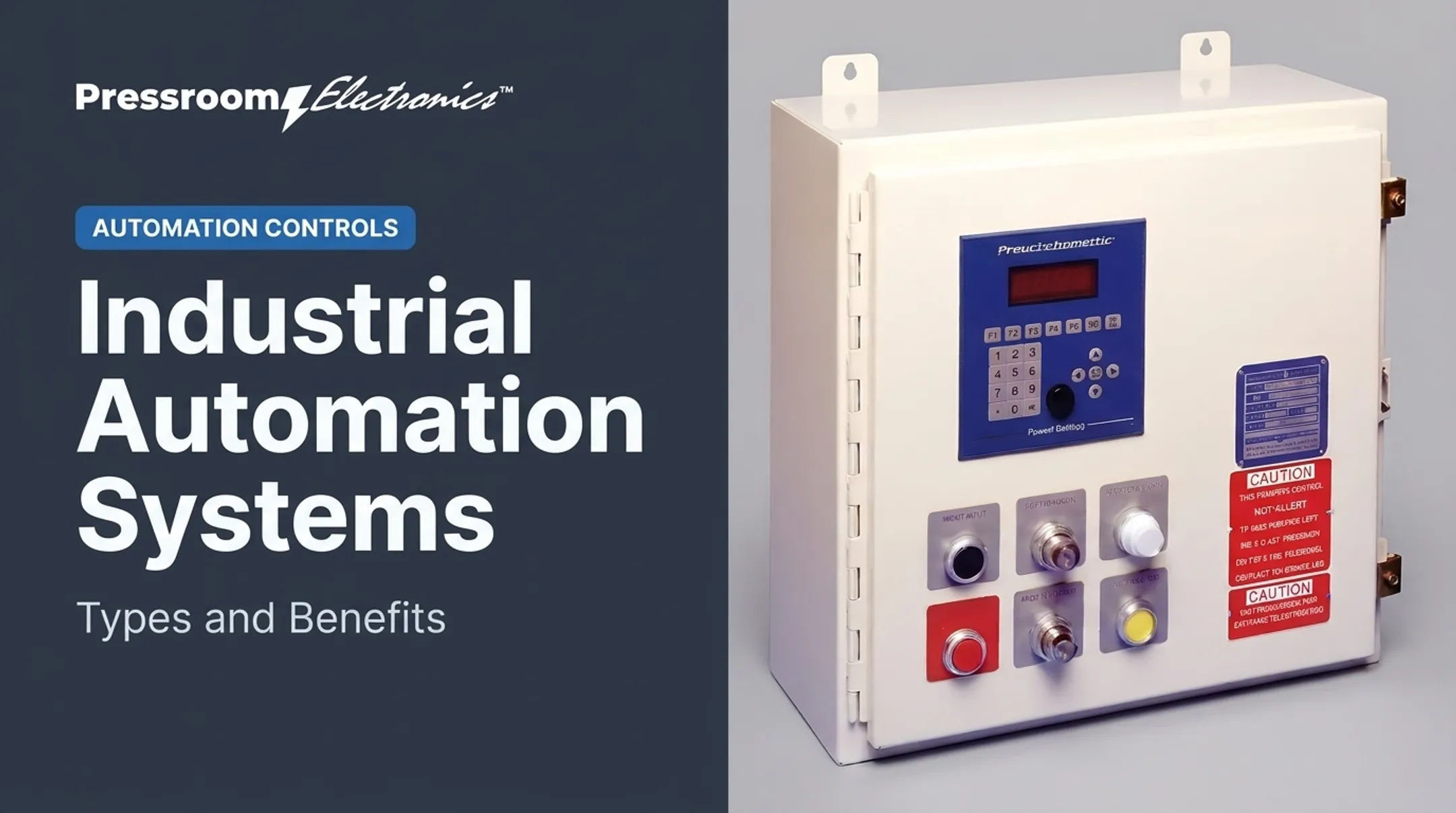
An industrial automation controller is a ruggedized hardware-and-software system. It monitors inputs, runs programmed logic or control algorithms, and commands outputs in a repeatable process.
It differs from a general-purpose computer in several ways:
- Deterministic, predictable response
- Designed for vibration, heat, dust, and electrical noise
- Direct I/O connections to field devices
- Continuous operation
- Machine-level control rather than office tasks
The basic input-process-output cycle
Sensors, switches, and encoders supply inputs. The controller processes them. Outputs then drive motors, valves, relays, drives, alarms, or safety functions.
On a stamping press, for example, a sensor confirms the strip has advanced. The controller checks press and die conditions, runs the sequence, and either completes the cycle or reports a fault.
Where controllers fit in an architecture
Controllers sit between field devices and higher-level systems such as HMIs, SCADA, MES, and plant networks. Remote I/O, drives, and safety systems connect alongside them.
One controller might run a single machine, a cell, or a line. NIST's OT security guide describes distributed control systems that combine central supervision with localized controllers sharing production tasks.
Types of Industrial Automation Controllers
PLCs
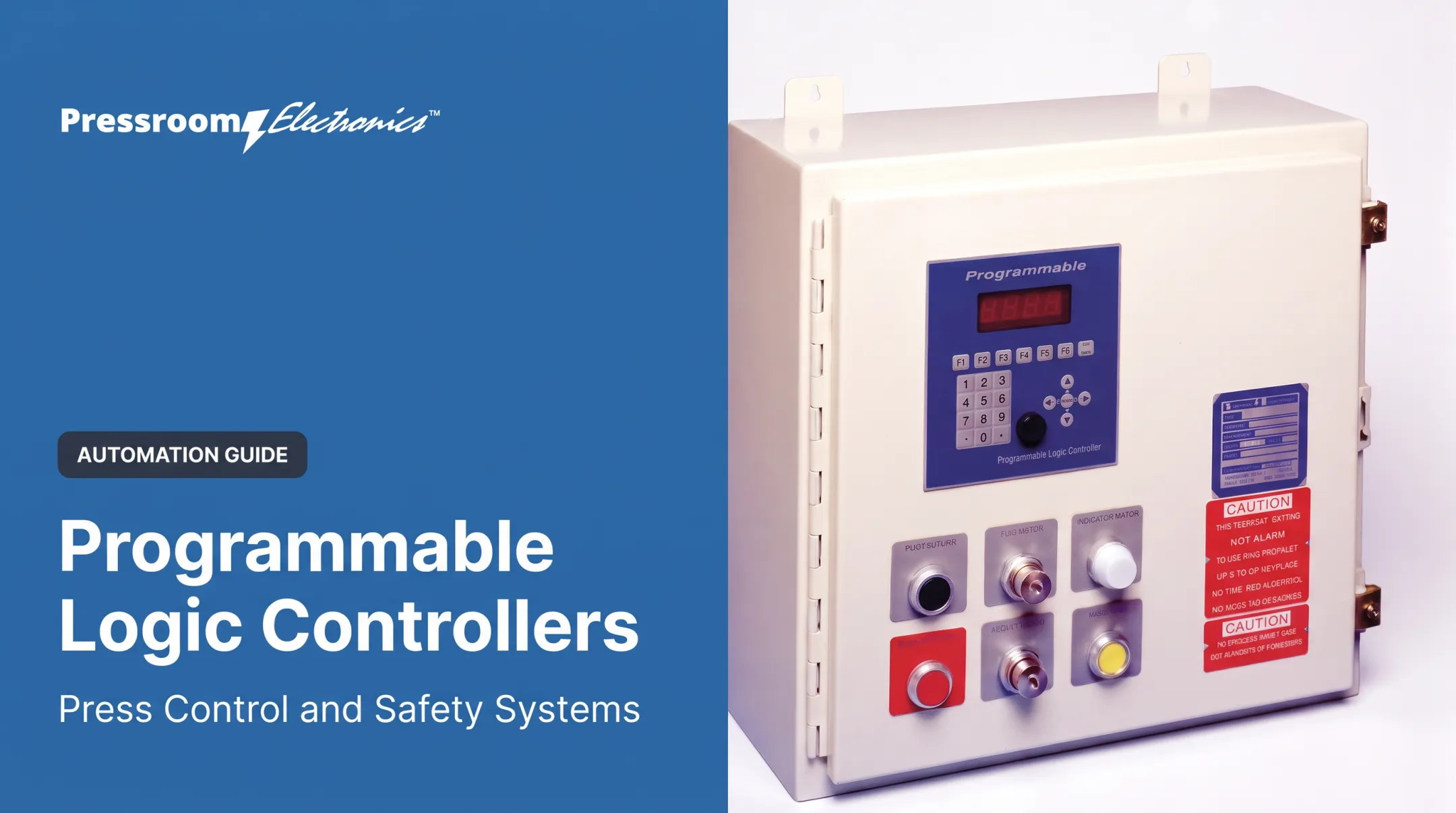
PLCs dominate discrete machine control: sequencing, interlocking, alarms, and PID. They typically offer modular I/O, IEC 61131-3 programming languages, built-in communications, and HMI/SCADA compatibility.
PACs
PACs blend PLC, PC, and motion capabilities. Parker notes that these categories overlap, so compare actual capabilities rather than labels. A PAC makes sense for a coordinated line needing more computing, networking, and data handling than a basic PLC.
Industrial PCs
Industrial PCs bring processing power, open software, visualization, analytics, and machine vision. Tradeoffs matter:
- Hardening for vibration, temperature, and dust
- Operating-system maintenance and patching
- Cybersecurity exposure
- Real-time behavior, which depends on the runtime, not the hardware alone
- Long-term support
Motion, robot, and dedicated machine controllers
These controllers cover specialized roles on the machine:
- Motion controllers coordinate servo axes, position, speed, and feedback
- Robot controllers handle kinematics, path planning, teach-pendant functions, and robot-specific safety
- Dedicated machine controllers are tied to a particular machine or OEM design; press clutch/brake control is one example
Safety controllers and distributed architectures
Safety controllers monitor e-stops, guarding, light curtains, and interlocks. Capability alone does not make a machine safe. Safety functions must be designed and validated within the complete machine safety system.
How you arrange controllers on the floor also affects risk and maintainability. Distributed designs use several controllers, remote I/O, and networked subsystems. They ease wiring and fault isolation. A single central controller is simpler to program but concentrates risk.
How Industrial Automation Controllers Work
Hardware components
Core parts include the processor, power supply, memory, local and remote I/O, communication ports, expansion modules, and diagnostic indicators.
I/O comes in discrete, analog, high-speed, specialty, motion, and safety types. Document signal types and electrical requirements before selecting a controller, because mismatches force rework.
The scan cycle
A simplified scan reads inputs, runs the program, updates outputs, handles communications, and logs diagnostics. Order varies by platform. On the Siemens S7-1200, for example, Siemens documentation shows outputs written first, then inputs read, then the program executed.

Scan time, task priority, and interrupts matter most for high-speed machines, synchronized motion, and safety reactions.
Programming
Common IEC 61131-3 approaches:
- Ladder diagram: interlocks and machine sequences
- Structured text: math, data handling, recipes
- Function block diagram: continuous and loop control
- Sequential function chart: stepwise processes
Programs implement sequences, permissives, timers, counters, alarms, fault recovery, and operator commands.
Communications
Controllers talk to HMIs, drives, remote I/O, robots, vision systems, historians, and other controllers. Relevant protocols include EtherNet/IP, PROFINET, EtherCAT, Modbus TCP, CANopen, and OPC UA. Support is controller-specific, so confirm each protocol against the exact model.
Feedback, diagnostics, and cybersecurity
Encoders, pressure and temperature sensors, and current monitors enable closed-loop control and fault detection. Plain-language fault messages shorten troubleshooting.
Security guidance from NIST and CISA converges on:
- IT/OT segmentation
- Remote access with multifactor authentication and least privilege
- Tested backups and restoration
- Firmware and change management
How to Choose the Right Industrial Automation Controller
Start with machine requirements
Document the sequence, axes, cycle and response needs, process variables, operator interactions, interlocks, and abnormal-condition behavior. A new machine and an obsolete-controller replacement differ. Retrofits must account for existing wiring, programs, networks, and spares.
Build an I/O list
Record each point's signal type, voltage or current, location, response speed, isolation needs, and local or remote status. Add expansion capacity based on documented growth plans, not a generic percentage.
Evaluate performance
Look at processing capacity, scan time, memory, PID, motion, high-speed counting, recipes, and data logging. Test against the real workload where possible. Headline speed and I/O count mislead.
Confirm interoperability
Match protocols, ports, topology, and HMI/SCADA interfaces. Consider installed equipment, programming tools, spare parts, and your technicians' existing skills.
Check environment and safety
- Rate temperature, vibration, dust, moisture, and electrical noise
- Choose enclosure type: NEMA 12 for indoor dust and dripping water; 4X for corrosion and hose-directed water
- Treat IP ratings as non-substitutes for NEMA enclosure types, per NEMA
- Address hazardous-location needs where applicable
- Evaluate machine safety separately through risk assessment
Plan lifecycle support
Review vendor support, documentation, replacement availability, licensing, training, and firmware updates. Rockwell's lifecycle stages run from Active Mature to End of Life to Discontinued. Also document how authorized technicians will troubleshoot, restore, and remotely support the controller without adding risk.

Applications and Benefits
Common applications
- Discrete manufacturing: PLCs sequencing machines
- Packaging and material handling: coordinated motion
- Process control: analog feedback and PID
- Robotics and machine tools: dedicated controllers
- Utilities and building systems: distributed supervision
- Metal stamping: press control and die protection
A standalone machine may need one PLC. A synchronized line needs motion and networking. A plant-wide system favors distributed controllers.
Measurable outcomes
Good selection and programming improve repeatability, fault diagnosis, utilization, and visibility.
In one retrofit, Electronic Drives and Controls replaced legacy controls on a Ruesch steel slitting line with a new PLC, drives, and HMI. Throughput rose from 300 to 500 ft/min, a 67% gain. That reflects the whole project, not the PLC alone.
Pressroom and metal stamping operations
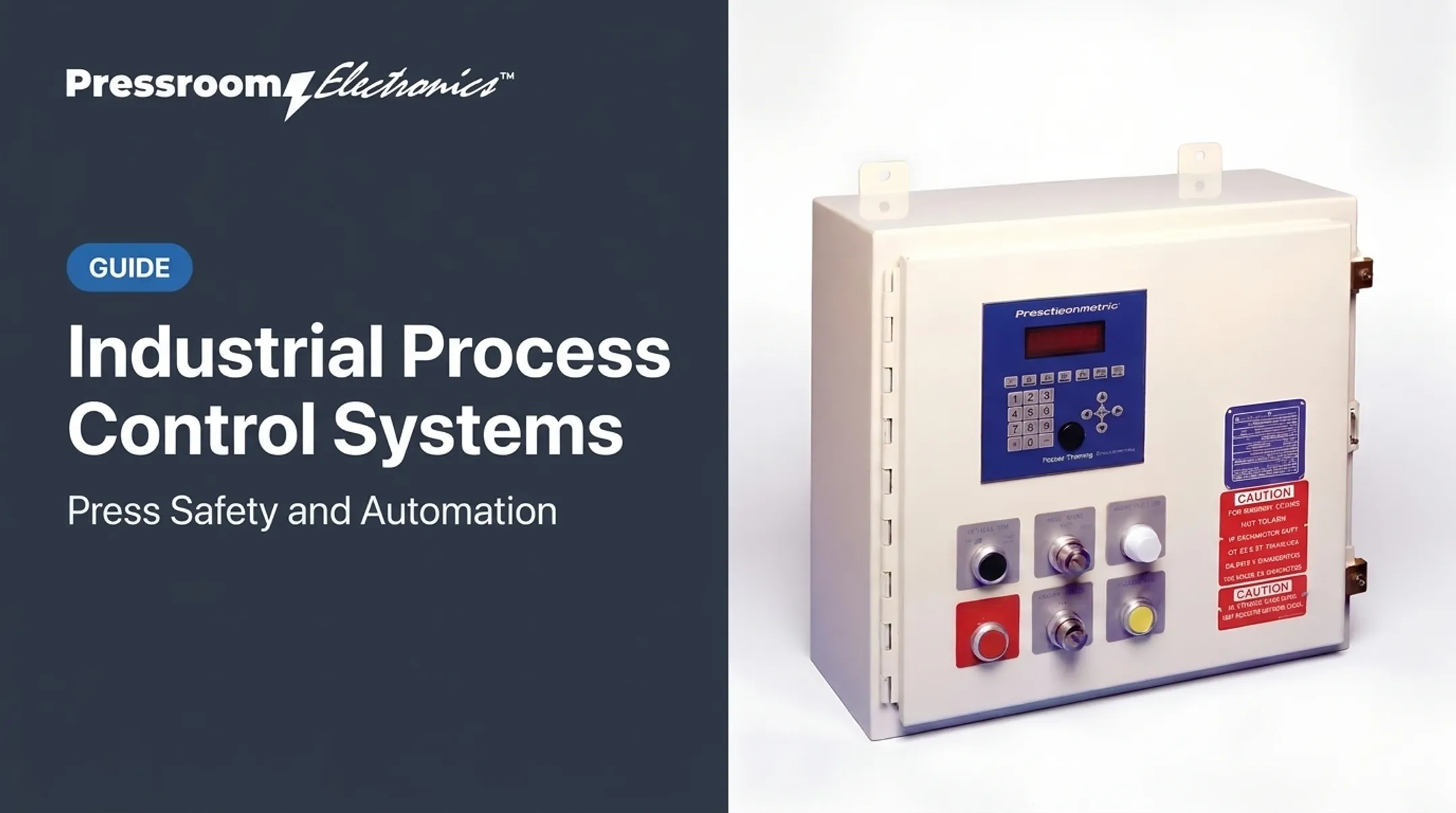
Specialized press controls work alongside broader automation. They handle clutch/brake operation, brake monitoring, die protection, guarding, and production monitoring on mechanical punch presses.
OSHA 29 CFR 1910.217 governs mechanical power presses, with conditional duties. Brake monitoring, for example, applies when required and checks performance on each stroke. Die protection and tonnage monitoring protect tooling and are distinct from personnel safeguarding.
Pressroom Electronics designs and builds press controls in the USA. The PressCam 8 combines a resolver-based programmable cam switch, timed brake monitor, die protection, and counters. The PressCommander line adds production monitoring, Ethernet, and touchscreen options.
Both support custom programming and remote field upgrades. Resolver- and rotary-cam-based controls are OSHA/ANSI compliant, and programmable downtime reason codes help teams find root causes.

Practical checklist by buyer:
- Job shops: prioritize aging-press compatibility and compliance documentation
- High-volume automotive and appliance stampers: emphasize die protection and uptime
- Press rebuilders and OEMs: check panel integration constraints
- Maintenance and safety contractors: verify documentation and shift-start testing procedures
Controls must be installed and serviced by qualified personnel, and presses must be maintained per OSHA 1910.217.
Frequently Asked Questions
What is the difference between a PLC and a controller?
A PLC is one specific type of industrial controller. "Controller" is the broader category, including PACs, industrial PCs, motion, robot, and safety controllers.
What is the role of a controller?
It reads field inputs, executes programmed logic, commands outputs, coordinates connected systems, and reports status or faults.
What are the different types of industrial controllers?
PLCs and PACs handle general machine control. Industrial PCs suit data-heavy work. Motion and robot controllers manage movement, safety controllers monitor protective devices, and dedicated controllers serve specific machines.
How do you choose an industrial automation controller?
Evaluate I/O, performance, communications, environment, safety, programming, compatibility, lifecycle support, cybersecurity, and expansion plans together.
Can one controller manage an entire production line?
A capable controller can. Distributed controllers often work better for modularity, fault isolation, local response, wiring, and maintenance.