This guide covers how PLC I/O works, how input and output modules differ, the main module types, how to compare them, and how to apply them in metal-stamping and pressroom automation.
Key Takeaways
- Input modules carry field-device status to the PLC; output modules carry PLC commands to equipment.
- Discrete signals are on/off states; analog signals are continuously varying values.
- Selection hinges on voltage, current, signal type, channel count, timing, isolation, diagnostics, and compatibility.
- Standard I/O does not replace safety-rated hardware for guarding or emergency stops.
What Are PLC Input and Output Modules?
A PLC I/O module is the hardware interface between the controller's CPU and the devices outside it. Inputs let the system receive information. Outputs let it issue commands.
How do PLC input and output modules fit into a control system?
The signal path is straightforward:
- A sensor or switch sends a signal to an input module.
- The PLC program evaluates that signal.
- An output module energizes or adjusts an external device.
Other parts of the architecture do different jobs. According to AutomationDirect's PLC Handbook, the CPU holds the microprocessor and memory, the power supply feeds the system, and communication modules add interfaces such as RS-232, RS-485, and Ethernet. I/O modules handle field-level signals. They don't replace the processor.

Why are PLC I/O modules important?
Properly matched modules let a controller monitor machine conditions, coordinate sequences, collect process data, flag faults, and drive equipment. Get the match wrong and the program can be perfect while the machine still misbehaves.
Here's a simple pressroom case:
- A part-present sensor feeds an input.
- The program checks that input along with a machine permissive, such as the press being in the right portion of the stroke.
- If both conditions are true, an output fires a valve or relay to feed or eject the part.
One input condition, one programmed response. Everything else in automation is a bigger version of that.
How Do PLC Input Modules Work?
An input module receives electrical signals from field devices and conditions them into data the CPU can interpret.
What are discrete PLC inputs?
Discrete inputs report a defined state: on/off, open/closed, true/false. Typical sources include pushbuttons, selector switches, proximity sensors, limit switches, and status contacts.
DC and AC inputs are not interchangeable. Voltage range and wiring configuration (sinking or sourcing) both matter. For reference, Rockwell's 5069-IB16 is a 24 V DC sinking input with a 10-32 V DC on-state range, while the 5069-IA16 handles 79-264 V AC. Always check the specific module's ratings before landing a wire.
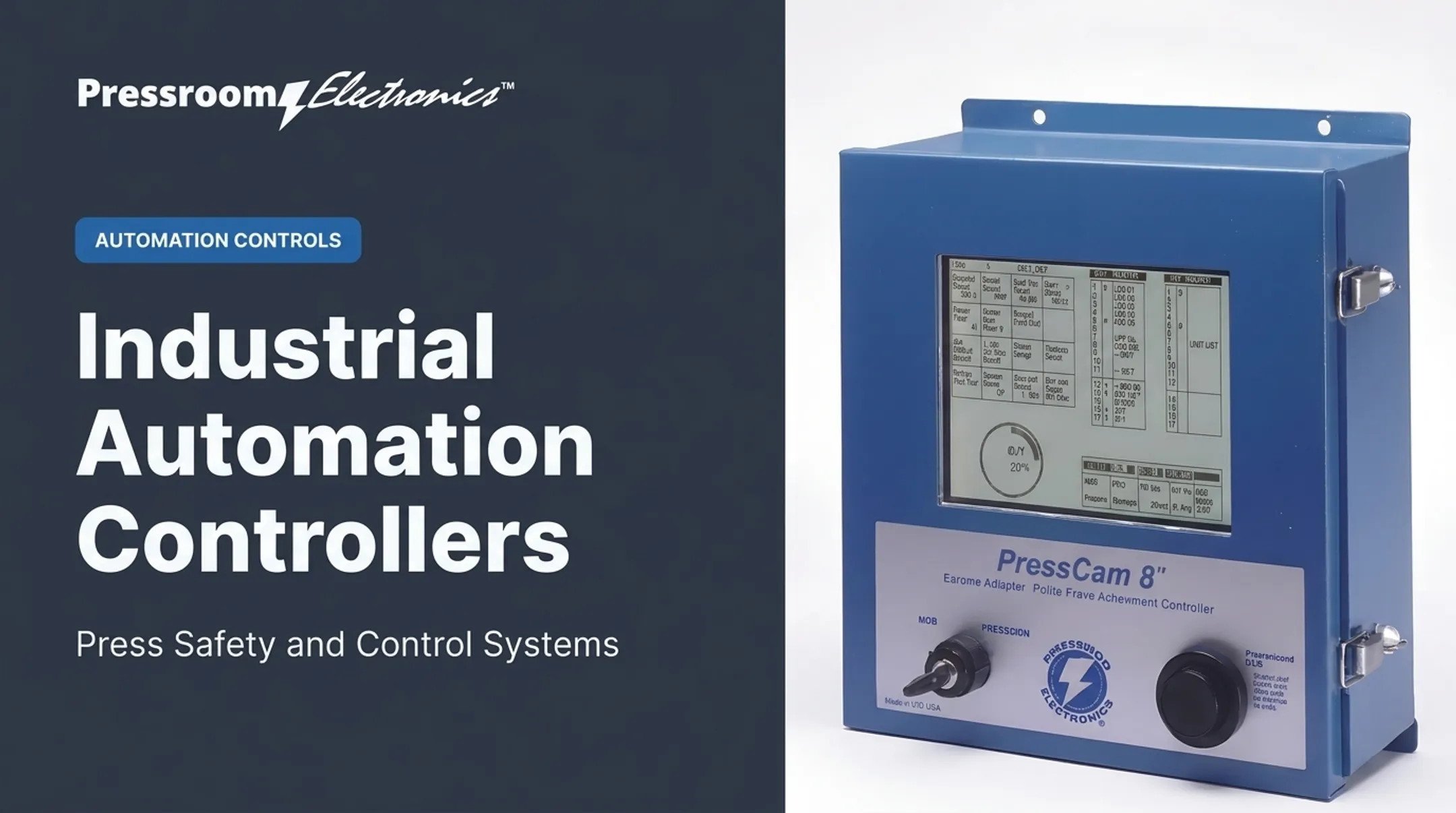
Press controls follow the same rule. Pressroom Electronics' PressCam 8 uses optically coupled inputs supporting 12-24 V DC or optional 120 V AC, and the voltage type must be chosen beforehand.
What are analog PLC inputs?
Analog inputs represent a range of values: pressure, temperature, position, level, or force. Common formats are voltage and current loops. Rockwell's 5069-IF8, for example, supports 4-20 mA and 0-10 V, among other ranges. Confirm ranges against the manufacturer's documentation for your exact module.
What electrical and diagnostic features matter in an input module?
- Filtering: The 5069-IB16 offers selectable filtering from 0-50 ms. A signal must stay valid for the whole filter time, so longer filtering cuts noise but delays the signal.
- Isolation: Many input points share a common return. The 5069-IB16 has no isolation between individual ports.
- Diagnostics: Analog modules like the 5069-IF8 report open-wire, underrange, and overrange conditions.
- Resolution versus accuracy: These are separate specs, so don't treat one as the other.
Fast applications need careful timing. Scan time is not the only constraint. Per Rockwell's Logix 5000 documentation, I/O values update asynchronously at the requested packet interval and can change during task execution. A short pulse on a high-speed press can slip past a filter or an update window.
Safety note: A standard input module does not provide a safety-rated emergency-stop or guarding function. Those need appropriately rated safety hardware and design.
How Do PLC Output Modules Work?
Output modules take commands from the PLC program and convert them into electrical signals that operate external equipment.
What are discrete PLC outputs?
Discrete outputs are on/off signals for indicator lights, relays, contactors, solenoid valves, and other actuators. Match these to the load:
- Output voltage and continuous current capacity
- Inrush current (the AutomationDirect C0-08TA triac module lists 10 A for 10 ms, separate from its 0.3 A continuous rating)
- Channel grouping and common limits
- Load type, resistive or inductive
What are analog PLC outputs?
Analog outputs send a variable command to proportional valves, variable-frequency drives, or positioning systems. They command a device. They don't power it. The module must stay within rated limits, and an intermediary device is often needed.
What are the main types of discrete output technology?
| Type | Example ratings | Practical notes |
|---|---|---|
| Transistor (DC) | 5069-OB16: 0.5 A per channel, 10-32 V DC, delay of 100 µs or less | Fast, no mechanical wear, DC only |
| Relay | 5069-OW16: 2 A resistive, 5-30 V DC or 5-264 V AC, 10 ms delay | AC or DC, but contacts wear: 300K resistive or 100K inductive cycles |
| Triac (AC) | C0-08TA: 17-240 V AC, 0.3 A per point | AC only, leakage up to 4 mA when off |

There is no single best type. The right choice depends on the load, switching frequency, required response time, and electrical design.
How do you protect and troubleshoot output modules?
Inductive loads create transients that can arc relay contacts or exceed transistor ratings. AutomationDirect's application note covers this in detail. Common protections include:
- Flyback diodes on DC inductive loads
- MOVs or RC snubbers on AC loads
- Interposing relays when the load voltage or current exceeds what the output can handle
- Built-in overload and short-circuit protection, where the module provides it
Follow both the module and load manufacturers' wiring instructions, since suppression guidance is circuit-specific.
For troubleshooting, work through the chain in order:
- Check the program status: is the output commanded on?
- Look at the output LED and PLC diagnostics.
- Measure voltage at the terminal.
- Test the load and its power.
That sequence separates a logic problem from a wiring, power, or failed-device problem. PressCam 8 helps here with LEDs on its relay outputs and fault codes that flag a valve relay off when it should be energized.
What Are the Types of PLC I/O Modules?
One system often mixes several types, depending on field devices and control needs.
What are discrete and analog I/O modules?
Discrete modules handle on/off devices such as switches, sensors, lights, and valves. Analog modules handle measurements and variable commands: pressure transmitters in, proportional valves out.
Combination modules put inputs and outputs in one unit. They're compact, but you give up some flexibility in channel mix.
What are local and remote I/O modules?
- Local I/O sits near the controller, usually in the same cabinet.
- Remote or distributed I/O sits near field devices and connects over an industrial network.
Rockwell's Compact 5000, for instance, uses an EtherNet/IP adapter. Remote I/O can cut wiring runs and cabinet space. The tradeoff is network dependency: a broken communications connection can cause a fault. Plan for adapters, networks, and diagnostics.
What are specialty PLC I/O modules?
- High-speed counter and pulse modules (AutomationDirect's BX-HSIO series switches up to 250 kHz; the BX-HSIO4 reaches 2 MHz)
- Thermocouple and RTD temperature modules
- Pulse-motion interfaces, such as step/direction and quadrature
- Frequency inputs and safety I/O
Choose by measurement or control task, and verify compatibility with your PLC platform. Rockwell also warns against using standard I/O data as safety data.
How should a buyer compare PLC I/O modules?
Compare modules on:
- Channel count and signal type
- Voltage and current ratings
- Common wiring and isolation
- Resolution and update rate
- Environmental ratings
- Network protocol and diagnostics
- Expansion options
Before buying, build a device inventory. List every sensor, switch, transmitter, actuator, and communication requirement, then map each to a compatible channel.
How Should You Select and Apply PLC I/O in Pressroom Automation?
A practical selection workflow
- Document field devices and their signal types.
- Separate standard control signals from safety functions.
- Identify timing needs, including crank-angle-based events.
- Verify electrical specs for every input and output.
- Leave spare capacity for maintenance and expansion.

What pressroom I/O looks like
Inputs typically monitor machine status, part presence, die-protection sensors, position feedback, and operator controls. Outputs command indicators, relays, valves, and other approved interfaces.
PressCam 8 is one example of a purpose-built system:
- 17 optically coupled inputs
- 13 solid-state or mechanical relay outputs
- 3 force-guided, monitored safety relay outputs
- Limit-switch timers from 0 to 9,999 ms with ±1° timing accuracy
- Setup storage for 100 dies
Die protection is a good illustration of the boundary. Wintriss documents 8-, 16-, or 32-sensor die-protection setups tied to press-cycle timing, yet its manual prohibits using auxiliary cam timing for safety functions like clutch/brake control. Monitoring is not safeguarding.
Where the safety boundary sits
Mechanical power presses fall under OSHA 1910.217, and ANSI B11.1 also applies. Rockwell states that standard outputs used in certain documented safety-loop arrangements do not perform the safety function. That function must come from validated safety-related products. Treat guarding, e-stops, and brake monitoring as safety-rated design, not ordinary I/O.
Working with Pressroom Electronics
Pressroom Electronics designs and manufactures electronic press controls and automation for metal stamping and forming, built as complete pressroom systems rather than standalone PLC I/O modules. Its customers include stamping plants, press rebuilders, and maintenance contractors evaluating customized controls for legacy mechanical punch presses.
Factory programming and remote field upgrades arrive as encrypted files through an onboard USB port. To discuss application requirements, contact sales@pressroomelectronics.com, or reach technical service at service@pressroomelectronics.com or (630) 443-9320.
Frequently Asked Questions
What is an input and output module?
It's the interface between a PLC and its field devices. Input modules read conditions or measurements; output modules send commands to equipment.
What are 10 input and output devices?
Inputs include pushbuttons, selector switches, proximity sensors, limit switches, photoelectric sensors, and temperature transmitters. Outputs include indicator lights, solenoid valves, contactors, and variable-frequency drives.
What are the different types of I/O modules in PLCs?
Discrete, analog, mixed, local, remote, and specialty modules. The right type depends on your field signals and PLC platform.
What is the difference between PLC input and output modules?
Input modules bring in device status and measurements. Output modules push PLC commands to actuators and other controlled equipment.
How do you choose the right PLC I/O module?
Match signal type, voltage, current, channel count, response time, isolation, diagnostics, and environment. Then confirm PLC compatibility and whether any safety requirements call for safety-rated hardware.