For US manufacturers, the damage shows up as lost output, late orders, idle labor, overtime, scrap, and tooling risk. Then comes the pressure to restart before anyone understands the cause. Cost varies widely by industry. Siemens' 2024 research puts large automotive plants at $2.3M per hour, though that is a global figure, not a typical US plant number.
This guide covers how to measure downtime, find recurring causes, strengthen maintenance and training, apply press-specific controls, and build a safe response loop.
Key Takeaways
- Track planned and unplanned downtime separately, but track both consistently.
- Use reason codes, event-level data, MTTR, MTBF, availability, and OEE to find the biggest losses.
- Combine preventive maintenance, monitoring, training, and root-cause analysis instead of reactive repair alone.
- On punch presses, tie controls, brake monitoring, die protection, and guarding to safer, faster decisions.
What Machine Downtime Means, and How to Measure It
What Does Machine Downtime Include?
Machine downtime is time when equipment is unavailable for scheduled production. Planned downtime includes maintenance, inspections, setup, and upgrades. Unplanned downtime comes from failures, faults, shortages, misfeeds, quality issues, or unexpected stops.
Track idle time, speed losses, and quality losses separately so they do not hide inside one downtime total:
- Idle or standby time, such as breaks or unassigned time
- Reduced-speed operation
- Quality losses such as scrap and rework
A machine can show little downtime and still lose OEE through slow cycles, short stops, or defects.
How Do You Calculate Machine Downtime?
The standard formula is downtime within planned production time ÷ planned production time × 100. Define the window first (one machine, a line, a shift, or the plant) and state whether the numerator counts planned stops, unplanned stops, or both.
Planned production time needs a clear definition too. Pressroom Electronics' monitoring system uses a clear definition: a 480-minute shift minus 30 minutes of breaks, 60 minutes of lunch, and 40 minutes of maintenance leaves 350 minutes of planned production time.
To estimate cost, add lost production contribution, labor, overtime, scrap, expedited shipping, restart effort, and customer impact. Here is a hypothetical example, not an industry average:
| Item | Hypothetical amount |
|---|---|
| Lost contribution margin (2 hours) | $3,000 |
| Idle labor and overtime | $900 |
| Scrap at restart | $400 |
| Expedited shipping | $600 |
| Total | $4,900 |

Capture the Data Needed for Useful Analysis
Record these for every event:
- Machine or line, start and end time, duration, and shift
- Job or material, and operator
- Reason code and alarm or fault information
- Repair performed and parts used
- Safety concerns, scrap, and follow-up action
Then add complementary metrics:
- MTTR (mean time to repair): average repair time
- MTBF (mean time between failures): average interval between failures
- Availability: actual production time ÷ planned busy time × 100
- OEE: availability × performance × quality
State what your MTTR measures. Repair time excludes administrative and logistical delays, while restoration time runs from failure to restoration. Don't chase one metric at the expense of safety, quality, or attention to recurring short stops.
Proven Strategies to Reduce Machine Downtime
Track and Categorize Every Downtime Event
Give operators a short, consistent reason tree: planned, unplanned, setup, material, quality, and safety. It should be easy to use at the machine yet detailed enough for maintenance and engineering to analyze.
Capture the symptom at the press. Investigate root cause separately. Operators shouldn't diagnose complex faults during an active stop. Review the codes regularly so they stay understandable and useful.
Use Real-Time Monitoring and Actionable Alerts
Live status, alarm history, and dashboards show when a machine stopped, how long it has been down, and whether the problem repeats. Trenton Pressing, a Georgia stamper, reported nearly 40 points of OEE improvement in one year. Its project combined monitoring, MES, training, and planning, so the gain can't be credited to monitoring alone.
Build escalation rules that route a stop from operator to supervisor to maintenance to engineering. Those rules should never encourage unsafe restart attempts. Attach context to each alert (job, fault, duration) so you avoid alarm noise.
Move from Reactive Repairs to Proactive Maintenance
- Preventive: work at set intervals, such as lubrication and wear-part replacement
- Condition-based: work triggered by assessed condition, through observation or monitoring
- Predictive: work based on quantified trends in vibration, temperature, or lubricant degradation
A NIST survey of US machinery and equipment manufacturers found the group using more predictive maintenance reported 18.5% less unplanned downtime. The sample was small and the finding is an association, not proof of cause.
Set intervals from downtime history, manufacturer guidance, equipment age, criticality, and failure patterns. Before planned work starts, confirm that parts, tools, documentation, and qualified people are ready.
Train Operators and Maintenance Personnel
Operators need to know normal machine behavior, warning signs, approved settings, basic checks, changeover steps, reporting rules, and where their authority ends.
Maintenance staff need systematic electrical and mechanical troubleshooting, fault documentation, safe isolation, and habits that avoid swapping parts by guesswork. Tie training to your plant procedures and applicable US workplace-safety requirements. Training alone doesn't guarantee compliance.
Use Root-Cause Analysis to Prevent Repeat Failures
Don't automatically chase the single longest event. Rank by frequency, total duration, cost, quality impact, safety risk, and effect on the production constraint.
Then work from symptom to corrective action:
- Use Pareto analysis to find the vital few causes.
- Apply 5 Whys or a fishbone diagram to the top item.
- Separate immediate containment from the permanent fix.
- Verify that the fix moved the metric you chose.
- Standardize it in work instructions, maintenance plans, reason codes, training, and settings.

Change one major variable at a time where practical.
Machine-Downtime Strategies for Mechanical Punch Presses
Identify Press-Specific Sources of Downtime
Presses lose time to press-specific sources such as:
- Clutch/brake systems and brake response
- Control faults, resolver or cam feedback, and sensors
- Lubrication issues, misfeeds, and die damage
- Guarding interruptions and electrical panels
- Aging or unsupported parts
"Mechanical failure" is too vague to act on. Build a failure history per press that records:
- Press number and control type
- Die or job
- Fault code and affected component
- Duration and corrective action
Protect Tooling, Parts, and Production Quality
Die protection and reliable sensing catch problems before they become damage. Mispositioned stock can wreck a die, and an unaddressed misfeed turns a small deviation into scrap or a long repair, as the FMA's die-protection article explains.
Link downtime logs with quality and tooling data. You may find that certain dies, materials, speeds, or shifts produce repeat stops.
Assess Aging Controls and Plan Modernization
Run a risk audit covering:
- Obsolete or hard-to-source parts
- Unsupported hardware or software
- Recurring faults and poor diagnostic visibility
- Consequences of failure on a bottleneck press
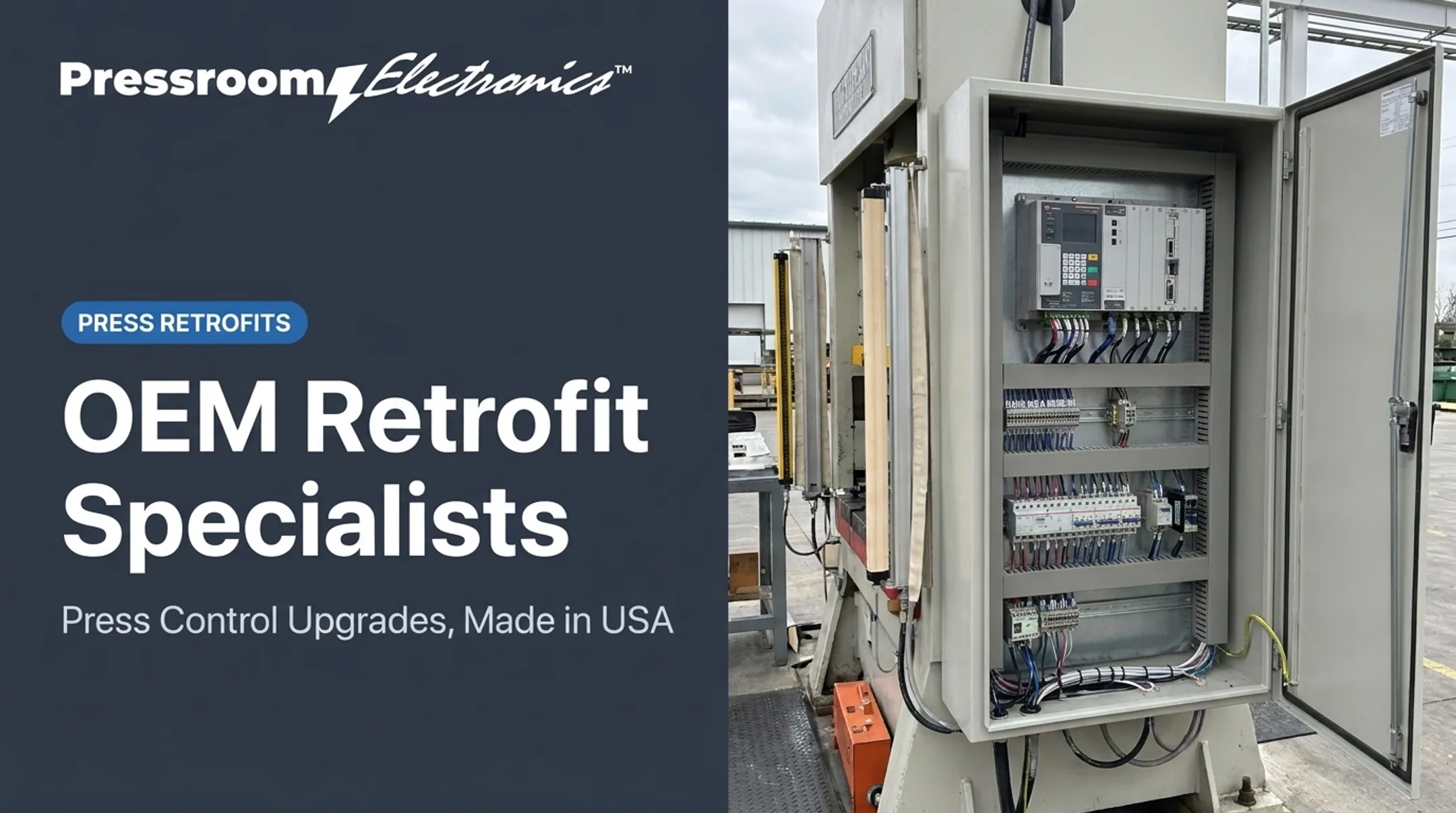
One Indiana stamper reported that older controls made desired die-protection additions difficult. Schedule retrofits during planned downtime and cover:
- Compatibility review and backup documentation
- Operator training
- Commissioning and validation by qualified personnel before production resumes
Use Programmable Controls and Production Data to Improve Diagnosis
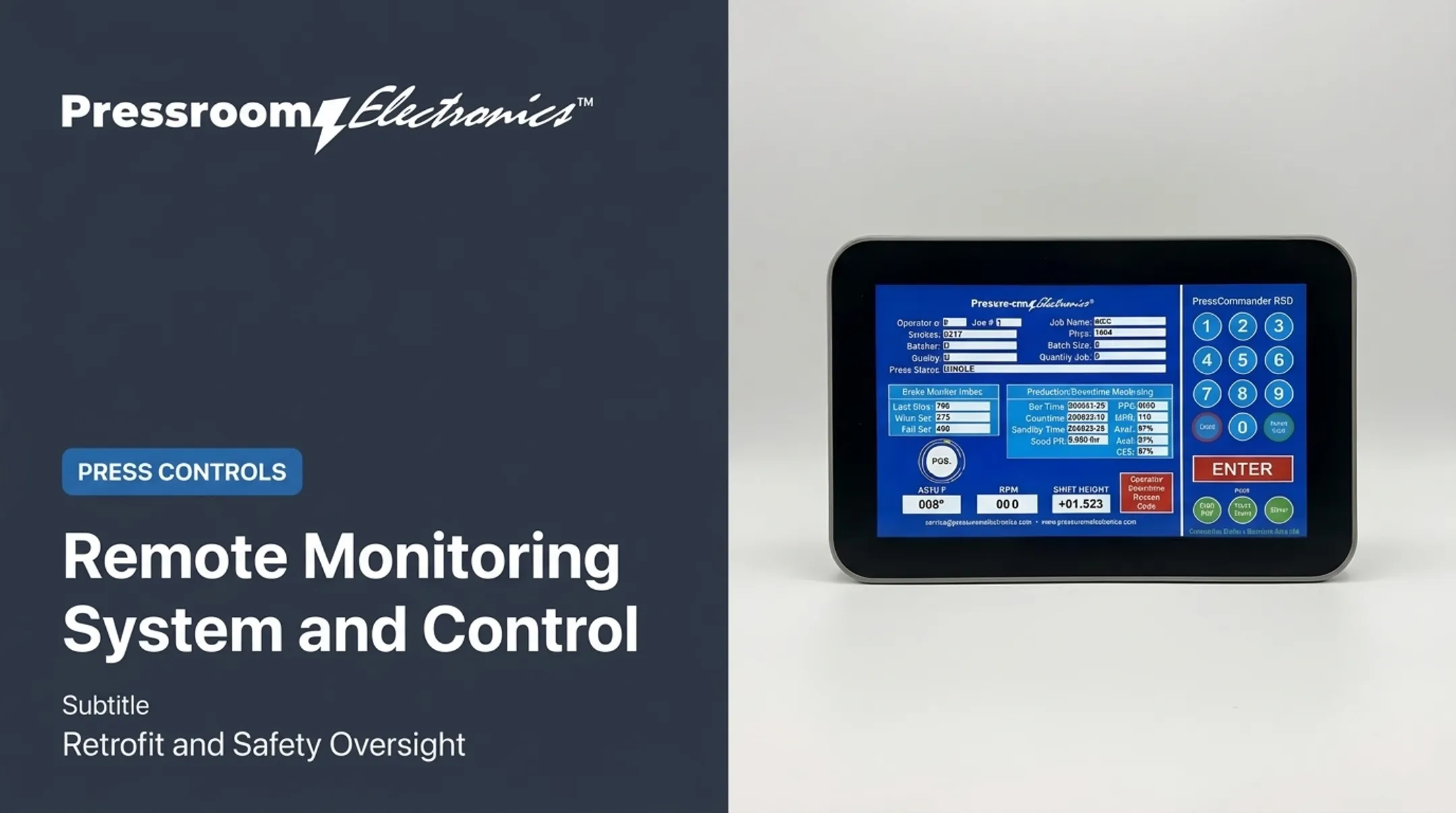
Programmable reason codes and logged history connect a stop to the job, shift, alarm, and corrective action. Pressroom Electronics' PressCommander supports up to 24 editable reason codes (30 characters each). With an interface board, it can trigger codes automatically from:
- Die protection
- Tonnage monitoring
- Shortfeed and misfeed signals
Logs export to Excel for Pareto charts.
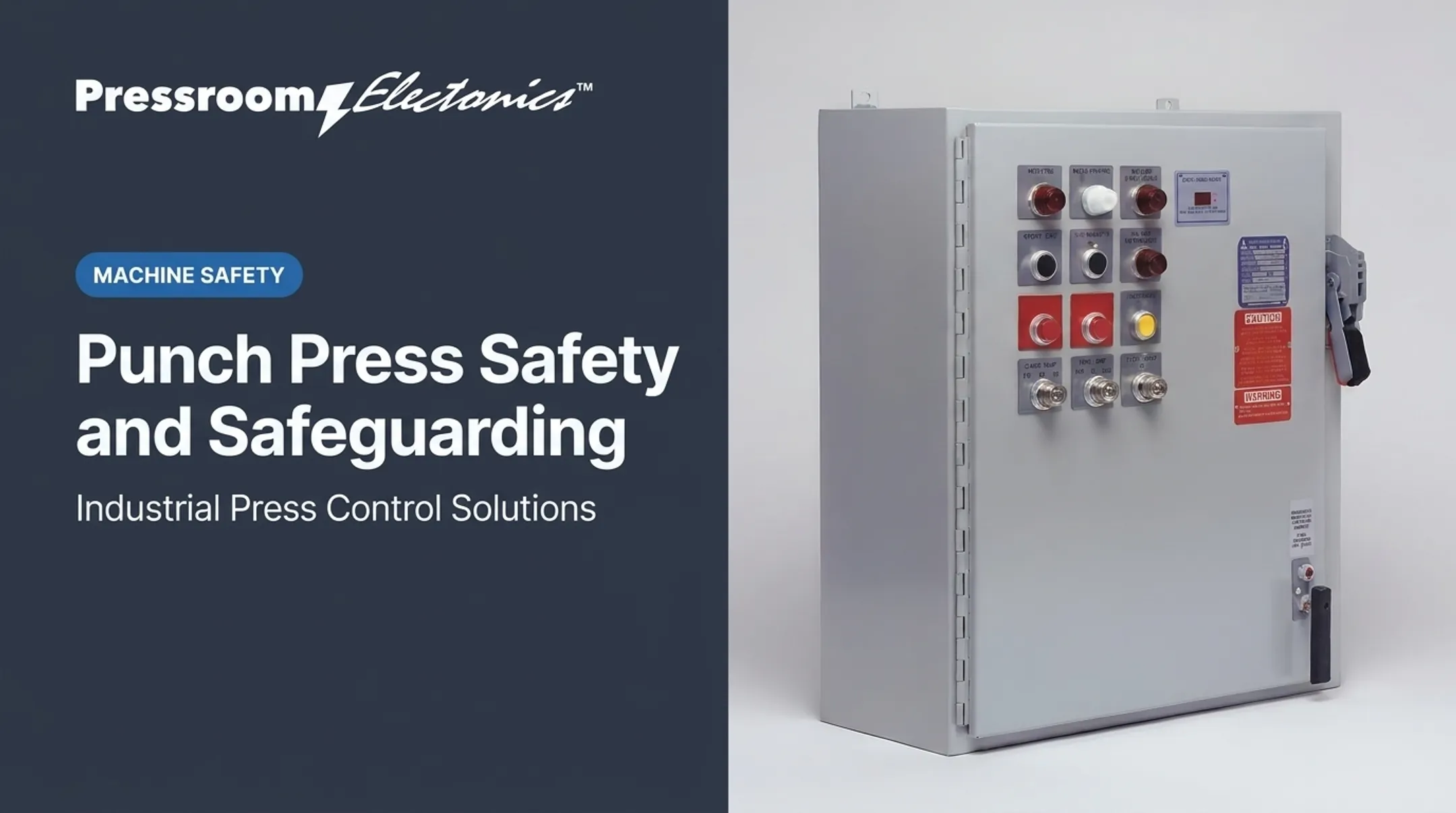
Pressroom Electronics also makes time-based brake monitors, PressCam 8 die-protection and limit-switch controllers, and light curtains. Confirm application fit, integration, and safety requirements with the manufacturer before choosing any system.
Make Safety Part of Downtime Reduction
A fast restart isn't a recovery if the cause is unknown or the press is unsafe. Cover lockout/tagout, guarding, brake performance, two-hand or presence-sensing safeguards where applicable, and documented restart authorization.
Review OSHA 1910.217 and 1910.147 and the relevant ANSI B11 standards for each machine, retrofit, and workplace. OSHA's brake-monitor requirement, for example, depends on specific feeding and safeguarding conditions. No single control automatically makes a press compliant.
Build a Faster, Safer Response and Improvement Loop
Create a Standard Response Workflow
- Identify and safely contain the stop.
- Make the stopped machine and reason visible on the floor.
- Assign ownership to the right role.
- Escalate based on duration or risk.
- Diagnose the fault before any restart attempt.
- Document the action taken and parts used.
- Verify a controlled restart.

Define escalation triggers for safety concerns, repeated faults, tooling risk, quality deviations, and constraint stops. Spell out what operators may handle and what needs maintenance or engineering.
Reduce Mean Time to Repair Without Guesswork
Technicians lose time hunting for information. Keep fault histories, schematics, troubleshooting guides, spare-parts lists, and repair checklists within reach. Plain-language fault messages cut search time further.
Record arrival, diagnosis, repair, and restart times, plus parts used and follow-ups. That way MTTR reflects the full recovery, not only hands-on wrench time.
Improve Shift-to-Shift Communication
Structured handoffs should list unresolved faults, temporary measures, parts on order, tooling condition, production risk, and inspections required before restart. Industry best practice calls for face-to-face, two-way exchange with written backup.
Shared dashboards and shift boards put maintenance, production, engineering, quality, and safety on the same event history.
Close the Loop with Continuous Improvement
Review the highest-impact causes regularly. Give each action an owner, due date, expected result, and verification method. Then update PM tasks, spare-parts plans, training, settings, alarm thresholds, and reason codes so gains don't rely on individual memory.
Put the Plan Into Action
Establish a Baseline and Pick a Focused Starting Point
Choose a defined measurement period and a few critical machines or constraints. Compare downtime by frequency, duration, cost, safety risk, quality impact, and recurrence.
Validate the data with operators and maintenance staff before setting targets. Bad reason codes and missing short stops will point the effort the wrong way.
Prioritize by Prevention, Recovery, and Risk
- Prevent stops: maintenance, modernization, training, better sensing
- Shorten recovery: diagnostics, spare parts, escalation, standard troubleshooting
- Control risk: safety and quality exposures, high-severity failures first
Start with repeated losses and unacceptable safety or quality risks. Document temporary containment separately from permanent corrective action.
Sustain and Scale the Program
Set a review cadence, owners, leading and lagging measures, and audits of whether reason codes, maintenance tasks, and response procedures are followed. Pressroom Electronics supports a four-phase monitoring rollout, from understanding the mechanics to continuous improvement, backed by daily review meetings.
Downtime reduction is an operating discipline. Measure accurately, act on the biggest losses, verify results, standardize fixes, and extend what works to comparable presses and lines.
Frequently Asked Questions
How can I reduce machine downtime?
Track events accurately, find root causes, shift to proactive maintenance, and train operators. Add real-time monitoring and recover faster without skipping safety steps.
How do you calculate machine downtime?
Divide downtime within planned production time by planned production time, then multiply by 100. Define planned time first. Downtime percentage is not downtime cost, which needs labor, scrap, and lost margin added.
What does machine downtime mean?
It is time when equipment is unavailable for scheduled production. It splits into planned and unplanned downtime.
What is the difference between planned and unplanned machine downtime?
Planned downtime is scheduled and prepared for, such as maintenance or setup. Unplanned downtime hits unexpectedly and should be analyzed for prevention or faster recovery.
How can machine controls help prevent press downtime?
Controls give fault visibility, programmable reason codes, brake monitoring, die protection, guarding, and production tracking. Each safety function still needs application-specific validation.