The stakes are real. A 2024 Applied Ergonomics study of OSHA Severe Injury Reports found 54 stationary-robot accidents causing 66 injuries from 2015 to 2022, mostly finger amputations and head or torso fractures.
This article covers fixed machine-cell guarding, not mobile security patrol robots. We walk through risk assessment, US standards, guarding components, controls integration, and ongoing verification.
Key Takeaways
- Start with a documented risk assessment covering reach, tooling, material flow, maintenance, and every access point.
- A fence is one layer; interlocks, sensing, safe logic, resets, and lockout/tagout must work together.
- Verify current OSHA, ANSI/A3, and ISO requirements instead of copying generic dimensions.
- Good guarding avoids workarounds, blind spots, and blocked maintenance access.
How Robot Perimeter Guarding Protects a Machine Cell
Hazards the perimeter must contain
Build the perimeter around the hazards OSHA's Technical Manual lists, plus the ones cells usually add:
- Trapping, crushing, and unexpected motion
- Gripper or tool failures
- Electrical and fluid-power hazards
- Hazardous light, sparks, and noise
- Pinch points, press motion, and conveyors
- Hot or sharp parts, ejected material, and stored energy
Map the full hazardous envelope, not just the robot base:
- Maximum reach, tooling, and payload
- Fixtures and transfer equipment
- Presses, dies, and connected machinery
Who is exposed
The assessment must cover everyone who can reach the cell:
- Operators and material handlers
- Maintenance technicians and programmers
- Cleaners, contractors, supervisors, and visitors
Maintenance and fault-clearing tasks often carry the highest exposure, because people enter the cell.
Guard types compared
- Fixed guards: OSHA's machine guarding eTool describes these as permanent barriers that don't depend on moving parts.
- Interlocked guards: Opening one stops the hazard and inhibits restart until it's restored. Restoring the guard must not restart the equipment.
- Awareness barriers: Chains, ropes, signs, and lights supplement safeguarding. They don't replace physical protection where hazardous access is possible.
The intended safety sequence
- Detect or prevent access.
- Stop hazardous motion.
- Prevent automatic restart.
- Require a deliberate reset.
- Confirm safe conditions, then resume.
Rockwell's published example follows this pattern: door closes, safety relay resets, then an external Start command is given. Closing the door is never the Start.

Why it matters in practice
In the 2016 AJIN USA case, workers entered a robotic cell to clear a sensor fault. An abrupt restart fatally crushed an operator. OSHA reported in 2023 that a judge upheld the majority of violations.
Effective perimeter guarding cuts exposure, controls maintenance access, and makes informal bypasses harder to sustain.
Guarding Components and Access-Control Devices
Physical Panels and Enclosures
Panel choice depends on what the cell produces and what the operator needs to see.
| Panel type | Best fit |
|---|---|
| Welded or woven mesh | Visibility, airflow, general containment |
| Clear polycarbonate | Process viewing, chip and spark containment |
| Solid steel | Welding light, splash, laser, full enclosure |
Viewing materials must resist the mass and velocity of foreseeable ejected material. Also check:
- Reach-through risk and floor clearance
- Transfer openings and adjacent equipment
- Cleaning and maintenance access needs
ISO 13857:2019 gives conditional tables for openings and distances. They are not universal height or aperture values.
Doors, Gates, and Service Access
Hinged, sliding, lift-up, and service-panel access points should match floor space, material flow, maintenance frequency, and equipment size.
Where opening a door exposes someone to hazardous motion, use safety-rated interlocks. ISO 14119:2024 addresses interlock selection and reducing foreseeable defeat. Where run-down hazards exist, guard locking holds the door until the machine reaches a safe stop.
Presence-Sensing Devices
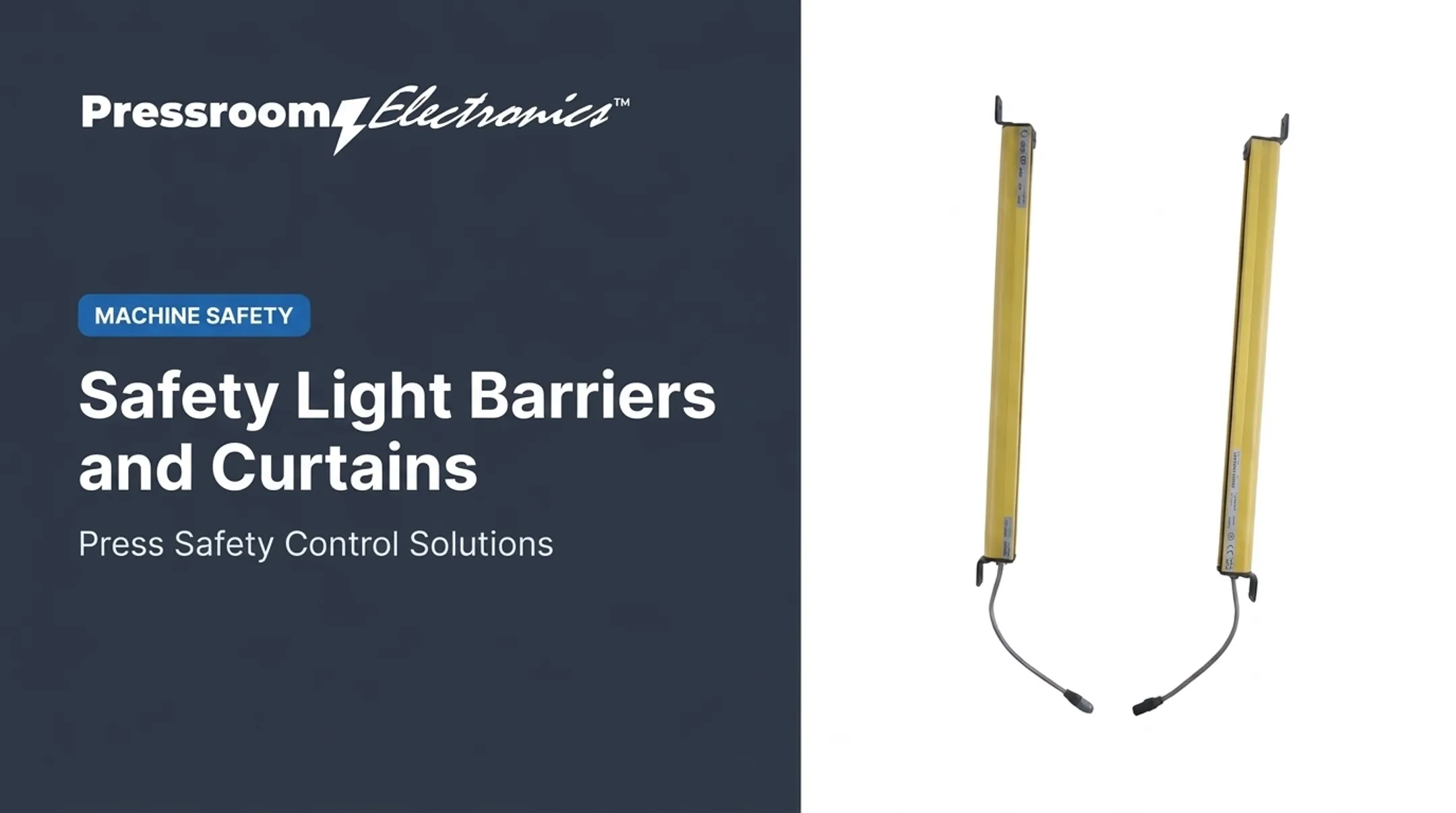
Light curtains, safety mats, and laser scanners can supplement or replace barriers at loading points and frequently accessed areas. IEC 61496 covers the devices themselves, but doesn't dictate cell-specific zone sizes.
Muting, blanking, and bypass are not conveniences. They need a documented risk assessment and validated logic:
- Muting must distinguish material from people and keep other protection active.
- Floating blanking changes detection capability, so safety-distance calculations must reflect it.
- Bypass must stay temporary and supervised, with full protection restored before normal production.
Emergency Stops, Controls, and Warnings
Provide these controls outside the hazard area:
- Labeled, reachable e-stops and pull cords
- Mode selectors and reset stations
- Status lights and audible alerts
E-stops are complementary. They don't replace guards, interlocks, sensing, or energy isolation.
Integration With Machine Controls
Guarding devices connect to safety relays, safety PLCs, robot controllers, press controls, and brake monitors. An ordinary PLC alone can't be relied on for safety stopping, per Rockwell's safety guidance.
Look for monitoring of switch faults and contactor feedback, such as welded contacts, plus separate reset and start functions.
Commissioning checks should confirm:
- Stop response and stopping time
- Interlock operation
- Reset location with the whole hazard area visible
- Control reliability under fault conditions
- Interaction between the robot and connected equipment
US Compliance: Risk Assessment, Standards, and Validation
Which references apply
| Reference | Scope |
|---|---|
| OSHA 1910.212 | General machine guarding |
| OSHA 1910.147 | Lockout/tagout; control-circuit devices aren't energy-isolating devices |
| OSHA 1910.217 | Mechanical power presses |
| ANSI/A3 R15.06-2025 | Robot safety; adopts ISO 10218-1 and -2:2025 |
| ANSI B11.19-2019 | Safeguarding performance |
| ISO 13857:2019 | Safety distances |
ANSI/RIA R15.06-2012 is now historical. Many older documents still cite it, so check editions before you rely on them.
OSHA regulations are enforceable. Consensus and ISO standards aren't OSHA regulations, though they can serve as evidence of recognized practice. Where no specific standard fits, OSHA may use the General Duty Clause. Involve qualified safety professionals and integrators, and follow manufacturer instructions.
The risk-assessment process
ISO 12100 follows an iterative, documented path:
- Define machine limits, functions, and tasks.
- Identify hazards.
- Estimate and evaluate risk.
- Select risk-reduction measures: safe design first, then safeguarding, then information for use.
- Document residual risk.
- Reassess after design or process changes.
Determine dimensions per cell
Don't copy a spec. Safety distances, openings, barrier height, stopping time, and access routes come from the cell's robot reach, hazards, and stopping performance.
B11.19 uses a formula (DS = K × (TS + TC + Tr + Gamma)) that builds in stopping time and response. Press stopping time under 1910.217 is measured at about 90 degrees of crankshaft rotation.
Validate before release
Test every interlock, e-stop, light curtain, mat, scanner, and reset. Include fault conditions, restart prevention, stopping performance, and connected machines. Never release a cell until guards and devices are installed and tested.

Keep these records
- Risk assessments and residual-risk notes
- Electrical and safety-circuit drawings
- Validation results
- Operating procedures and training records
- Inspection logs and modification history
Designing a Perimeter for Real Production Workflows
Lay out around the work
Plan the perimeter around how the cell actually runs:
- Robot reach and tooling sweep
- Loading, unloading, and conveyor paths
- Forklift or cart traffic
- Emergency egress and room for repairs
- Operator sightlines
Guards shouldn't create new hazards or block necessary viewing. Cameras can cover distant sightlines when a direct view isn't practical.
Escape releases should open from inside without tools. During reset, the whole hazardous area must be visible.
Let the environment pick the panel
- Welding arc light: opaque or filtered panels
- Laser energy: enclosures rated for the beam
- Chips, hot parts, splash: impact-resistant viewing panels
- Washdown: water-jet-resistant, sloped surfaces that don't pool residue
Design failures to prevent
- Climbable or bypassable panels
- Unprotected gaps
- Blind access points and blocked exits
- Inaccessible resets
- Poorly positioned interlocks
The Getrag investigation in 2004 shows the risk. A worker died in a fenced cell with interlocked gates, and OSHA said entry may have involved climbing the fence or crawling through conveyor openings.
Pilz notes defeat is driven by speed pressure, convenience, poor ergonomics, and simplified operating modes. If a step is slow or awkward, people will go around it.
Implementation, Maintenance, and Integration Checklist
Implementation sequence
- Site survey and risk assessment
- Guarding design
- Control-system integration
- Installation
- Validation
- Operator training
- Production handoff
Document cell drawings, safety circuits, procedures, and approved operating modes.

Recurring checks
Inspect these items on a set schedule:
- Panels, fasteners, doors, and interlocks
- E-stops, light curtains, mats, and scanners
- Warning devices, reset stations, and signs
- Stopping performance
Repeat checks after repairs, incidents, process changes, or control modifications.
Intervals depend on the equipment. OSHA's Technical Manual points to manufacturer recommendations for robots, while 1910.217 requires at least weekly inspection of press clutch/brake and related components. Lockout/tagout procedures need review at least annually.
Where Pressroom Electronics fits
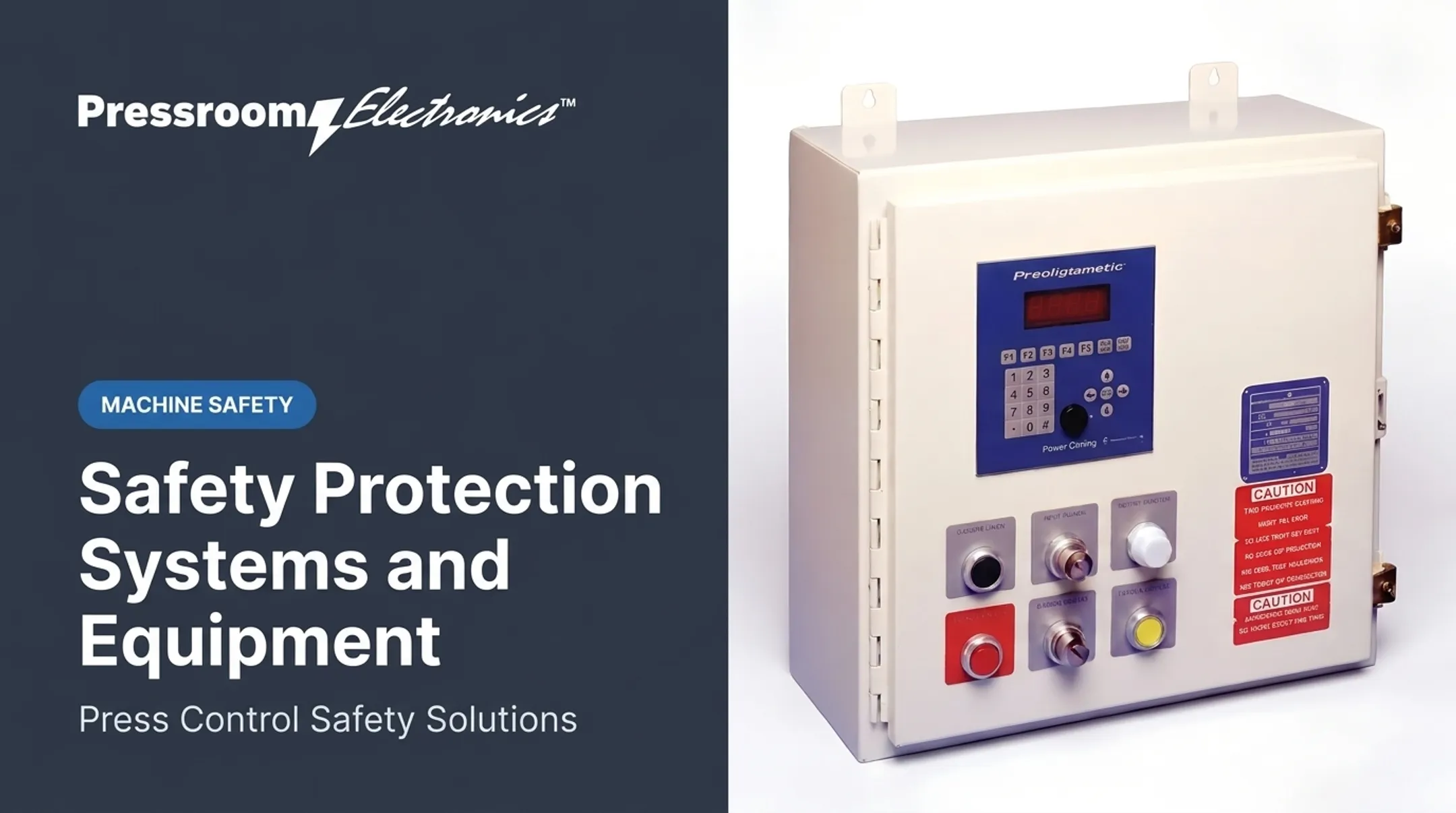
For metal-stamping and forming operations, Pressroom Electronics makes press controls, light curtains, safety mats, UltraTouch palm buttons, brake monitoring, die protection, and production monitoring. Its Model PPG is a free-standing, two-pylon perimeter light curtain with monitored safety relays and a reset button on the receiver pylon.
Evaluate them when connecting light curtains, mats, or palm-button stations to a press or machine-cell safety architecture. Confirm product compatibility and application requirements with Pressroom Electronics, since suitability depends on other equipment the company does not supply.
Frequently Asked Questions
What is robot perimeter guarding?
It's the physical and engineered safeguards around an industrial robot or machine cell. That includes barriers, interlocked access, sensing, safety controls, and warnings, not fencing alone.
Is a physical fence always required around a robot cell?
No. The safeguard depends on the documented risk assessment, application, access needs, and applicable standards. OSHA lists fixed guards, interlocked guards, and presence sensing as options.
What devices should be used with robot perimeter guarding?
Typical combinations include interlocked doors, light curtains, mats or scanners, e-stops, safety relays or PLCs, reset stations, and warning lights. The mix depends on the cell's hazards.
What OSHA and ANSI standards apply to robotic machine guarding in the US?
Key references include OSHA 1910.212 and 1910.147, ANSI/A3 R15.06-2025, ISO 13857, and ANSI B11.19-2019. Verify current editions and scope with a qualified safety professional.
How do I choose between wire mesh, polycarbonate, and solid panels?
Compare visibility, containment, impact resistance, sparks, welding light, lasers, cleaning, and environment. The risk assessment makes the final call.
How often should robot guarding and safety devices be inspected?
Document pre-operation and periodic inspections suited to the application, following manufacturer guidance. Add checks after maintenance, incidents, or system changes.