Introduction
Manufacturing accounts for 1,348 amputations, or 55.6% of the 2,426 reported to federal OSHA in 2024, according to OSHA's 2024 report. That covers federal-jurisdiction employers only, so it understates the national picture.
Behind each number sit an injured worker, a damaged machine, lost production, a workers' compensation claim and often an OSHA inspection. Lockout/tagout and machine guarding both sit in OSHA's FY2026 top 10 most-cited standards so far.
Guarding and electrical safety work as a pair. Guards and enclosures limit access to live parts and danger zones. Isolation, inspection, training and maintenance cover what barriers can't.
Key Takeaways
- Guards must block contact with live parts without blocking working space or emergency access.
- Stopping a machine is not isolation; lockout/tagout and voltage verification still apply.
- Inspect guards, interlocks, light curtains and E-stops before use and after any change.
- Never bypass a safeguard or run equipment showing exposed conductors, heat or arcing.
- Choose PPE from a task-specific hazard assessment.
Safety Guidelines for Electrical Safety and Guarding
Safeguarding combines design, physical barriers, safe work practices, qualified maintenance, inspection and training. No single layer is enough.
The hazards are broad:
- Electric shock, electrocution and burns
- Arc flash and arc blast, which OSHA says can be catastrophic even at 120/208 V
- Fire
- Unexpected machine movement, crushing, shearing and entanglement
- Damage from impact or contamination
Safety depends on configuration and behavior. Equipment must be designed and guarded properly, and workers must follow operating, isolation and reporting procedures. It is also an ongoing program. Any change to presses, controls, guarding, wiring or layout requires a fresh safety review.
General Safety Precautions
PPE. Select it from a documented hazard assessment under 1910.132(d), matched to the task. Depending on the work, that may mean eye and face protection, safety footwear, hearing protection, arc-rated clothing, voltage-rated gloves or insulating equipment. Not every item applies to every job.
Workspace. Keep panels and disconnects accessible. Per 1910.303(g), required working space can't be used for storage, and access and lighting must be adequate. Control trip hazards around equipment, and shield panels from forklifts, carts and stock.
Cords, cables and covers. Inspect portable cord-and-plug equipment and flexible cords before use on each shift (1910.334). Remove damaged items from service. Skip makeshift repairs, and keep moisture, conductive debris and metal particles away from electrical gear.
Authorization. Workers should know their labels, disconnects, E-stops and warning signs, and the limits of their authorization. Unqualified personnel report defects. They don't open enclosures.
Safety During Installation
Installation hazards include:
- Contact with energized conductors
- Incorrect wiring, poor grounding or bonding
- Unexpected startup and stored mechanical energy
- Lifting injuries
- Placement that blocks future maintenance
Site Preparation
- Review electrical drawings and manufacturer instructions
- Confirm the disconnecting means
- Set up a safe work zone
- Verify mounting and guarding locations
- Preserve access around panels and controls
Isolation and Verification
Follow the 1910.147(d) sequence:
- Prepare for shutdown
- Shut down the equipment
- Isolate energy sources
- Apply lockout/tagout
- Relieve stored energy
- Verify isolation

Under 1910.333, a qualified person verifies de-energization, including tests for induced voltage or backfeed. Use properly rated test instruments, check each phase, and confirm the tester on a known source before and after.
Qualified work means training and demonstrated skill with the specific equipment and its hazards (1910.399).
When to Stop
Stop installation if:
- Drawings are incomplete or equipment identity is uncertain
- Conductors or enclosures are damaged
- Grounding is questionable
- Guarding interferes with required access
- No approved safe-work procedure covers the task
Post-Installation Checks
Before returning equipment to production, verify:
- Wiring, covers, barriers and interlocks
- E-stops and control functions
- Grounding and labels
- Machine behavior under normal operation
Safety While Using or Operating Electrical Equipment and Guarded Machinery
Pre-Start Checks
Test the whole safety system at the start of every shift, following the manufacturer's procedure. That includes:
- Press controls, enclosures, access doors and interlocks
- Light curtains, palm-button stations and two-hand controls
- E-stops, brake monitors and die-protection devices
For mechanical power presses, OSHA 1910.217(e) also requires periodic inspections and component checks at least weekly, with repairs made before operation.
Stop-Work Warning Signs
Stop and report:
- Exposed wiring or loose, missing covers
- Damaged guards or failed interlocks
- Repeated control faults, nuisance trips or unexpected motion
- Heat, odor, smoke or arcing
- Inconsistent stopping performance
Never Bypass Safeguards
Taping down, wedging open or defeating a guard, interlock, light curtain or E-stop to keep production moving is how serious injuries happen. OSHA reported that a first-day employee lost three fingers on a press brake after light curtains were deliberately bypassed.
Matching Safeguards to the Press
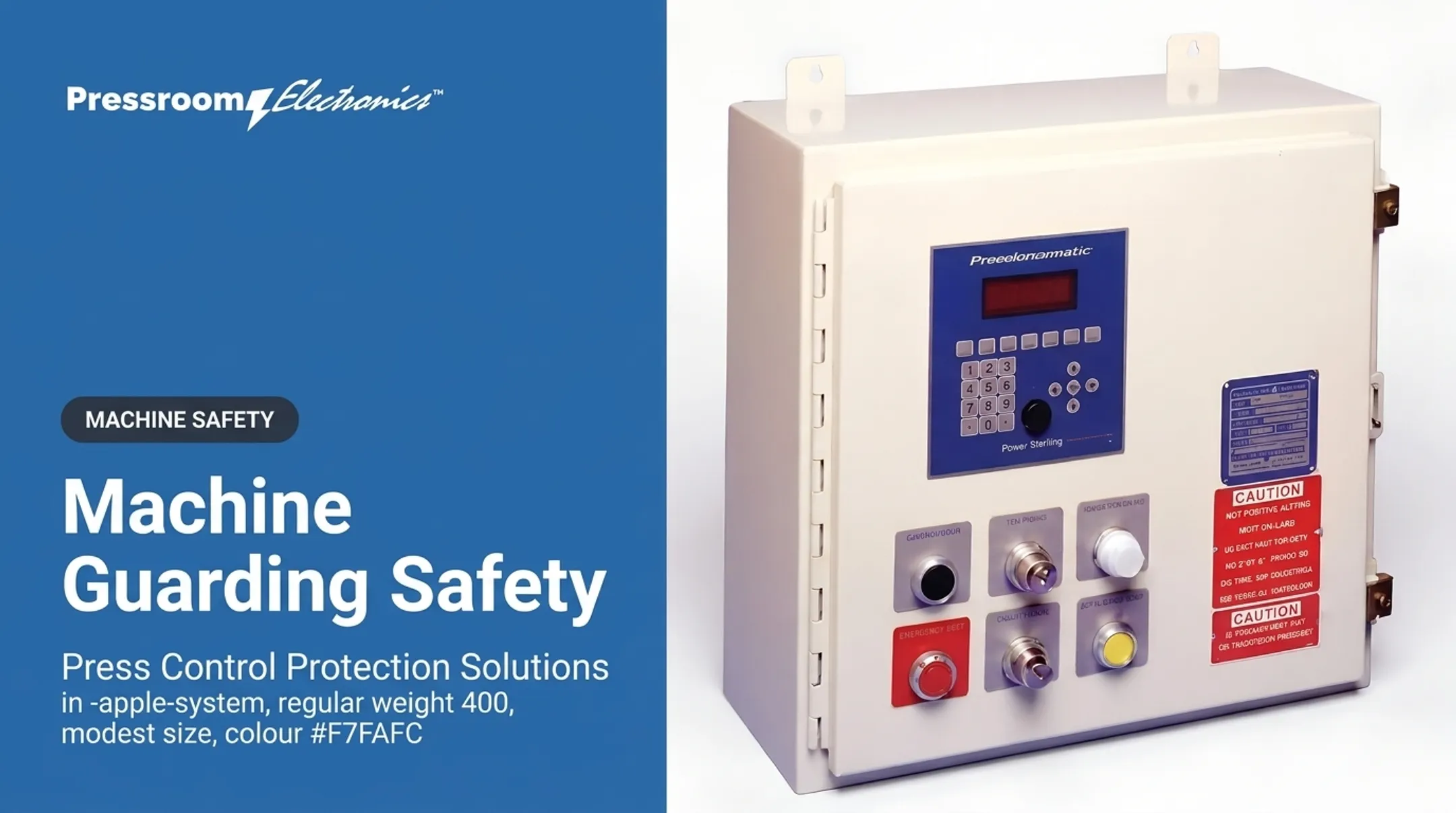
Configure devices to the press, tooling, access points, cycle and maintenance needs. Pressroom Electronics, for example, builds press controls with brake monitoring, such as the LT-1900, which prevents a successive stroke when stopping performance exceeds its setpoint. Paired with light curtains, mats or palm buttons, that gives layered protection when specified and integrated correctly.

Operator Limits
Until the machine is in its required safe state and an authorized procedure permits the work, operators must not:
- Open enclosures
- Repeatedly reset unexplained faults
- Reach into the point of operation
- Clear jams or adjust equipment
Environmental and System Safety Considerations
How the Environment Degrades Equipment
These conditions wear down enclosures, wiring, connectors, guards and safety devices:
- Moisture and condensation
- Metal dust and conductive debris
- Heat, vibration and corrosive substances
- Poor ventilation and vehicle impact
Siemens' switchboard manual lists dust, fumes, vibration, humidity and temperature extremes as reasons for more frequent maintenance.

Enclosure Suitability
Under 1910.303(b), equipment exposed to dampness, deteriorating agents or excessive heat must be identified for that environment. Enclosure types aren't interchangeable:
| Type | Protection described |
|---|---|
| 4 | Windblown dust, rain, splashing and hose-directed water |
| 4X | Type 4 plus corrosion protection |
| 12 | Indoor dust, lint and dripping or light splashing liquids |
| 13 | Indoor dust, fibers, and spraying water, oil and noncorrosive coolants |
Type 12 doesn't equal Type 13 for oil and coolant exposure, so match the rating to the actual location.
Electrical and Mechanical Interactions
These conditions can undermine an otherwise sound guard:
- Unexpected press movement
- Stored pneumatic or hydraulic energy
- Clutch/brake faults
- Tooling changes and control modifications
Isolation must address all of them.
Management of Change
Trigger a documented review before normal operation resumes after:
- Any production change or control upgrade
- Guard relocation or new tooling arrangement
- Repeated safety-device faults
Retraining may also be required under 1910.147(c)(7).
Inspection and Maintenance
Base schedules on:
- Manufacturer guidance
- Site risk assessment
- OSHA requirements
- Standards such as NFPA 70B-2026, now titled Standard for Electrical Equipment Maintenance
Separate visual checks that operators can do from testing that needs qualified personnel.
Common Safety Mistakes to Avoid
- Assuming low voltage or a closed enclosure is safe. Under 1910.333(a)(1), live parts below 50 V may remain energized only if exposure to burns or arc explosion is not increased. Verify voltage, exposure and equipment condition.
- Walling off panels. A barrier that blocks working space, door swing, ventilation or emergency access creates compliance and maintenance hazards.
- Running with a failed safeguard. A dead interlock, brake monitor, light curtain, E-stop or damaged cable raises exposure to shock, unexpected motion, arc events and crushing, and invites unplanned downtime.
- Skipping lockout for "quick" jobs. Pushbuttons, selector switches and interlocks can't be the sole means of de-energization. OSHA's G&S Metal Products case tied 2024 amputations to unexpected press motion during servicing and scrap removal; the minor-servicing exception applies only to routine, repetitive work integral to production, with alternative protection.
- Treating records as paperwork. Recurring faults, near misses and temporary repairs should trigger corrective action and follow-up verification.
Conclusion
Effective protection rests on compatible equipment, appropriate barriers, maintained safety devices, clear working space, qualified electrical work, lockout/tagout, training, and routine inspection. Treat guarding and electrical controls as part of production reliability, not an obstacle to output.
Review your site plan against current OSHA requirements, applicable NFPA standards, and manufacturer instructions, and consult a qualified safety or electrical professional.
Frequently Asked Questions
What is an electrical hazard?
Electrical hazards include shock, electrocution, arc flash, arc blast, burns, fire and unexpected energization. Actual risk depends on exposure, equipment condition, the task and work practices.
What is a fixed wiring inspection?
A fixed wiring inspection is a documented examination of permanent wiring (a term more common in the UK). In the US, the counterpart is NFPA 70B electrical preventive maintenance plus OSHA 1910.303 suitability and installation checks by a qualified person.
What types of PPE are required for electrical work?
Requirements come from the task-specific hazard assessment. Typical options include eye and face protection, arc-rated clothing, voltage-rated gloves, insulating equipment, safety footwear and hearing protection. PPE supplements de-energization and guarding; it does not replace them.
How does guarding reduce electrical risk around industrial machinery?
Enclosures, barriers, covers and controlled-access guards reduce unintended contact with live parts and hazardous zones. Guarding must preserve required access and doesn't eliminate lockout/tagout.
What standards apply to electrical safety and guarding in US manufacturing?
OSHA Subpart S (electrical) and Subpart O (machine guarding, including 1910.217), plus NFPA 70, 70E, 79 and 70B and ANSI B11 standards. Confirm the edition your facility has adopted, not only the latest publisher version.
When should electrical equipment be de-energized and locked out?
Generally before servicing, maintenance, installation, troubleshooting, jam clearing or guard removal when hazardous energy could cause injury. Follow the written procedure; exceptions are narrow.