This guide covers US industrial machine safeguarding for punch presses, forming equipment, robotic cells, and related production machinery. It is not about property or facility security. The sections below walk through planning, components, compliance, validation, and maintenance.
The stakes are real. OSHA's preliminary FY2026 data ranks machine guarding (1910.212) 10th among cited standards, with 1,072 violations, per NSC's summary.
Key Takeaways
- Select guarding through a documented risk assessment that covers every task, not just production.
- A fence is one part of the system; gates, interlocks, stopping controls, and sensing devices often complete it.
- Check openings, reach distances, access routes, and egress against OSHA rules and current consensus standards.
- Validation, training, and recurring inspection protect workers and keep presses running.
What Is Perimeter Guarding?
Perimeter guarding is a physical barrier system around a machine, a group of machines, a robotic cell, or a hazardous process area. It prevents unintended access to the hazard zone. OSHA's robot guidance describes fixed barrier or perimeter guards as preventing access and contact with moving parts.
Perimeter Guard, Machine-Mounted Guard, and Awareness Barrier
- Perimeter guard: surrounds the machine or cell and controls entry.
- Machine-mounted guard: attaches directly to the machine, such as a point-of-operation barrier.
- Awareness barrier: a chain, rope, or sign that warns people but does not physically prevent contact. In a June 10, 2013 interpretation, OSHA said it does not consider these to be guarding under Subpart O.
Machine Perimeter Guarding vs. Facility Perimeter Security
Facility perimeter security protects a property boundary with fences, cameras, access control, and intrusion detection. Machine perimeter guarding controls access to an operating hazard inside the plant. The two use different tools and answer different questions.
Why Perimeter Guarding Matters in Industrial Environments
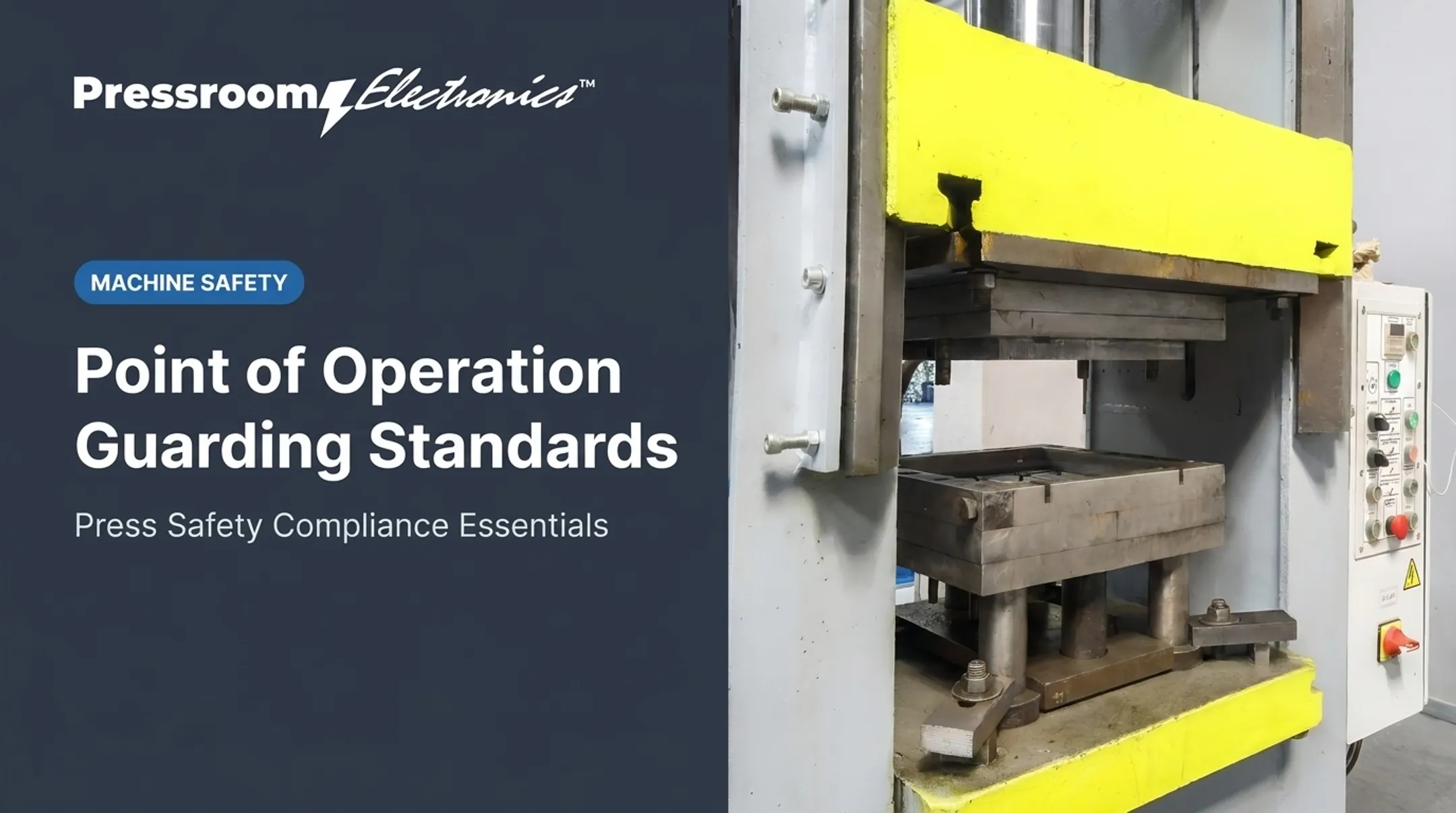
A well-designed barrier reduces exposure to point-of-operation hazards, pinch points, unexpected machine movement, flying material, and collisions with production equipment. On a punch press, the slide closes upper and lower dies while employees insert, hold, or withdraw stock. That is exactly the exposure a barrier is meant to limit.
Operational benefits include:
- Controlled access, so only authorized people enter the cell
- Fewer interruptions from unsafe entry
- Clearer accountability during maintenance
- Protection for expensive tooling and machinery
Injury data underscores the risk. BLS reported 2,050 caught-in or compressed-by cases in fabricated metal product manufacturing in 2020. That figure is historical and is not a perimeter-guard failure rate.
Perimeter guarding does not eliminate every hazard. Pair it with safe work procedures, lockout/tagout, training, and personal protective equipment where required.
How to Plan and Implement Perimeter Guarding
Start With a Risk Assessment and Task Review
Map the machine's hazards and every way people interact with it: normal operation, loading, unloading, setup, adjustment, die changes, troubleshooting, cleaning, and maintenance. OSHA's robot guidance calls for application-specific hazard analysis involving employers and workers. ANSI B11.0 and ISO 12100 offer documented methods.
Ask these questions:
- Can someone reach over, under, around, or through the barrier?
- Can material or debris be ejected?
- Could a forklift or cart strike the guard?
- Could someone remain inside the guarded area during restart?
Select the Guard Layout for the Actual Work Cell
Let the assessment drive decisions on:
- Location, height, and strength
- Panel arrangement and gate positions
- Visibility, walkways, and material flow
- Maintenance access and escape routes
A generic fence layout skips those decisions.
Compare the three section types:
- Fixed sections: Use where nobody needs routine access.
- Secured removable sections: Require tools to open; suited to occasional maintenance.
- Movable access gates: Use when people must enter; interlock them.
Integrate the Barrier With the Machine's Safety Functions
Opening an interlocked gate should initiate a stop and prevent automatic restart until the hazard is controlled and reset conditions are met. OSHA's guard eTool states that replacing an interlocked guard should not automatically restart the machine.
On presses, the barrier may interface with clutch/brake controls, brake monitoring, die protection, light curtains, two-hand controls, and emergency stops. Under 1910.217(c)(2)(iv), an interlocked press barrier must prevent reaching the point of operation before die closure or slide-motion cessation. Validate device selection and stopping performance for the specific machine.
Install, Commission, and Document the System
Cover these installation points:
- Secure anchoring and alignment
- Tamper-resistant fasteners
- Protected wiring
- Correct interlock installation
- Labeled access points
- Fixed sections that cannot be removed without tools
Then document:
- Risk assessment and guard drawings
- Device settings and test results
- Training records and inspection schedule
- Approved procedures
Without them, later maintenance or press modifications can undermine the design.

What Should a Perimeter Guarding System Include?
Fixed Barriers and Structural Components
Rigid panels, mesh, posts, brackets, and anchors form a boundary that survives the plant environment and foreseeable impact. In stamping and forming shops, material choice, corrosion resistance, visibility, smooth edges, and fit with the machine layout all matter. Mesh lets operators and supervisors see the cell.
Access Gates, Doors, and Removable Sections
Minimize access points where practical. Place them for safe workflow, and design them so nobody can casually bypass them, leave them open, or use them as a shortcut through the hazard zone.
Gate hardware to consider:
- Interlock switches
- Guard locking where residual motion warrants it
- Inside-release provisions
- Reset controls placed outside the guarded area
- Measures that prevent unexpected restart after access
Complementary Safeguarding Devices
Several safeguards can supplement a perimeter guard:
- Light curtains and area scanners
- Pressure-sensitive safety mats
- Two-hand or palm-button controls
- Emergency-stop devices and warning indicators
- Lockout/tagout procedures
The right mix depends on the hazard analysis, machine stopping time, access frequency, operator position, material transfer method, and whether people can enter the zone.
For free-standing optical perimeters, Pressroom Electronics' Model PPG is a two-pylon, 110 VAC light curtain system with built-in monitored safety relays, offered in guarded zones of 4 to 64 inches.
Press Controls and Monitoring for Stamping Applications
Evaluate the barrier as part of the complete press safety system, not as an isolated fence. That matters most on aging mechanical punch presses and rebuilt equipment.
OSHA 1910.217(b)(14) requires brake monitoring that checks performance on each stroke and prevents a successive stroke when stopping performance deteriorates.
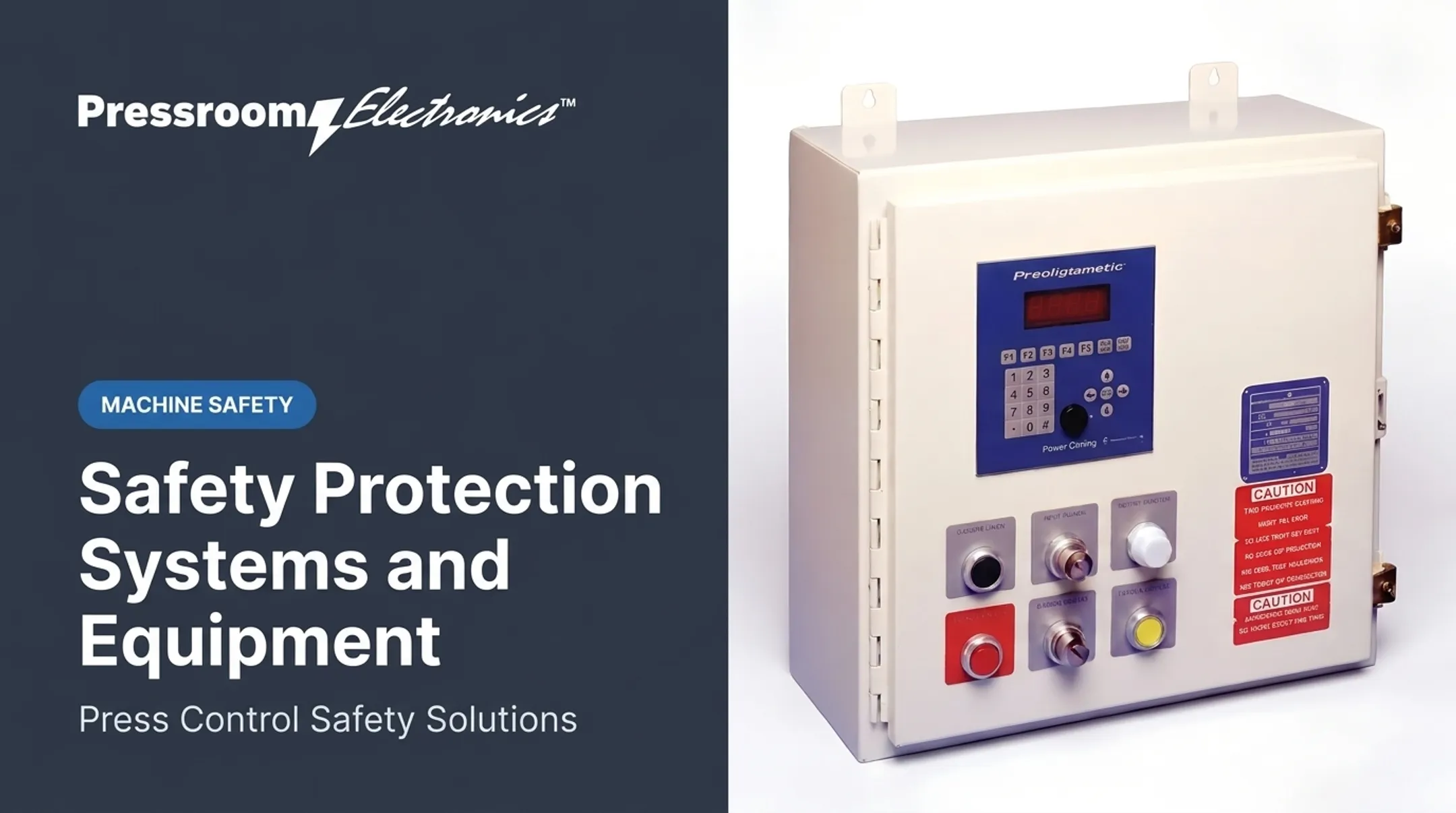
Pressroom Electronics integrates press controls, brake monitoring, die protection, guarding, and production monitoring, so plant teams can coordinate safeguarding with machine operation. Confirm the exact configuration for your press before relying on any specific function.
Design Details That Reduce Bypass and Usability Problems
Check guard openings, reach distances, line of sight, control access, material transfer openings, and housekeeping clearances. Guard against climbing, crawling, reaching, and interlock defeat.
Usability is a safety issue. A German IFA/DGUV survey of safety professionals linked difficult setup, troubleshooting, and cleaning to incentives to bypass safeguards. If a gate slows the job, someone will eventually defeat it. Design for workflow from the start.

How to Verify, Maintain, and Improve the Guarding System
Check Applicable US Requirements and Consensus Standards
Separate enforceable rules from voluntary standards. OSHA says national consensus standards are not OSHA regulations.
- 29 CFR 1910.212: general machine guarding, covering point-of-operation, nip-point, rotating-part, and flying-chip hazards.
- 29 CFR 1910.217: mechanical power presses. It excludes press brakes and hydraulic and pneumatic presses.
- ANSI B11.19: 2019 (R2024), performance requirements for risk-reduction measures.
- ANSI B11.1: 2009 (R2020), mechanical power presses.
- ANSI/A3 R15.06-2025: current robot safety standard, revising the 2012 edition.
OSHA has no specific standards for the robotics industry, so robot cells rely on 1910.212 and consensus standards. Table O-10 sets guard-opening limits for mechanical presses only. For example, an opening 2-1/2 to 3-1/2 inches from the hazard may be no wider than 1/2 inch.
Involve qualified safety professionals and confirm requirements for your equipment.
Validate Safety Performance Before Production Use
Run this commissioning checklist before production:
- Confirm guard stability and panel openings.
- Test for reach-through risks from every side.
- Operate each gate and confirm interlock function.
- Test fault detection and emergency stops.
- Verify reset behavior and unexpected-restart prevention.
- Record results and finish corrective actions.
Safety distances rest on actual response characteristics. Under 1910.217(c)(3), Ds > 63 inches/second × Ts, with stopping time measured at about 90 degrees of crankshaft rotation.
Measure stopping time with a stop-time device. Recalculate when brake wear, tooling, or the stop sensor changes.
Inspect and Maintain the Barrier and Safety Devices
Schedule inspections for:
- Loose or damaged panels and bent frames
- Missing fasteners and worn hinges
- Defeated or misaligned interlocks
- Damaged cables and blocked escape routes
- Changed openings and unauthorized modifications
OSHA 1910.217(e) requires periodic inspection of press parts and safeguards, plus at least weekly testing of clutch/brake, antirepeat, and single-stroke mechanisms. Records need the date, signature, and press identifier. Presses meeting (b)(13) and (b)(14) are excepted from the weekly directed inspection.
Build the rest of the program around these practices:
- Use written checklists
- Test devices per manufacturer instructions
- Tag out defective equipment
- Revalidate after any machine, tooling, software, or layout change
Use Incident and Downtime Information to Improve Safeguarding
Review near misses, repeated access violations, nuisance trips, bypass attempts, maintenance delays, and unplanned stops. OSHA advises investigating to find root causes, not to assign blame.
Programmable reason codes and production tracking help separate safety stops from equipment faults and expose recurring causes. Pressroom Electronics offers downtime monitoring built around this approach. A CDC-published program of small metal fabricators raised average machine safety scores from 73% to 79%. Use that as evidence that audits improve safeguarding, not as proof of fewer injuries or less downtime.

Conclusion: Build a Safer, More Productive Pressroom
Effective perimeter guarding is a complete strategy: risk assessment, physical barriers, controlled access, integrated safety functions, validation, training, and ongoing inspection. A fence alone covers only the first piece.
Press manufacturers, rebuilders, stamping plants, and safety teams can review their press controls and guarding requirements with Pressroom Electronics. The company designs and manufactures customized pressroom controls and automation in the USA. Call (412) 262-1115 to start the conversation.
Frequently Asked Questions
How do you secure a perimeter?
An industrial machine perimeter is secured with fixed barriers, controlled access gates, interlocks, suitable safety devices, validated stopping functions, procedures, and inspections, all chosen by risk assessment. Facility perimeter security uses different technologies.
What does 'perimeter security' mean?
It means measures that protect a boundary from unauthorized access or intrusion, usually around a building or property. Machine perimeter guarding instead keeps people away from an active hazard.
What are the three levels of perimeter security?
There is no universal model. One Security Magazine article describes a three-level entrance strategy of deterrence, detection, and prevention, while another uses four layers. Treat each as a source-specific framework, not a machine-safeguarding standard.
What are the five Ds of perimeter security?
Deter, detect, deny, delay, and defend, as described in Security Magazine. They are physical-security principles and do not replace a machine-specific risk assessment.
What is the difference between perimeter guarding and machine guarding?
Perimeter guarding surrounds a machine or work cell. Machine guarding is broader and includes point-of-operation guards, presence-sensing devices, controls, and other measures mounted on or connected to the machine.
Does perimeter guarding replace interlocks or other safeguarding devices?
No. A fence alone may not control access or stop hazardous motion when entry is required. Interlocks, presence sensing, emergency stops, and lockout/tagout may be necessary based on your documented risk assessment.