Machine guarding stays a persistent trouble spot in U.S. plants. Final FY2025 OSHA data put 29 CFR 1910.212 at 1,498 violations, tenth on the Top 10 list. That figure covers guarding in general, not light curtains specifically.
Safety light barriers and curtains are electro-sensitive protective devices. They project an invisible detection field and can signal a machine to stop when something interrupts it. They are one part of a safeguarding system, not a standalone compliance fix. This guide covers barrier versus curtain differences, operation, Type 2 versus Type 4, standards, installation, and cost.
Key Takeaways
- An emitter, receiver, and safety-rated outputs detect access without a physical gate.
- Selection starts with the hazard and access pattern, then resolution, height, range, and response time.
- Pick Type 2 or Type 4 from a documented risk assessment, not by grabbing the higher class.
- Mounting distance, reset logic, testing, and control integration decide real-world protection.
What Are Safety Light Barriers and Curtains?
A safety light curtain is a photoelectric device with an emitter and a receiver that form monitored infrared beams. Standards call this equipment ESPE (electro-sensitive protective equipment). Light curtains are one type of active optoelectronic protective device (AOPD). Ordinary optical sensors are not safety devices and don't belong in this category.
Terminology varies by manufacturer. Generally:
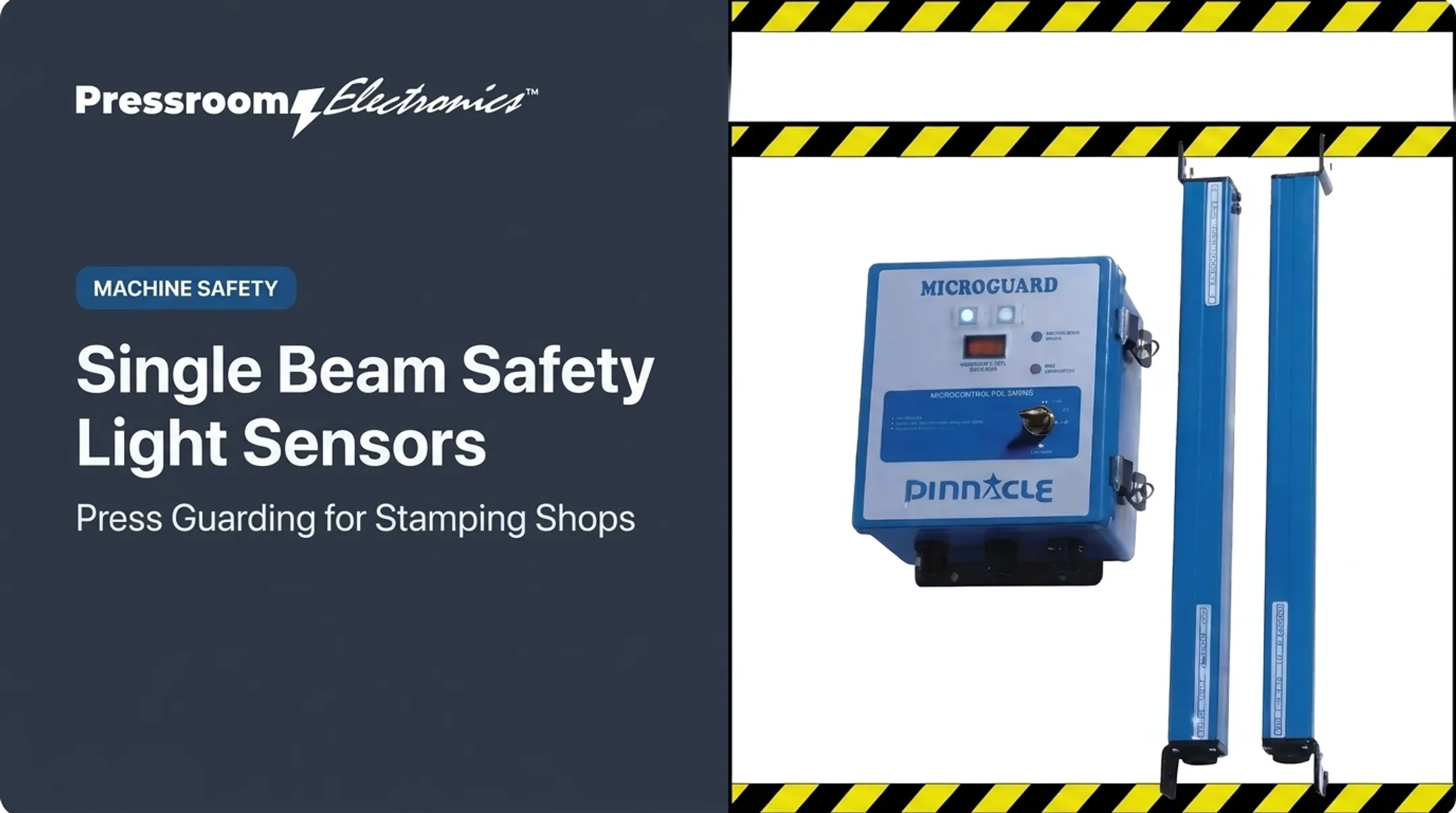
- Light barrier: a single-beam or multi-beam arrangement, often for body detection at an access point
- Light curtain: a dense field of closely spaced beams that detects fingers, hands, or arms across an opening
How a Light Barrier Differs From a Light Curtain
Barriers and curtains map to different protection jobs:
- Point-of-operation protection guards the working area of a press
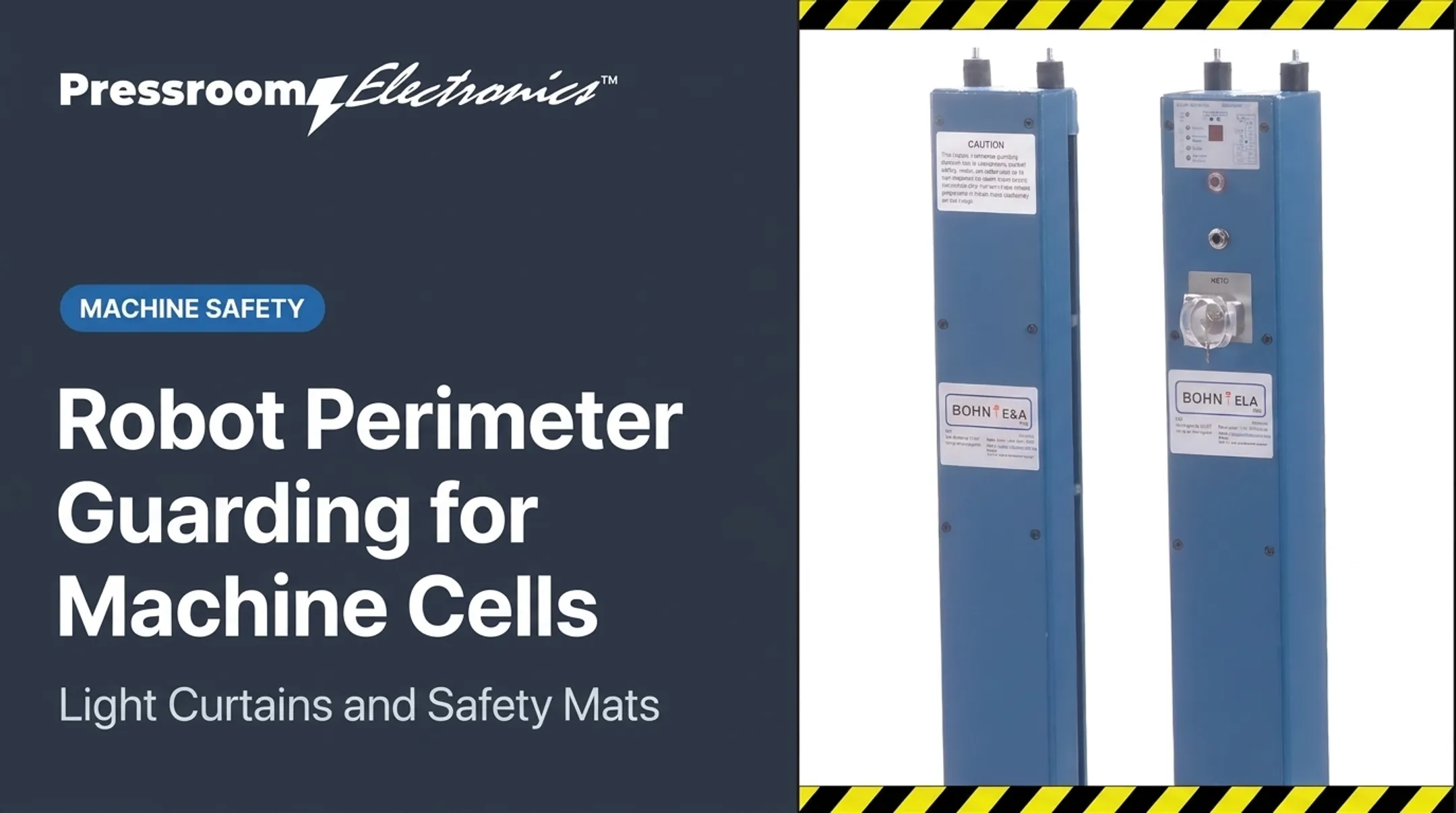
- Access protection covers a defined opening, such as a robot cell entry or conveyor pass-through
- Perimeter protection surrounds a larger zone
Pilz describes multi-beam barriers for body protection at access points such as robot cells and conveyors. Fine-resolution curtains suit hand and finger protection.
The right device also depends on how a person could reach the hazard:
- Reaching over, under, or around the field
- Stepping through and standing behind it, undetected
- Approaching from an angle the field doesn't cover
Each path needs a separate answer. Resolution alone won't close them.
How Safety Light Barriers and Curtains Work
The Basic Detection and Stop Sequence
The emitter sends beams to the receiver. When an object blocks them, the receiver switches its safety outputs (OSSDs) off. A safety relay, safety controller, or the machine's control circuit reads that change and removes power or commands a stop.

Pressroom Electronics' guidance for presses calls for at least two captive-contact safety outputs wired in series. The contacts open when the curtain is blocked or loses power.
Two restart modes are common:
- Automatic restart: outputs return when the field clears
- Manual reset: outputs stay off until someone deliberately resets
Reset must never allow motion while a person could still be inside the hazard zone. Banner's manual also requires a separate machine-start action beyond the device returning to run.
Applications in Presses and Industrial Machinery
Light curtains guard mechanical presses, press brakes, stamping lines, robot-welding cells, turntables, and conveyor openings. They let operators load and unload without opening a gate.
On mechanical power presses, OSHA 1910.217(c)(3)(iii) covers presence-sensing devices. Three limits apply:
- Guards are still required on every entry area the device doesn't protect
- Full-revolution-clutch presses can't use presence sensing as guarding
- Ordinary presence sensing can't initiate slide motion, except under the paragraph (h) PSDI rules
Faster access doesn't remove the need to verify stopping performance.
Safety Functions That Affect Productivity
Several functions support production flow when designed and validated properly:
- External device monitoring (EDM): checks the machine's primary control elements
- Beam coding: reduces interference between nearby curtains
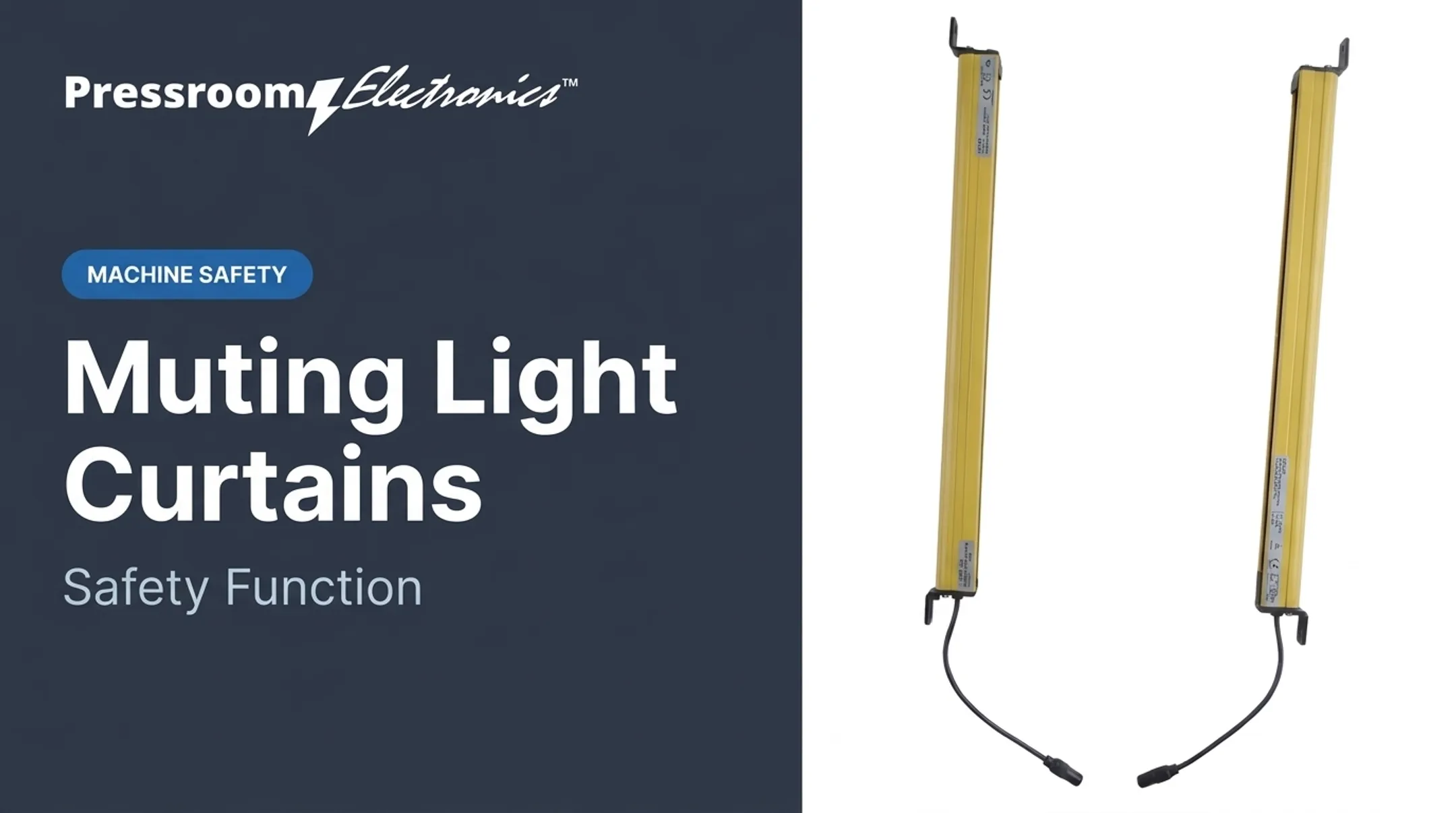
- Muting: automatically suspends protection during a non-hazardous part of the cycle
- Blanking: ignores a set object (fixed) or lets disabled beams follow material (floating)
Controlled muting suspends protection only during non-hazardous cycle segments while personnel safeguards stay active. Rockwell's material-transfer example uses four sensors so material can pass without exposing people. Muting must end only when no undetected person remains.
Floating blanking can leave unguarded gaps, so validate it carefully.
On presses, OSHA permits muting during the upstroke for parts ejection, circuit checking, and feeding. Pressroom Electronics' #130 Mute-Out mutes a light guard from ¼ inch before bottom of stroke through top dead center, using cross-checked limit switches.
How to Choose the Right Safety Light Curtain or Barrier
Start With a Machine Risk Assessment
Begin with the hazard, not a catalog. Document:
- Hazardous motion and point of access
- Operator tasks and material flow
- Stopping capability
- Foreseeable misuse
The assessment decides whether you need point-of-operation protection, access protection, perimeter protection, a physical guard, an interlock, or a mix.
Resolution and Detection Capability
Resolution is the smallest object the device reliably detects. Finer resolution covers fingers and hands; coarser covers arms or bodies. Check the manufacturer's stated value for the exact model.
For reference, Banner's S4B lists 14 and 30 mm, while Omron's F3SG-SR family lists 14, 25, 45, and 85 mm.
Resolution and approach direction drive the minimum safe distance. Use the current applicable safety-distance method rather than a rule of thumb.
Protected Height, Range, and Response Time
- Protected height must cover the whole opening
- Range must match emitter-to-receiver spacing without alignment or reflection problems
- Response time adds to the machine's control and stopping time
A SICK C4000 model, for example, lists 750 mm height, 10 m range, and 16 ms response. Those are model values, not general ratings.
Environmental and Electrical Requirements
Check:
- Enclosure rating (IP65 is common) and exposure to dust, oil, vibration, and temperature
- Ambient light and reflective surfaces
- Neighboring curtains and interference management
- Connectors, wiring, and 24VDC supply
- Safety outputs compatible with your relay or controller
- Reset configuration, EDM, and diagnostics
Selection Checklist
Confirm each item against the machine and the device before you buy:
- Hazard type and protection arrangement
- Resolution, height, and range
- Response time and machine stopping time
- Required safety performance
- Environment and control interface
- Reset method, muting, and blanking needs
- Documentation and service access
Type 2 vs. Type 4 and Applicable Safety Standards
What Type 2 and Type 4 Mean
Types 2 and 4 are device classifications under IEC 61496. They are not control categories or performance levels. Type 4 offers more robust fault detection and optical performance for higher-risk applications. Verify the certification of the exact product.
Relating Device Type to PL, SIL, and the Complete Safety Function
Pilz's guidance puts the application ceiling at PL c / SIL 1 for Type 2 and PL e / SIL 3 for Type 4. The ceiling is not a guarantee.

The light curtain is only one part of the safety function. That function also covers outputs, the relay or controller, contactors, machine controls, diagnostics, stopping performance, and installation. Match the full function to the required PL or SIL from your risk assessment. Never infer compliance from Type alone.
U.S. Regulatory and Consensus Standards
- OSHA 1910.212: general machine guarding
- OSHA 1910.217: mechanical power presses; verify current text
- ANSI B11.19: safeguarding performance requirements
- ANSI B11.1, B11.2, B11.3: mechanical presses, hydraulic/pneumatic presses, press brakes
- IEC 61496, ISO 13849-1, ISO 13855, IEC 62061: device, controls, positioning, and functional safety
OSHA treats listed consensus standards as guidance, not regulation. Editions change. ISO 13855:2024, for example, replaced the 2010 edition. Have a qualified safety professional confirm what applies.
Avoiding Common Compliance Mistakes
- Using a general-purpose infrared sensor as a safety device
- Misjudging the mounting distance
- Allowing automatic restart where someone could stand inside
- Defeating muting or blanking
Retain the risk assessment, specifications, wiring diagrams, validation records, inspection results, and training records for audits and incident response.
Installation, Integration, and Maintenance
Mounting and Safety Distance
Mount the curtain far enough away that the machine finishes stopping before a hand reaches the hazard. Follow the applicable formula and the manufacturer's instructions.
The general form in ISO 13855:2024, per Pilz, is S = K×T + D_DS + Z. Older manufacturer pages show S = K×T + C. ANSI B11.19-2010 uses DS = K(TS + TC + Tr + Tbm) + Dpf. Confirm which standard applies to your press.

Measure press stop time at the fastest speed with the heaviest tooling, at the 90° downstroke position. Also check:
- Rigid, impact-protected mounting
- Alignment and visible status indicators
- Access to adjustment hardware
- No path around the ends or behind the device
Commissioning and Functional Testing
A qualified person should validate the full safety function. Test:
- Beam interruption and machine stopping
- Manual reset and restart prevention
- EDM and fault indication
- Muting or blanking behavior
Inspect on a schedule set by your risk assessment. Banner, for example, calls for daily checkout at shift change, power-up, and setup change, plus a semiannual checkout. During each checkout, verify:
- Alignment and lens condition
- Cables and mounting hardware
- Damage or unauthorized changes
On mechanical presses, OSHA 1910.217(e) requires weekly inspection and records.
Integration With Press Controls and Guarding Systems
On presses, the curtain works with the control, brake monitor, die protection, and guarding. OSHA requires a control system and brake monitor when a presence-sensing device guards feeding or part removal. A failure must prevent the next stroke until corrected.
Pressroom Electronics makes press controls, brake monitors, die protection, and light curtains, and can review how safeguarding interfaces with them. A curtain alone doesn't guarantee compliance.
Frequently Asked Questions
How much does a light curtain cost?
Price varies with height, resolution, range, Type, outputs, response time, environmental rating, and accessories. Relays, installation, and validation add cost. Request an application-specific quote.
What is the difference between Type 2 and Type 4 safety light curtains?
Type 4 is the higher classification, with more robust fault detection for demanding applications. The right choice comes from your risk assessment, required safety function, and current standards.
What is a light curtain for machine guarding?
It is an emitter-and-receiver device that creates a monitored light field. When a person enters the hazard area and breaks the field, it signals the machine to stop.
How do I calculate the safety distance for a light curtain?
The calculation uses approach speed, response time, machine stopping time, resolution, and the applicable standard. Use the current manufacturer and standards-based method with qualified safety support.
Can a safety light curtain replace a physical machine guard?
Not automatically. It can be one safeguarding method, but it provides no physical barrier. Every access route must be addressed and validated through a documented risk assessment.