That balance is the core challenge of presence sensing. In 2024, federal OSHA received reports of 2,426 amputations, 1,348 of them in manufacturing. That dataset covers federal-jurisdiction workplaces only, not all U.S. employers.
This guide covers safety-rated presence sensing, not the sensors that detect parts or position. It walks through device types, operating principles, press applications, selection, integration with press controls, and ongoing validation.
Key Takeaways
- A presence sensing safety device detects a person entering a hazard zone and triggers a defined stop.
- Light curtains, scanners, radar, and mats each fit different hazards and access patterns.
- Stopping time, safety distance, controls, reset, and validation matter as much as the sensor.
- Ordinary proximity sensors are not personnel safeguards.
What Are Presence Sensing Devices and How Do They Work?
OSHA 1910.211(d)(12) defines a presence sensing device as one that creates a sensing field and signals the clutch/brake control to deactivate the clutch and apply the brake when an operator's body or hand tool is in that field.
Presence sensing versus general object detection
Inductive, capacitive, ultrasonic, magnetic, and limit sensors are useful for counting parts, verifying position, and detecting doors. They are not designed or rated for personnel protection. OMRON's proximity sensor cautions explicitly prohibit using ordinary proximity sensors for press or personnel protection.
How the detection-and-stop sequence works
The sequence runs in order:
- The device detects an intrusion.
- Its safety outputs go to a safety relay, safety controller, or clutch/brake control.
- The control removes drive and applies the brake.
- The machine must not restart until a deliberate reset.
Expected safety functions include:
- Fault detection
- Monitored reset
- Restart prevention
- Tolerance of single failures
ANSI B11.1-2009 requires that a single component failure not prevent the normal stop command and that it block further strokes until corrected. A power failure at the device must also produce a stop.
Dual outputs matter here. Rockwell's manual says both outputs are processed separately, and either one switching off must create a safe state. External device monitoring catches welded contacts in the final switching elements.
Stopping distance and safety distance
The device must sit far enough from the hazard that the machine stops before a hand arrives.
OSHA 1910.217(c)(3)(iii) gives Ds = 63 in/s × Ts for mechanical presses, with Ts measured at roughly 90 degrees of crankshaft rotation. ANSI B11.19 uses a fuller form, Ds = K(Ts + Tc + Tr + Tbm) + D(pf), adding control response, device response, brake-monitor allowance, and a penetration factor.

Stopping performance drifts. These factors lengthen stop time:
- Brake wear
- Heavier tooling
- Higher speed
- Clutch air supply
- Control changes
Measure it, then monitor it. Have a qualified safety professional confirm the calculation for your machine.
Which Types of Presence Sensing Devices Support Machine Safety?
Safety light curtains and photoelectric systems
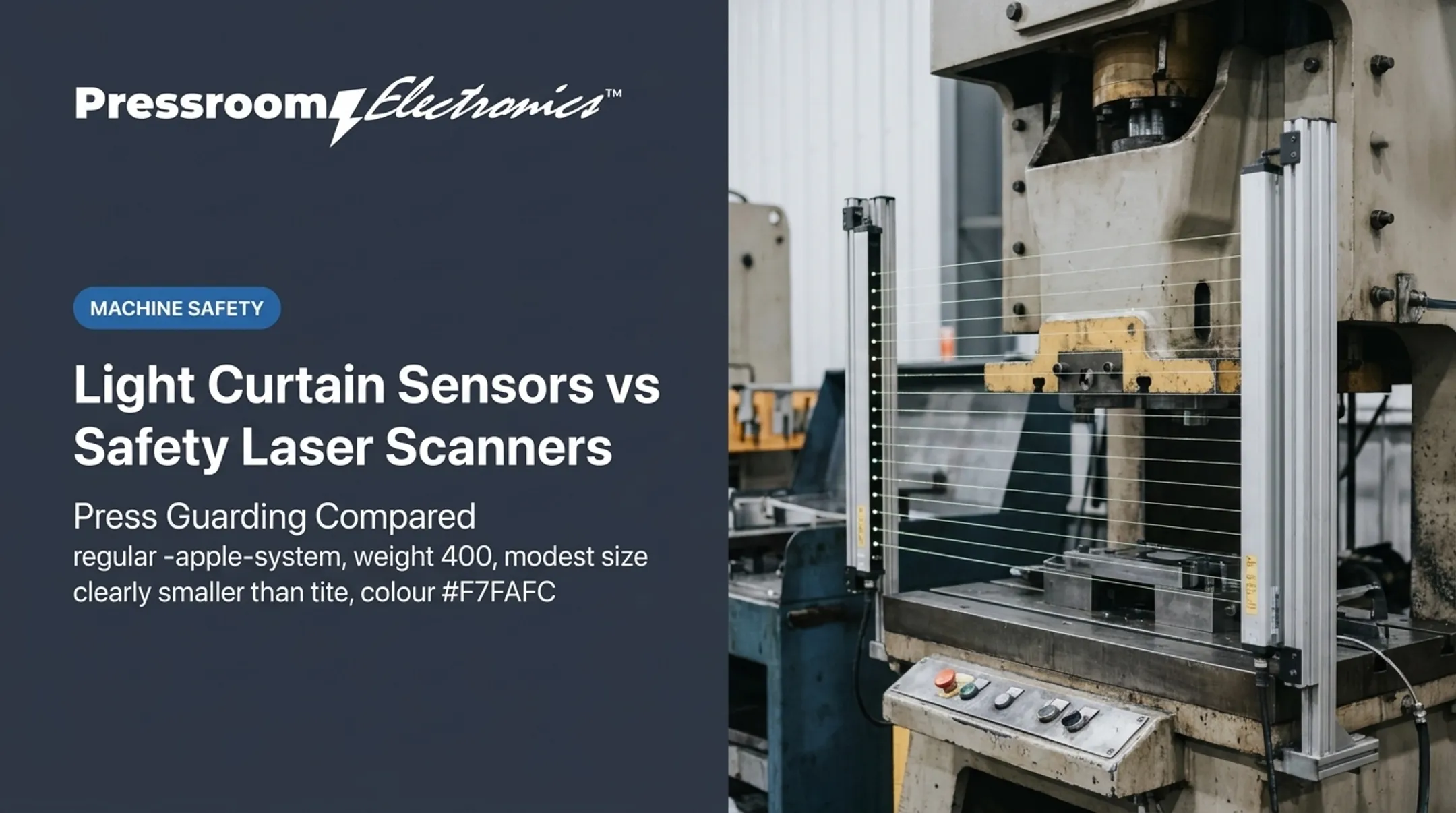
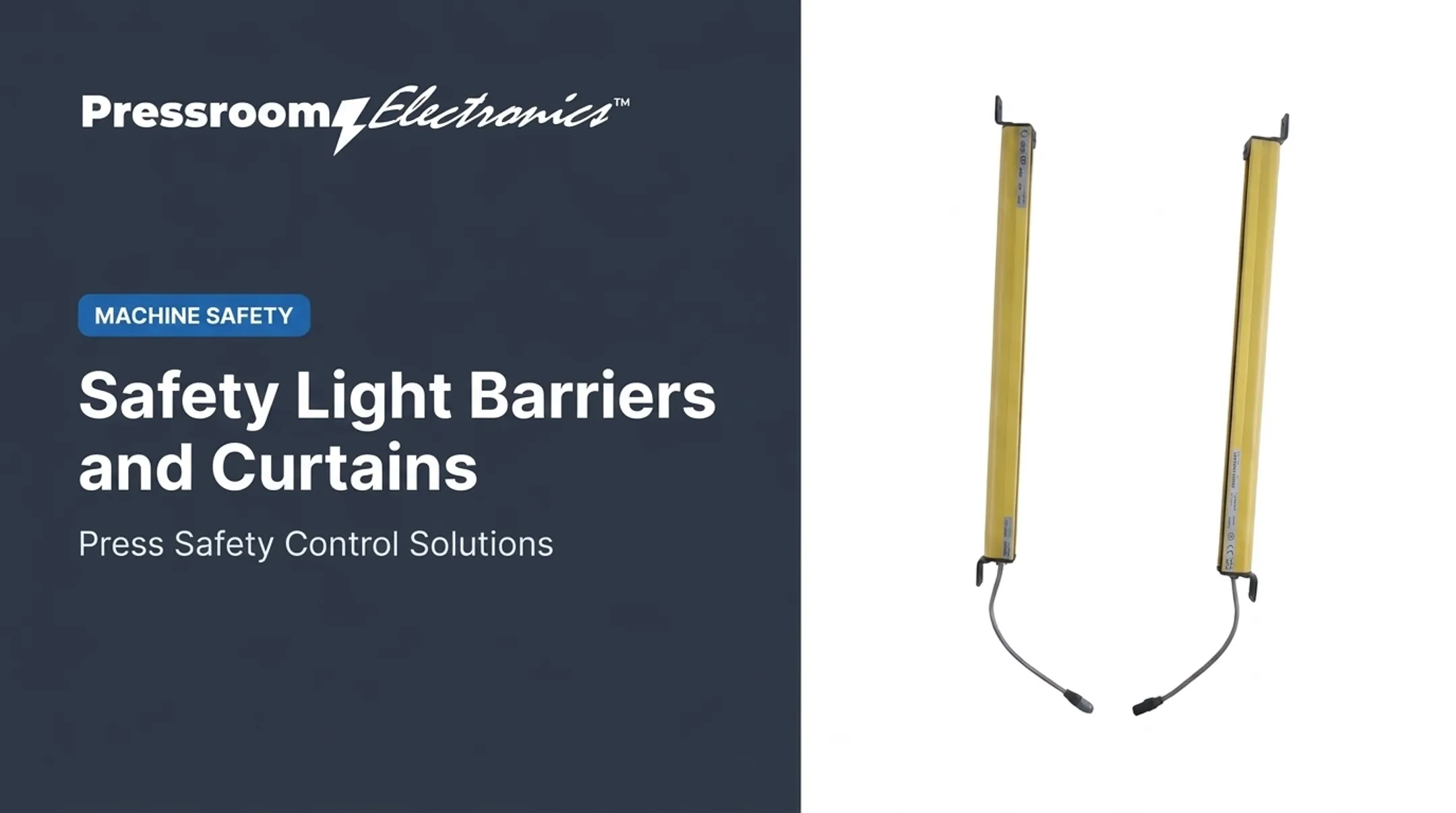
An emitter and receiver form a protective field of parallel beams. Interrupting any beam triggers a stop. Typical uses include press points of operation, access openings, and automated cells.
Photoelectric arrangements come in three configurations:
- Through-beam: separate, opposing emitter and receiver
- Retroreflective: emitter and receiver together, with a separate reflector
- Diffuse: emitter and receiver together, with the target returning the light
Those describe geometry, not safety ratings. Only products rated for personnel safeguarding belong in this role.
Type 2 devices top out at PL c, while Type 4 devices reach PL e, per SICK's ESPE white paper. Those figures are component ceilings, not the achieved rating of your machine's safety function.
Pinnacle Systems light curtains, which Pressroom Electronics supplies, are Type 4 / Category 4 and made in the USA. Cascading models cover multiple planes on irregularly shaped machines.
Area scanners, radar, and camera-based devices
When a linear curtain doesn't fit, scanners, radar, and 3D cameras protect two- or three-dimensional zones. Trade-offs include line of sight, field shape, and environment.
Some manufacturers document that shiny metal or tile can affect laser scanners, that static metal can limit radar, and that direct sun can affect 3D cameras. Check current manufacturer documentation for the exact model.
Safety mats and pressure-sensitive devices
Mats detect a person standing in a zone, which suits robot cells and areas without a defined pinch point. Pressroom Electronics' Zone Control signals the press to shut down when a mat is stepped on, with automatic or manual reset. Pinnacle mats are sealed to NEMA 6/IP67, and STTS mats pulse each mat every 19 milliseconds to detect tampering.

Limits are practical: surface damage, wrong placement, wear, and exposure. A mat doesn't stop ejected material, and it needs routine functional testing.
Complementary safeguarding technologies
Interlocked guards, fixed guards, two-hand controls, and trip devices cover what one device can't. OSHA 1910.217 also requires guards for any point-of-operation entry not protected by a presence sensing device.
Emergency stops and ordinary sensors never replace a proper presence-sensing safeguard. The final arrangement should follow a documented risk assessment.
How to choose among device types
| Condition | Leans toward |
|---|---|
| Fixed point of operation, frequent access | Light curtain |
| Irregular or multi-plane hazard | Cascaded curtain or scanner |
| Open floor area, no pinch point | Safety mat or scanner |
| Dusty or smoky area | Verify radar or curtain specs |
| Reflective surfaces | Verify per model |
Confirm resolution, range, performance level, and environmental rating against your risk assessment.
Where Presence Sensing Devices Are Used in Manufacturing
Press brakes, punch presses, and stamping equipment
A light curtain can protect the point of operation, die space, or an access opening. It must be coordinated with the clutch, brake, control, and stopping performance.
OSHA 1910.217 prohibits presence sensing on full-revolution-clutch presses. Press brakes and hydraulic/pneumatic presses fall outside that scope and follow ANSI B11.3-2022 and B11.2-2013 respectively.
Automated feed systems and robotic work cells
Coil feeds, transfer presses, robots, conveyors, and palletizers put people and machinery in shared space where access points shift during production. Mats and scanners cover those open zones, and ANSI/A3 R15.06-2025 governs robot cells.
Muting suspends protection automatically during a nonhazardous part of the cycle. OSHA permits upstroke muting for parts ejection, circuit checking, and feeding.
Maintenance, setup, and access protection
Presence sensing can guard access during setup or normal operation, but it does not replace lockout/tagout. Under 1910.147, control-circuit devices aren't energy-isolating devices, so servicing still requires hazardous-energy control.
PSDI and productivity-sensitive applications
Presence Sensing Device Initiation uses the device to start a cycle. OSHA allows it only in full compliance with 1910.217(h) and Appendix A.
- Not allowed on full-revolution-clutch presses
- Normal production only, never die setting or maintenance
- Light curtains must detect objects no larger than 1.25 in (31.75 mm), with blanking prohibited
- The manufacturer certifies the design, an OSHA-recognized third party validates it, and the employer certifies the installation
- Annual recertification is required
PSDI can reduce operator motion, but no productivity gain is guaranteed. It must never defeat a hazard control or allow unintended restart.
How to Select and Integrate a Presence Sensing System
Start with a documented machine risk assessment
Identify hazardous motion, access routes, operator tasks, setup activities, material flow, and foreseeable bypass or reach-over. ANSI B11.0-2023 and ISO 12100:2010 provide the frameworks.
The assessment shows whether one device suffices or layered protection is needed. Pressroom Electronics offers plant surveys and risk assessment services.
Match the device to the environment and workflow
Weigh these factors:
- Resolution and sensing range
- Line of sight and ambient light
- Reflective material, dust, oil, and vibration
- Washdown and temperature
- How often operators enter
ANSI B11.1 requires the device to detect a hand despite reflective workpieces, with response time unaffected by sensitivity adjustments or environmental changes. Nuisance trips push crews toward workarounds. Fix the cause.
Verify stopping time, safety distance, and control compatibility
Measured stop time, approach speed, device response, and reach distance set the mounting location. Use qualified professionals and current standards.
Key integration points:
- Safety relays or controllers
- Clutch/brake controls
- Monitored reset and restart prevention
- External device monitoring and diagnostics
After an interruption, the normal stroke-initiating means must be used to resume operation. Pressroom Electronics' BM-1600 brake monitor measures stopping time from 0 to 999 milliseconds on each brake application.
Plan for legacy press modernization
Take an aging mechanical punch press. An upgrade might pair a Type 4 light curtain with a modern clutch/brake control, brake monitoring, die protection, and guarding. Pressroom Electronics supplies press controls, brake monitors, light curtains, and safety mats for retrofits, but not every sensing technology.
OSHA requires anyone reconstructing or modifying a mechanical press to comply with 1910.217(b). Document existing brake performance, wiring, control architecture, machine condition, replacement parts, and changes to the original safeguarding.
Commission, validate, and document
Test before production:
- Functional test of the protective field
- Fault-response test
- Stop-time measurement
- Safety-distance verification
- Restart check
Confirm the machine can't run when the field or access condition is unsafe. Retain the full record set:
- Manuals and risk assessments
- Wiring diagrams and test results
- Training records and change-control documents
Maintenance, Validation, and U.S. Compliance Considerations
Banner's S4B manual calls for checks at shift change, power-up, and setup change. Continuous operation should not exceed 24 hours between checks. Cover these points each time:
- Alignment and optical surfaces
- Mounting, cables, and indicators
- Safety outputs and reset behavior
- Stopping performance
When a device becomes unreliable, check these common causes first:
- Contamination on lenses
- Misalignment or damaged cables
- Altered tooling and brake wear
- Production-flow changes
- Unauthorized bypasses
Investigate nuisance trips rather than defeating them. OSHA's May 2023 release on a New Jersey press brake case described three fingers amputated after a deliberate light-curtain bypass, with $498,464 in proposed penalties. Those penalties were proposed, not final.

Inspection records sit under the same OSHA framework. 1910.217(e) requires periodic, regular inspections with dated, signed records that identify the press.
Directed checks of clutch/brake, antirepeat, and single-stroke mechanisms happen at least weekly, though presses meeting (b)(13)-(14) are exempt from that directed requirement. Not every press carries a blanket weekly-record rule.
Separate regulation from guidance. OSHA rules are mandatory. ANSI B11 standards are voluntary consensus documents, though they can serve as evidence of recognized hazards under the General Duty Clause. Consult qualified safety professionals for site-specific compliance.
Frequently Asked Questions
What kind of sensor can detect human presence?
Safety light curtains, area scanners, radar, and safety mats can, when rated for personnel protection. A general proximity sensor isn't automatically suitable.
How does presence sensing work?
The device detects an intrusion and signals a safety control system. That system initiates a protective stop before hazardous motion reaches the person.
What is a presence sensing safety device?
It's a device designed and rated to protect people from machine hazards. Sensors that only detect parts, position, or process conditions don't qualify.
What are the common uses of proximity sensors in industry?
They detect metal, non-metallic materials, magnets, positions, door states, and machine travel without contact. They shouldn't replace safety devices without verified suitability.
What is a photoelectric sensor used for?
Photoelectric sensors use light to detect objects, count parts, and verify positions. When designed and rated for machine safety, they can also form a protective light field.