For a plant, each citation points to real exposure: a worker with an amputation, lost shifts, damaged tooling, unplanned downtime, penalties and legal trouble. The risk peaks when hazardous motion is reachable, when guards get bypassed, or when people enter danger zones during setup, cleaning, jam clearing, maintenance and changeovers.
Key Takeaways
- Guards must block access to hazardous motion; PPE, awareness and e-stops are not substitutes.
- Choose safeguards from a documented hazard assessment, not habit.
- Inspect guards, interlocks and sensing devices before use and after any maintenance or change.
- Apply lockout/tagout to covered servicing, even when a machine looks stopped.
Safety Guidelines for Machine Guarding
OSHA's eTool says it plainly: "Guards are barriers which prevent access to danger areas." Machine guarding means barriers, protective devices and related control functions that keep people away from hazardous parts, flying material and unexpected movement.
Under 1910.212(a)(1), guarding must protect operators and other employees in the machine area from:
- Points of operation
- Ingoing nip points
- Rotating and reciprocating parts
- Pinch and shear points
- Belts, pulleys, chains, gears and shafts
- Flying chips and sparks
Safety depends on the whole system: machine design, guard configuration, control performance, worker behavior, maintenance discipline and the surrounding environment. A perfect guard on a poorly maintained machine still fails.
Safeguarding is also never finished. Reassess after production changes, tooling changes, guard modifications, incidents, near misses and changes to cleaning or maintenance routines.
General Safety Precautions
Start With a Machine-Specific Risk Assessment
Identify every accessible hazard, including those reachable around, under, over or through a guard. Then tie the findings to the applicable OSHA standards and ANSI standards such as B11.19, which addresses the performance of guards, devices and control functions.
PPE and Clothing
Base PPE on the hazard assessment under 1910.132: eye and face protection, hearing protection, safety footwear, and fitted clothing. Control hair and jewelry. PPE never replaces an engineered guard.
Be careful with gloves. OSHA's amputation guidance lists gloves, loose clothing, jewelry and long hair as entanglement hazards around rotating equipment such as drill presses. A blanket glove rule is wrong there.
Workspace Readiness
- Keep access routes and sightlines clear
- Control pedestrian traffic near machines
- Remove slip and trip hazards from floors and platforms
- Provide adequate lighting
- Use signs and labels to reinforce physical safeguards, never replace them
Guard Design
Effective guards should:
- Attach securely and hold up to the forces of the job
- Use smooth edges that will not create new hazards
- Block reach-through and reach-around access to the point of operation
Openings and safety distances matter. For presses, 1910.217 Table O-10 limits opening width by distance from the hazard. For example, an opening 1/2 to 1 1/2 inches from the point of operation can be no wider than 1/4 inch. Confirm all dimensions against current OSHA and ANSI sources.
Safety During Installation
Start by mapping the machine's hazards and how people work around it:
- Hazardous motions and the operating cycle
- Loading and unloading points
- Maintenance access and line of sight
- Interactions with nearby conveyors, robots, presses and material handling
Choosing the Safeguard
OSHA's eTool describes four guard types: fixed, interlocked, adjustable and self-adjusting. Devices are a separate class: presence-sensing devices, two-hand controls and two-hand trips. Interlocked gates and perimeter fencing can also work.
The right choice comes from the risk assessment. Frequent access may call for interlocked guards or presence sensing; a rarely touched hazard may suit a fixed guard.
One press-specific caution: under 1910.217(c)(3)(iii), presence sensing cannot safeguard full-revolution-clutch presses.
Isolate Energy First
Before installing, modifying, aligning or testing a guard or device, isolate electrical, pneumatic, hydraulic, mechanical and stored energy under your employer's OSHA-compliant lockout/tagout procedure. Pushbuttons and selector switches are not energy-isolating devices.
Know When to Stop
Halt installation or startup if you find:
- An uncontrolled energy source
- An unstable or incomplete guard
- An unverified interlock
- Blocked emergency access
- Inadequate clearance
- A guard so awkward that workers will bypass it
Validate Before Production
Qualified personnel should verify and document:
- Guard alignment and access protection
- Interlock operation
- Stopping performance and restart behavior
Safety While Using or Operating Machine Guarding
Pre-Start Inspection
Walk through this sequence every shift:
- Confirm guards are present, undamaged and fastened.
- Check doors and interlocks.
- Test light curtains, pressure-sensitive devices and two-hand controls.
- Test emergency-stop devices.
- Look for damage or signs of tampering.

Pressroom Electronics' Model 3200 manual calls for testing the entire machine safety system at the start of every shift, including stopping capability and guard and device settings.
Safe Operating Behavior
- Keep hands and body outside danger zones
- Use approved feeding or work-holding tools
- Avoid loose clothing
- Never reach through or around a guard while motion is possible
Routine Exposure Points
These tasks are where people get hurt:
- Clearing jams and removing scrap
- Adjusting dies and changing tooling
- Cleaning, lubricating and troubleshooting
When any of them requires removing a guard or entering the danger zone, normal controls are not enough. Full lockout/tagout or another documented energy-control procedure applies.
Workers must never defeat, bypass, tie back or override a safeguard to keep production moving. A damaged or malfunctioning safeguard means the machine comes out of service and gets reported.
Mechanical Presses and Stamping
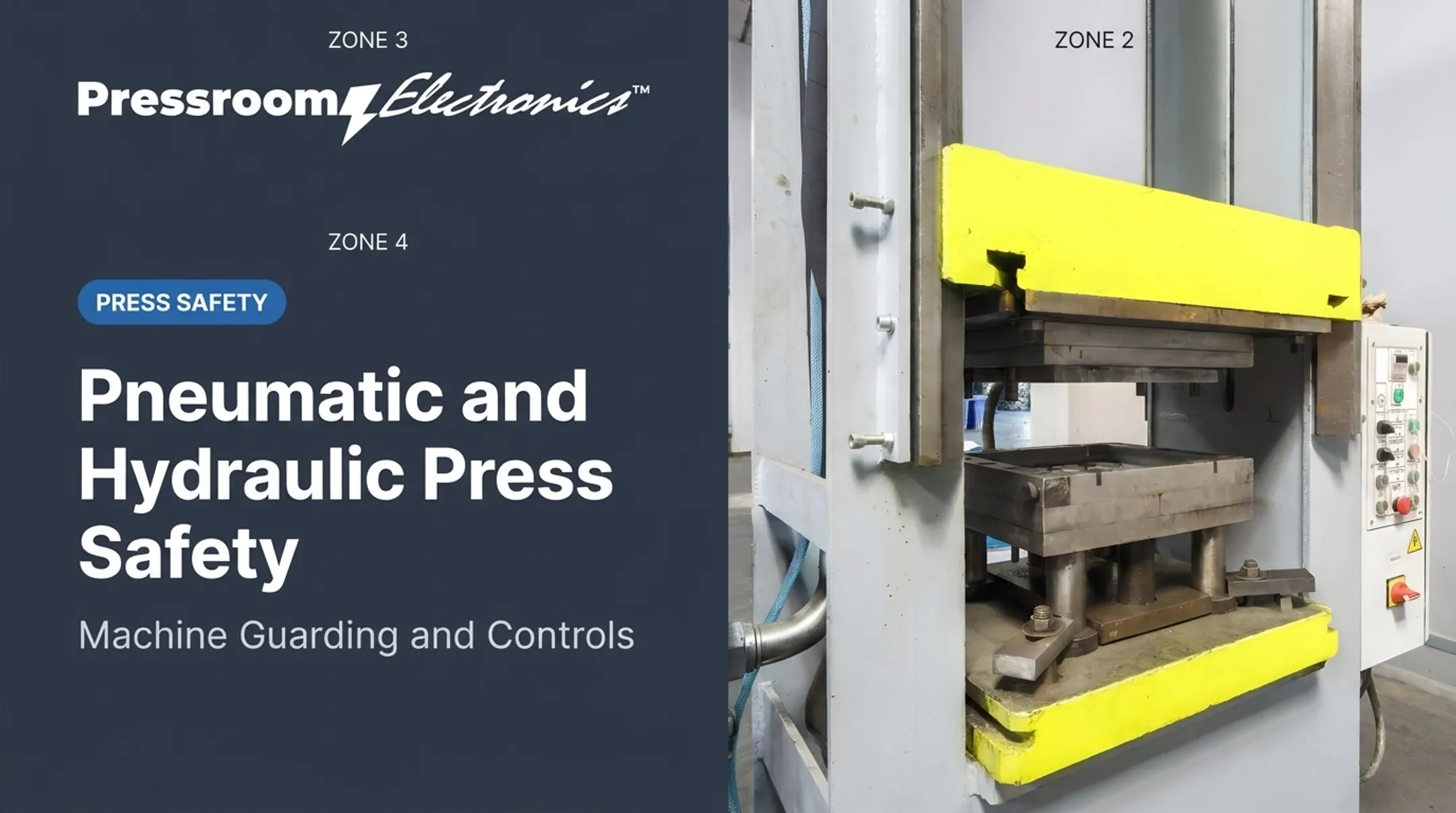
On mechanical punch presses, controls, brake monitoring, die protection and guarding work together. Under 1910.217, hand-in-die feeding with two-hand controls, presence sensing or Type B gates on part-revolution presses triggers the (b)(13) control-system and (b)(14) brake-monitor requirements. Brake monitors detect deteriorating stopping performance before it defeats the safety distance.
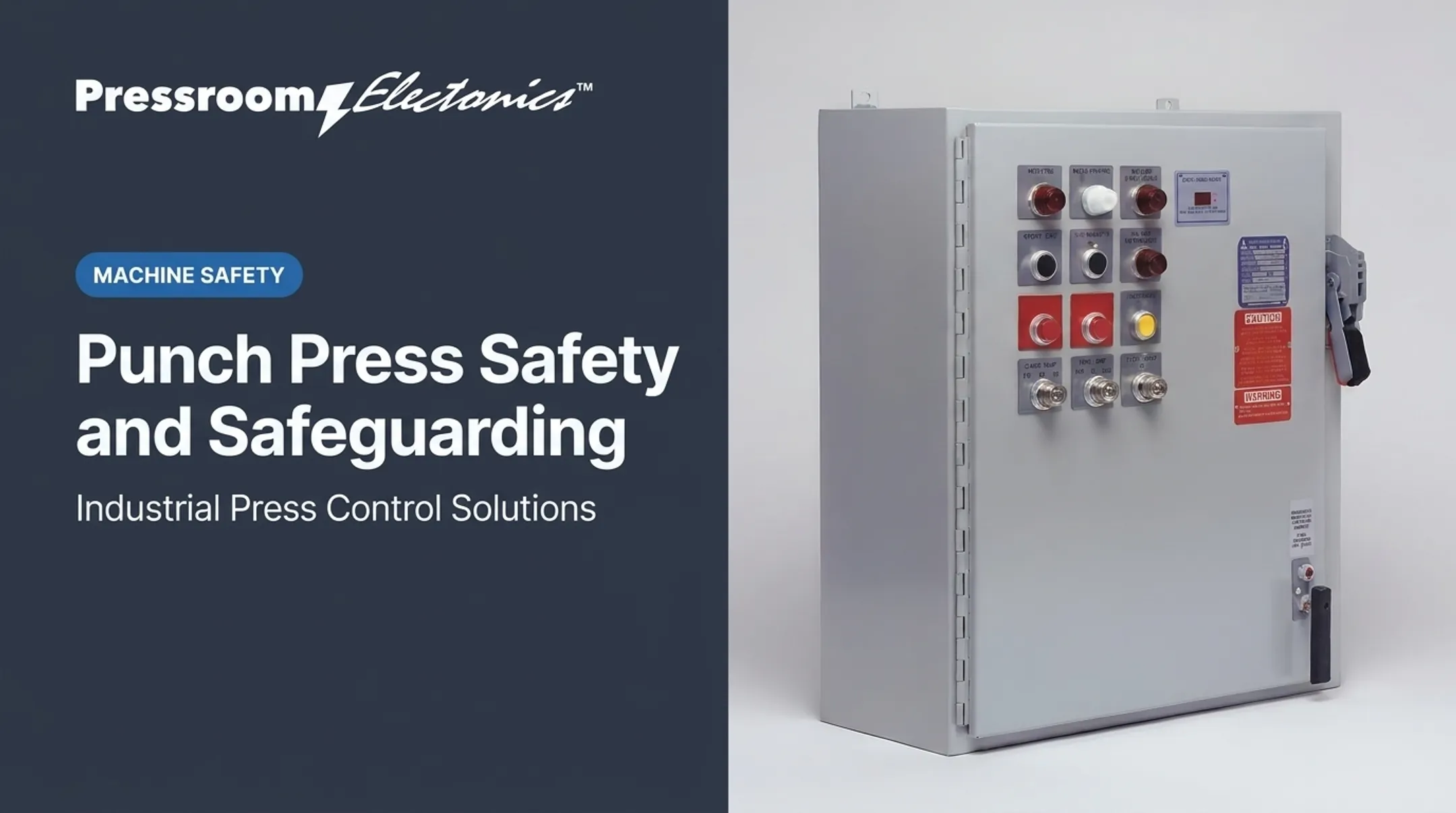
Pressroom Electronics makes OSHA- and ANSI-compliant press controls, time-based brake monitors and die protection that can support this setup. No single product establishes compliance, though. That takes correct specification, installation, validation and upkeep.
Emergency Stops Are Not Safeguards
OSHA 3170 states that emergency stops "are not considered machine safeguarding" because they neither detect nor prevent exposure. An e-stop reacts after someone recognizes a hazard. Guarding keeps the person out of it.
Environmental and System Safety Considerations
Dust, moisture, washdown, heat, vibration, poor visibility, electrical interference and material buildup can degrade guards, sensors, interlocks, control panels and stopping performance.
Verify ratings against the equipment manufacturer's specifications. For example, the PCS-4000's No. 306 pressure switch is rated NEMA 12 oil-tight and dust-tight.
Look beyond a single machine:
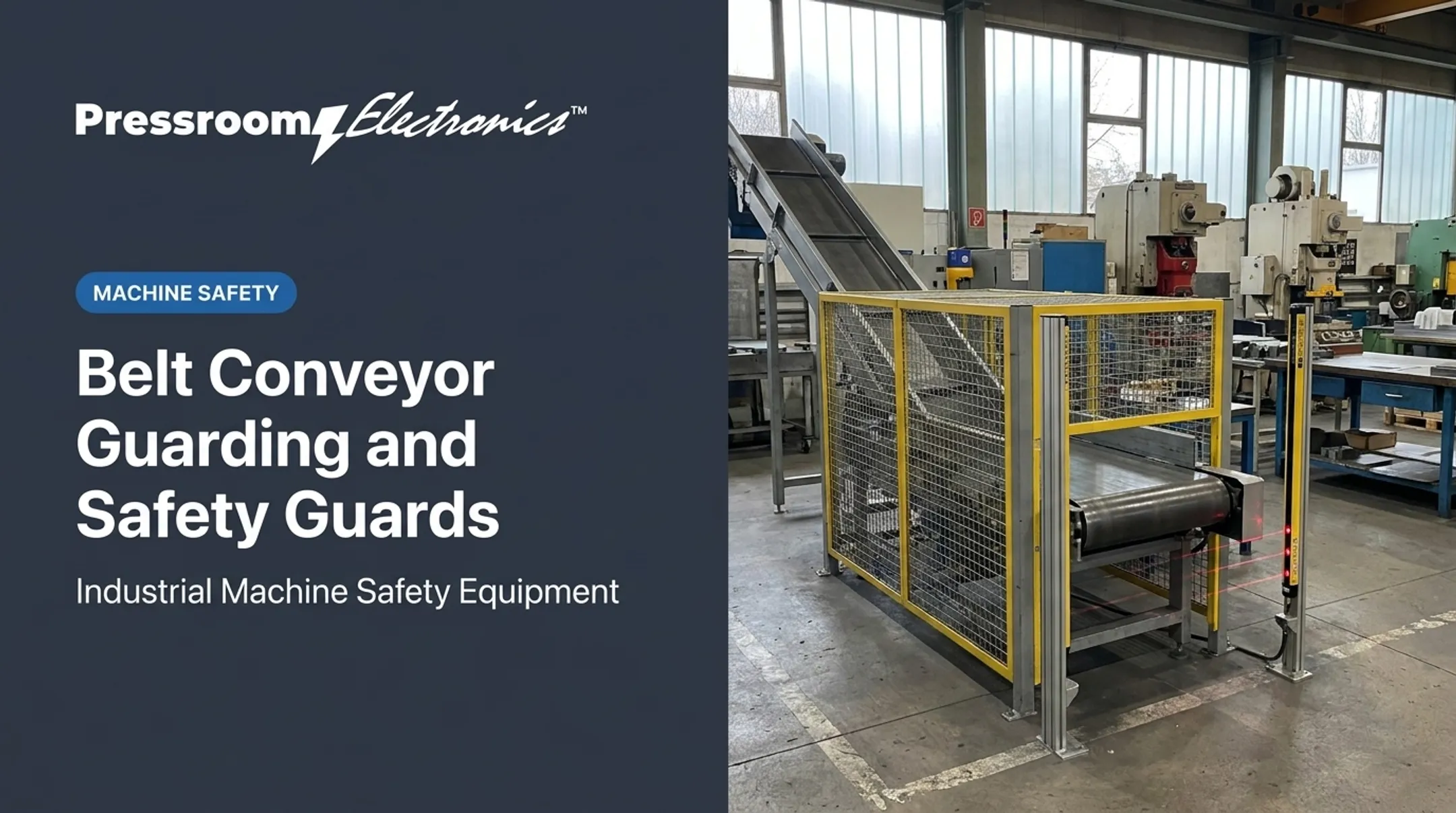
- Gaps between machines and conveyor transfer points
- Robot access and adjacent press lines
- Material storage that blocks or creates access routes
- Unguarded sides where a worker could step in
OSHA's Technical Manual flags water, heat, dust and electromagnetic interference as adverse influences on integrated robot cells, and notes that interconnected equipment may need to be inhibited along with the robot.
Recurring Verification
Inspect after maintenance, sanitation, tooling changes, process changes and temporary guard removal. Keep documented corrective actions with supervisor or maintenance signoff, and retrain when procedures change. For mechanical power presses, 1910.217(e) requires:

- Regular inspections with certification records showing the date, the performer's signature and the press identifier
- Weekly testing of clutch/brake, anti-repeat and single-stroke features unless the press meets the (b)(13) and (b)(14) exception
Common Safety Mistakes to Avoid
Treating Guarding as a One-Time Install
New tooling, temporary repairs, and changed workflows create new access points. A guard that was compliant at commissioning may not be today.
Bypassing and Overriding
Tied-back interlocks, guards removed for convenience, and production pressure overriding a stop-work call are costly. In 2022, a press-brake incident at United Hospital Supply in New Jersey amputated three fingers. OSHA found deliberate light-curtain bypass and proposed $498,464 in penalties. That is a proposed total, not a confirmed payment.

For scale, federal 2026 maximums are $16,550 per serious violation and $165,514 per willful or repeat violation.
Skipping Post-Maintenance Checks
Most guarding failures show up after service, not during steady production:
- Skipping inspection after maintenance or jam clearing
- Ignoring damaged guards or odd stopping behavior
- Restarting equipment before guards, fasteners, controls, and devices are confirmed working
Conclusion
Effective guarding combines hazard assessment, engineered protection, suitable controls, energy isolation, trained workers, and recurring verification. Drop any one and the rest weaken.
Build guarding into standard operating procedures, maintenance planning, change management, and production reviews. Pressroom Electronics supplies light curtains, safety mats, press controls, and brake monitors for plants that need them, but the program, not any single device, keeps people safe.
Frequently Asked Questions
What are the OSHA requirements for machine guarding?
The core rule is 29 CFR 1910.212, with 1910.219 for power transmission, 1910.217 for mechanical power presses and 1910.147 for hazardous energy. Verify which apply to your machine and industry.
Which machine parts require guards?
Hazardous points of operation, rotating and reciprocating parts, power-transmission components, nip and pinch points, shear points and anything that can eject material. The guarding method depends on your hazard assessment.
What are the safety measures to prevent mechanical hazards?
Use engineered guards, plus interlocks or presence-sensing devices where appropriate. Add safe work procedures, training, regular inspections and lockout/tagout, and prohibit bypassing safeguards.
What are the safety precautions around rotating machinery?
Wear fitted clothing and control hair and jewelry. Keep your distance, use guards and feeding tools, and isolate energy before adjusting, cleaning or maintaining.
What are the four types of machine guarding?
OSHA's eTool lists fixed, interlocked, adjustable and self-adjusting guards. Devices such as presence sensing and two-hand controls are classified separately, so these are not the only options.
What is the 7 foot rule for machine guarding?
It comes from 1910.219, which requires guarding for shafting, pulleys and belts seven feet or less from the floor or platform. It is not a universal exemption: fan blades under seven feet need guards, and some overhead belts above seven feet must still be guarded.