Introduction
A machine can have a sound frame, true ways, and a spindle that still cuts well, yet cost you a week of downtime because a control board is no longer made. That's the problem with aging CNC machines and pressroom equipment. The mechanics hold up. The electronics don't.
A retrofit modernizes selected systems while keeping all or part of the existing machine. It isn't automatically the right answer. Mechanical condition, production requirements, safety needs, downtime tolerance, and total project cost decide that.
This guide defines CNC retrofit solutions, covers the components and benefits, shows how to evaluate a project, and compares retrofit with replacement.
Key Takeaways
- A retrofit extends a mechanically sound machine’s life by updating controls, drives, feedback, wiring, safety, or automation.
- Worn ways, damaged ballscrews, and spindle problems need separate assessment; a new control won't fix them.
- True project cost includes engineering, installation, training, documentation, and lost production.
- Tie every upgrade to a measurable goal such as uptime, safety, or visibility.
What Are CNC Machine Retrofit Solutions?
What retrofit equipment means
Retrofit equipment is modern hardware, software, and supporting systems installed on an existing machine to replace obsolete or inadequate technology. The machine base stays where practical. Some projects are a partial control upgrade. Others modernize the electrical, motion-control, safety, and automation systems together.
What "retrofit" means in engineering
Engineering retrofit work adapts new components to an existing design. It documents interfaces and constraints, then validates that the updated system runs safely and reliably in its intended application.
The terms get mixed up, and industry usage typically separates them this way:
| Term | Meaning |
|---|---|
| Retrofit | Replacing the CNC, servo, and spindle systems on a mechanically sound machine, per FANUC's retrofit brochure |
| Repair | Restoring equipment to OEM specifications |
| Rebuild | Restoring mechanical, geometric, and positioning specifications while keeping existing controls |
| Remanufacture | Mechanical rebuild plus control retrofit |
| Replacement | Acquiring newer equipment |
When retrofitting is appropriate
Retrofits are strongest when the frame, ways, spindle, and axes still suit the process, but unsupported controls, poor diagnostics, or limited connectivity cause the trouble. Age alone isn't decisive.
Warning signs that favor rebuild or replacement:
- Severe structural wear
- Persistent accuracy problems
- A work envelope that's too small
- Insufficient spindle or axis performance
- Mechanical parts that are hard to repair
What Components Does a CNC Retrofit Replace or Upgrade?
CNC control, operator interface, cabinet, and wiring
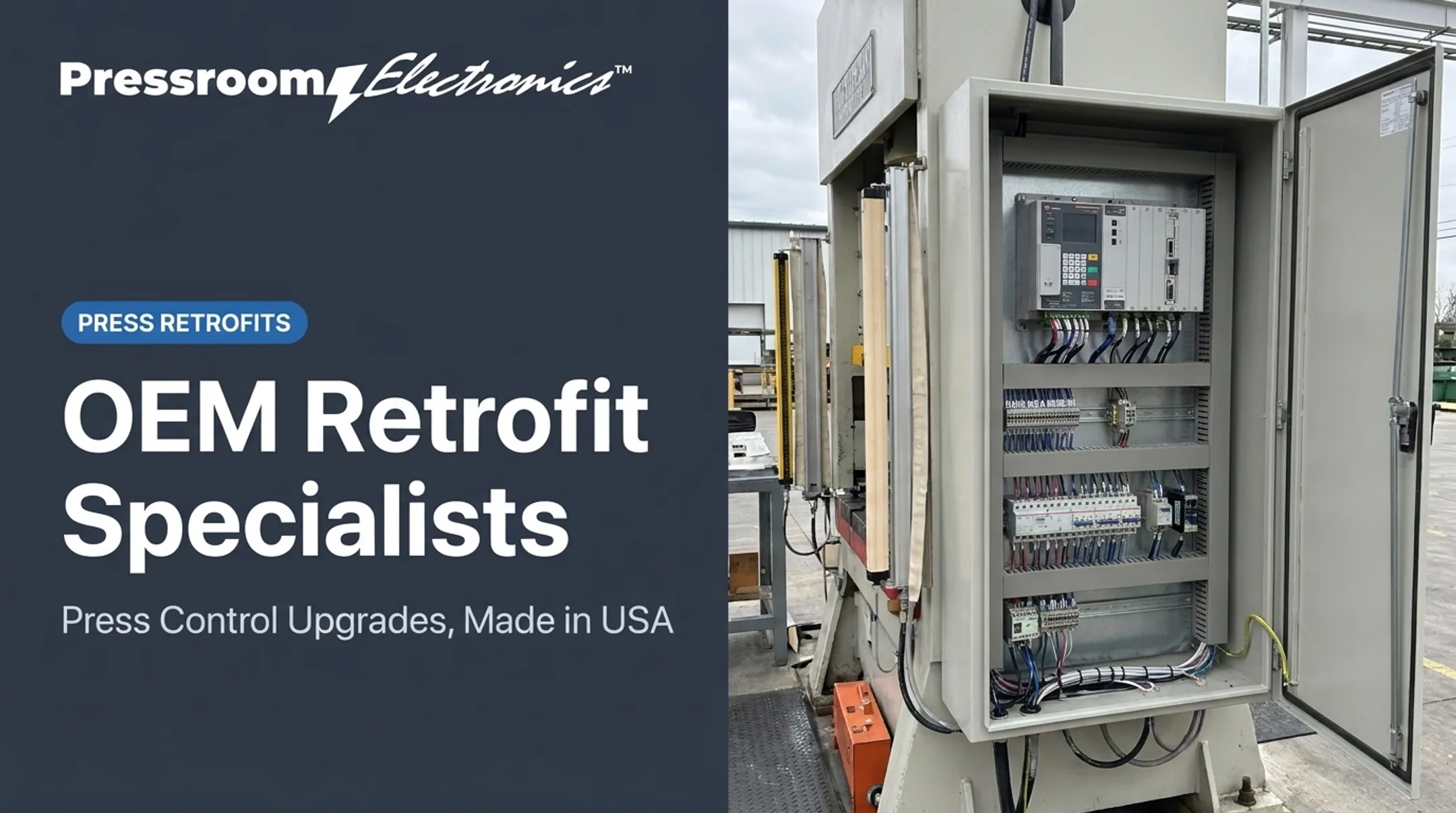
The control, operator panel, cabinet, I/O, power distribution, and wiring form the machine's nervous system. A good provider documents existing circuits first, preserves needed machine functions, and then configures the new control around the application.
Don't assume legacy data carries over. Back up and plan for:
- Part programs and CAM postprocessor compatibility
- Parameters, offsets, and tool tables
- Alarm lists and machine settings
Suppliers such as MachMotion say existing G-code is typically transferable, but that's not universal. Test it.
Drives, motors, spindle systems, and feedback devices
Servo and spindle drives, motors, encoders, resolvers, and linear scales determine positioning, speed control, repeatability, and diagnostics. Some projects replace the CNC and reuse existing drives. Others add absolute linear scales, which removes homing at startup.

Selection must match:
- Load and axis configuration
- Required accuracy and electrical supply
- Spindle demands and existing mechanical transmission
Resolvers need special handling. Bosch Rexroth documentation says this encoder type can't be configured automatically by an encoder scan.
Mechanical systems and auxiliary equipment
Inspect the mechanical limits before you commit to a control-only scope:
- Ballscrews, ways, and bearings
- Spindles and lubrication
- Hydraulics, coolant, and tooling interfaces
- Enclosures
These systems cap what a control retrofit can deliver. A modern control cannot correct worn geometry or a failing spindle.
Require a documented mechanical inspection and a written list of included and excluded repairs. Retrofit warranties typically cover installed components, while spindle, ways, ballscrews, and frame remain the owner's responsibility.
Safety, automation, and production data systems
Guarding, interlocks, emergency stops, safety relays, light curtains, robots, and feeders all interact with the retrofit. Robot-integrated cells fall under ANSI/A3 R15.06-2025. Safety-related control design follows ISO 13849-1:2023.
Production monitoring adds alarm history, reason codes, utilization tracking, and remote visibility where the selected system supports them.
Pressroom-specific modernization considerations
Mechanical punch presses are a different case. Clutch/brake controls, brake monitoring, die protection, guarding, and production monitoring support a broader modernization plan, but they are not interchangeable with a general CNC controller.
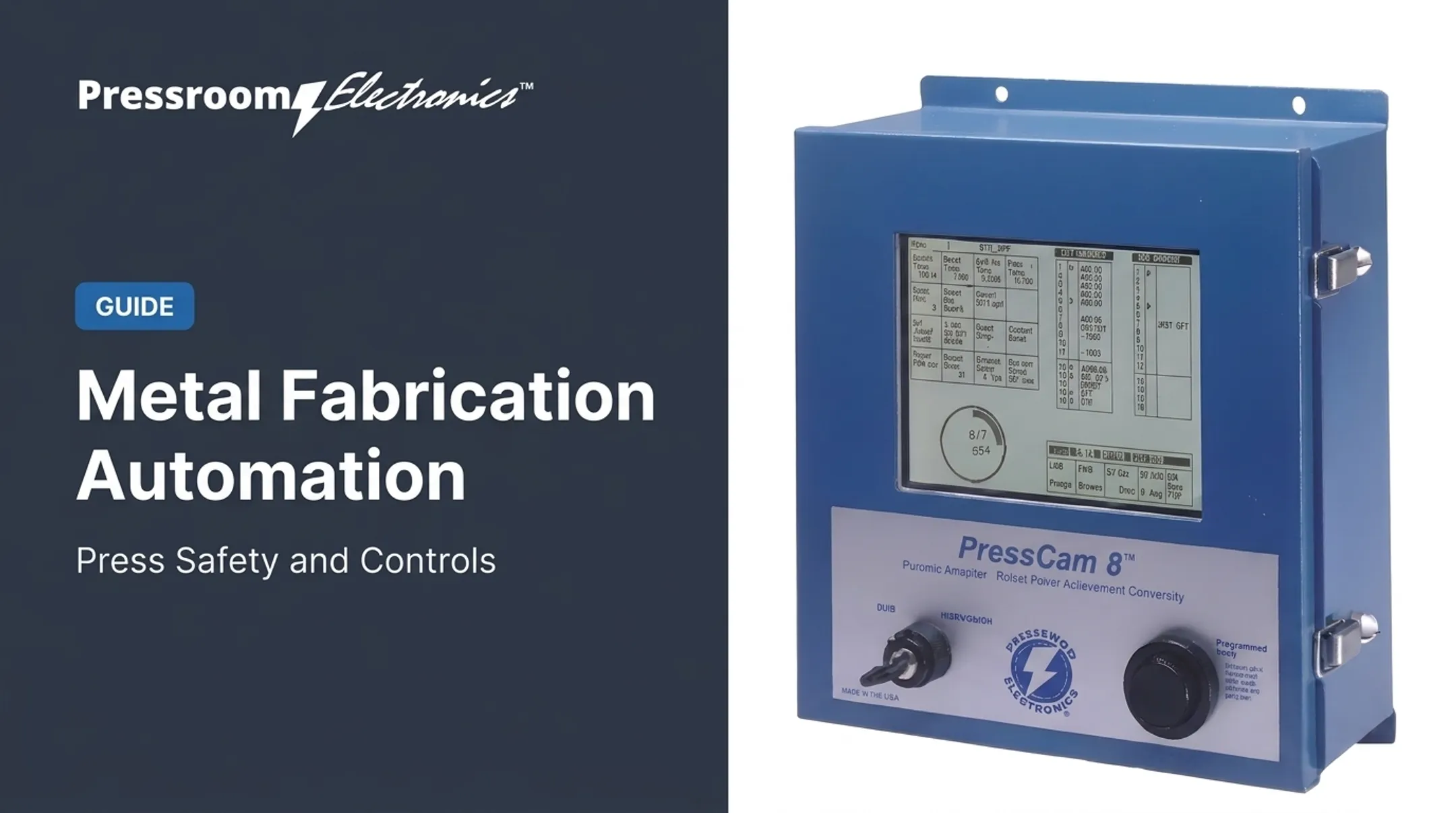
Pressroom Electronics builds this kind of equipment. Its PressCommander is a resolver-based clutch/brake control with built-in automation, offered in retrofit models for 1-500 SPM and 501-1200 SPM ranges.
The BM-1600 brake monitor prevents a successive stroke when stopping time exceeds the set limit. Confirm press compatibility before specifying either product.
What Benefits Can a CNC Retrofit Deliver?
Reduce unplanned downtime and simplify troubleshooting
Current controls with alarm history and programmable reason codes help maintenance teams find root causes faster. Supportable components also shorten waits for parts.
Be cautious with numbers. Treat vendor claims on downtime reduction or OEE as case-specific; no industry-wide retrofit percentage is established for those gains.
Improve machine utilization and production performance
Better motion control, programming functions, and cycle monitoring can mean shorter setups, steadier repeatability, and higher throughput. Published cases show what's achievable, though not what's typical:
- Siemens reports roughly 7% cycle-time improvement at M. + M. Mai
- The same source cites 50% less commissioning time and 4% higher machine productivity at Siemens Elektromotorenwerk
- A HEIDENHAIN rebuild with absolute scales eliminated homing, which had added about half an hour at startup
These are separate metrics from separate cases. Don't treat them as averages.
Strengthen operator and machine safety
Modern safety circuits, interlocks, guarding interfaces, and monitored stopping address risks in aging control systems. For mechanical power presses, OSHA 1910.217 applies, and it excludes press brakes and hydraulic or pneumatic presses. Current ANSI editions include B11.1-2009 (R2020) and B11.19-2019 (R2024).
Compliance depends on the whole machine, installation, validation, and operating procedures. A component's documented function isn't a compliance guarantee.
Improve connectivity and production visibility
Network connectivity makes machine status, downtime causes, and performance trends visible to maintenance, engineering, operations, and management. NIST's work on MTConnect supports real-time status collection for OEE analysis. Visibility alone isn't a quantified gain, but you can't fix what you can't see.
For compatible presses, Pressroom Electronics emphasizes globally accessible production data, programmable reason codes, resource allocation, and performance tracking. PressCommander's 10" touchscreen option covers downtime monitoring, OEE calculation, and signature analysis.
Extend asset life and support sustainability goals
Reusing a suitable machine base defers disposal and preserves tooling, fixtures, programs, and operator knowledge. Retrofitting can avoid emissions tied to new heavy castings. Do not assume operating-electricity savings versus new equipment; compare expected utility use for each option.
How to Evaluate a CNC Retrofit Project
Inspect mechanical and electrical condition first
Inspect before you request proposals. Check:
- Geometry, backlash, leveling, and wear patterns
- Spindle, ballscrews, ways, gibs, and bearings
- Lubrication, hydraulics, and coolant
- Motors, drives, wiring, cabinets, and safety devices
- Parts availability
Power the machine and cycle it. Note alarms, heat, vibration, and tool changes. Gather alarm logs, downtime history, maintenance records, accuracy measurements, and known failure points.
ISO 230-1:2012 covers geometric accuracy. ISO 230-2:2014 covers positioning accuracy and repeatability.
Define the production problem and desired outcome
List what the machine must do over the next several years:
- Part sizes, materials, and tolerances
- Cycle needs, axes, and spindle demands
- Automation, operator skill, and data requirements
Turn that into measurable goals such as restoring supportability, raising availability, improving setup consistency, or adding monitoring.
Map compatibility, safety, and integration requirements
Demand a written scope that marks each item as included, excluded, or dependent on inspection findings. It should cover:
- Hardware, software, and wiring
- Mechanical repairs and safety functions
- Automation interfaces, programs, and documentation
Also check electrical power, communication protocols, feedback compatibility, tooling and workholding interfaces, adjacent equipment, and plant-network integration.
Plan downtime, commissioning, training, and acceptance testing
Schedule removal, installation, wiring, programming, dry runs, first-piece production, training, and handover around your production calendar. Add contingency time.

Write an acceptance plan covering:
- Safety validation and alarm testing
- Axis and spindle performance and repeatability
- Production-part runoff
- Documentation, spares, and warranty responsibilities
- Post-installation support
ASME B5.54-2005 (R2020) offers a test methodology for machining centers; supplier and user agree on tests and limits.
Build a complete cost and ROI model
Pricing varies with machine type, axes, control platform, mechanical repairs, automation, and complexity. One U.S. supplier, MachMotion, publishes a range of $15,000 to $60,000 for most CNC retrofits. That's one supplier's figure, not a market average, and it doesn't apply to press clutch/brake controls.
Add indirect costs:
- Engineering, freight, and rigging
- Electrical work and software conversion
- Training, lost production, and outside processing
- Tooling changes and future support
Net present value is a solid framework, but no single case defines a universal payback period.
CNC Retrofit vs. Machine Replacement: Which Is Right?
When a retrofit is likely to be stronger
A retrofit is often the better path when:
- The mechanical base still holds accuracy
- Tooling and programs are already established
- The machine configuration is specialized
- The real problem is electronic, such as unsupported drives or unavailable boards
Retrofitting can also avoid new foundations, extra tooling, and rigging.
When replacement may create more value
Replacement deserves priority when:
- Mechanical wear is extensive
- Capacity or speed falls short of future work
- Quality requirements can't be met
- Several major systems would need rebuilding at once
Consider new and inspected used machines. Evaluate condition, supportability, delivery, installation, warranty, tooling, and production capability before you commit.

Compare using total cost and operational risk
Compare both paths across:
| Factor | What to weigh |
|---|---|
| Cost | Capital cost, lost production, installation |
| Risk | Mechanical risk, implementation time |
| Capability | Capability gain, safety, data access |
| Longevity | Expected useful life, resale value, support |
Get a detailed retrofit proposal and a comparable replacement quote. Pick the option that fixes the actual production constraint, not the lowest sticker price.
Frequently Asked Questions
How much does a CNC retrofit cost?
There's no universal price. Cost depends on machine type, control and drive scope, mechanical repairs, programming, installation, automation, and downtime. Request a documented, application-specific proposal.
What is retrofit equipment?
It's modern components installed on an existing machine. Examples include controls, drives, motors, feedback systems, wiring, safety equipment, monitoring, and automation.
What does "retrofit" mean in engineering?
It means adapting new technology to an existing machine while accounting for interfaces, constraints, safety, compatibility, testing, and documentation.
What is the purpose of retrofitting?
The goals are extending equipment life, replacing obsolete systems, improving reliability and maintainability, supporting safety and connectivity, and avoiding replacement when the base remains suitable.
What are the 7 major parts of a CNC machine?
Classifications vary. Xometry's teaching grouping lists the input device, machine control unit, machine tool, driving system, feedback system, display unit, and bed. Its full article lists 40 parts.
What is the CNC process?
Design and CAM programming produce G-code. The control commands drives and servo motors, encoders provide feedback, and the spindle removes material. Inspection follows. A retrofit typically modernizes the control, drive, and feedback stages.