Introduction
A control system upgrade can modernize an aging stamping press without replacing the machine. Whether it's the right call depends on mechanical condition, control architecture, safety requirements, and production goals.
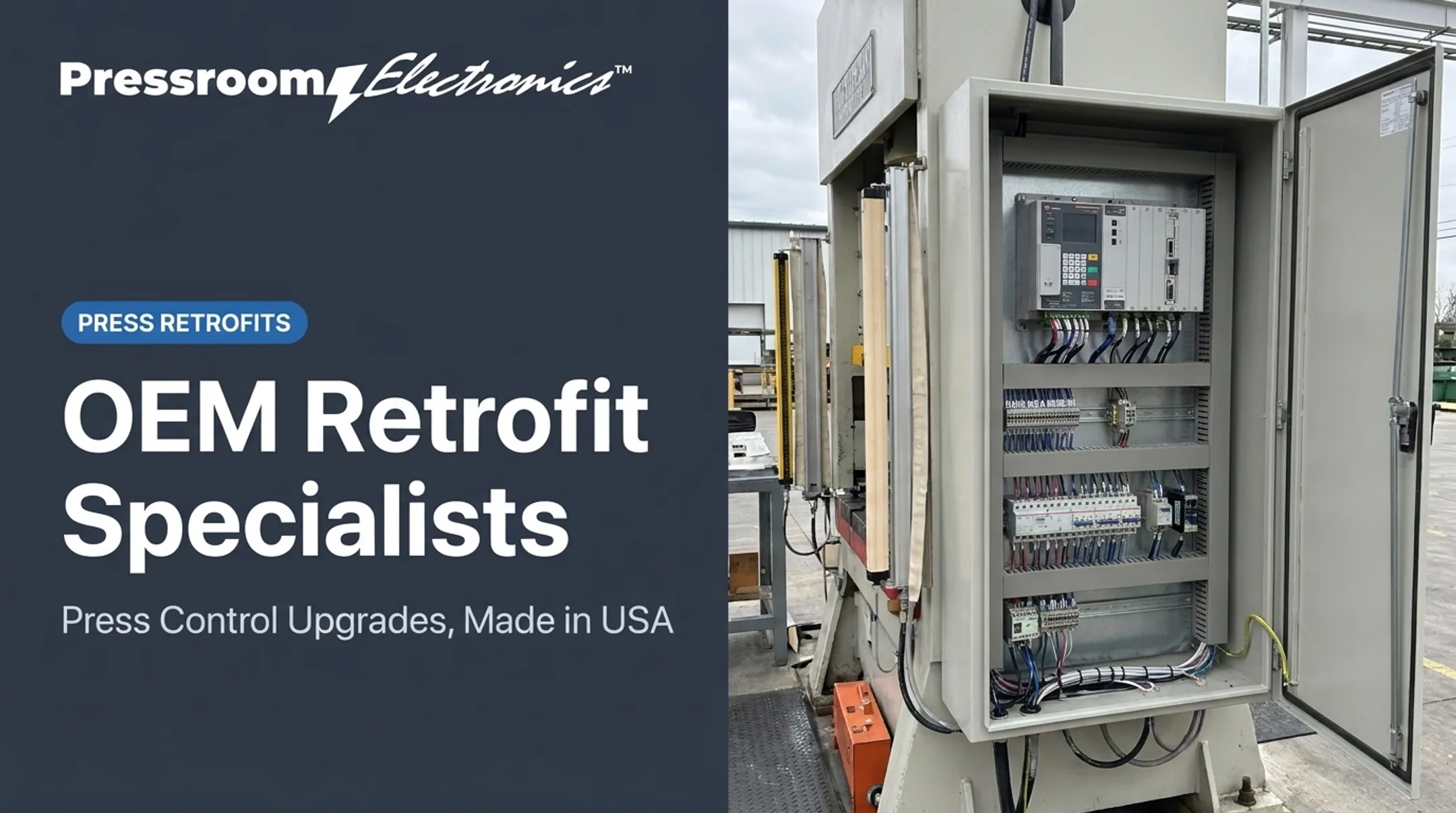
The warning signs are familiar. Parts are hard to find, faults repeat, and the screen says little about why the press stopped. Rockwell, for example, discontinued the 1747-L553 SLC 5/05 processor on March 31, 2024, which stranded plenty of older panels.
This article gives you a framework: when to upgrade, what to expect, how to prepare, and when a new press is the better investment.
Key Takeaways
- Upgrade when the press structure is sound but the controls are obsolete or limiting output.
- Modern controls support brake monitoring, die protection, diagnostics, and production visibility.
- Start with a documented assessment of the press, controls, interfaces, and plant priorities.
- Compare scope, service life, and lead time against a new press before committing capital.
When Does a Pressroom Need a Control System Upgrade?
Why aging controls become a production risk
Obsolete processors, I/O modules, relays, HMIs, drives, and communication interfaces make troubleshooting harder. Sourcing replacements takes longer, and some parts come only through repair or exchange. Rockwell's lifecycle definitions note that shortages can begin before an official discontinuation date.
Intermittent faults on unsupported hardware stretch repair time. The knowledge often sits with one or two people who understand the legacy system. When they're out, the press waits.
Signs the controls are limiting performance
- Inconsistent cycle behavior or limited adjustment options
- Vague fault messages and poor operator feedback
- Difficulty adding newer sensors, monitors, or plant data connections
- Job setups that depend on handwritten notes rather than stored recipes
Safety and compliance triggers
A controls evaluation should accompany a machine safety risk assessment. That matters most where clutch/brake operation, emergency stopping, guarding, interlocks, or palm buttons are involved.
OSHA 1910.217 sets specific expectations. Part-revolution clutch/brake controls need a stop that overrides other controls and an antirepeat function. Presence sensing is prohibited on full-revolution clutches, so identify your clutch type first.
A control can meet applicable OSHA and ANSI requirements and still leave the press noncompliant if installation or integration falls short. Have qualified safety personnel review the final installation.

Business and lifecycle triggers
Sometimes the case is strategic rather than urgent. These goals can justify an upgrade before failures pile up:
- Standardizing components across the pressroom
- Improving spare-parts availability
- Supporting a rebuild
- Preparing for automation
What Can a Control System Upgrade Improve?
Reliability, maintainability, and troubleshooting
Current hardware, clear documentation, and better diagnostics help maintenance find faults faster. Plain-language fault messages beat decoding a blinking light.
Programmable reason codes add the next layer. They separate downtime caused by controls from tooling, material, setup, or operator issues.
At Wiegel Tool Works, PMA's account shows detailed downtime codes exposed coil, tooling, and packaging staging and labor problems rather than the expected maintenance issues. That is a monitoring result, not a control-replacement gain, but it shows why root-cause data matters.
Press safety and equipment protection
An upgrade can lay the foundation for better:
- Clutch/brake control and brake monitoring
- Die protection
- Guarding and interlocks
This is subject to the application's risk assessment and engineering requirements.
Safety functions are not an automatic result of swapping a controller. They need validation during commissioning, and the results should be documented. Stop-time tests should be repeated and compared with prior readings.
Productivity and machine utilization
Custom logic, better cycle coordination, and faster fault recovery can help a shop use existing capacity. Be skeptical of any promised percentage.
General Stamping & Metalworks upgraded 12 of 15 presses, adding electronic die protection, automation, and tonnage monitoring, but no measured before/after gain was published.
Data visibility and operational decisions
Shared production data gives maintenance, production, and management one view of machine status, utilization, downtime causes, and trends.

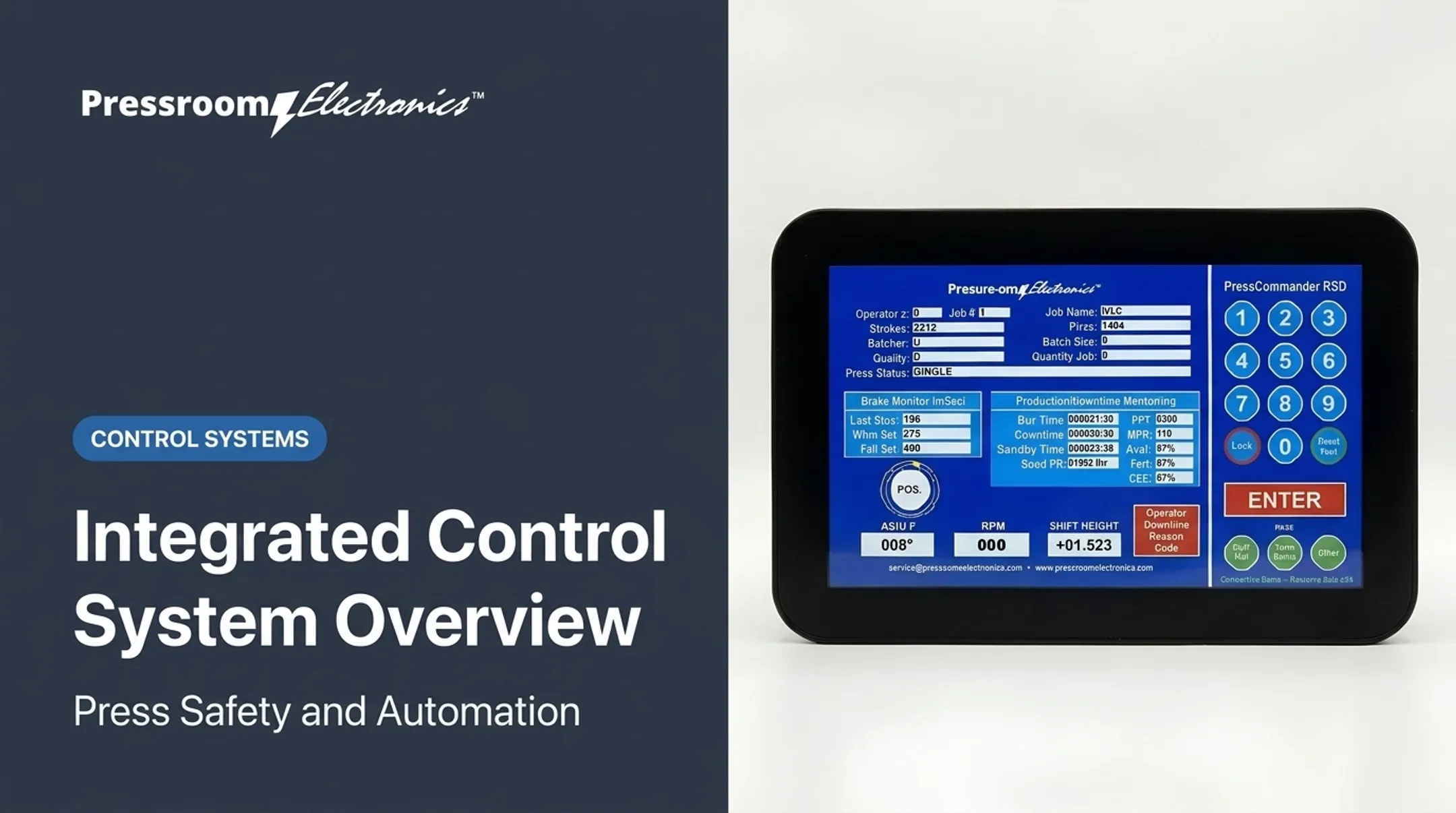
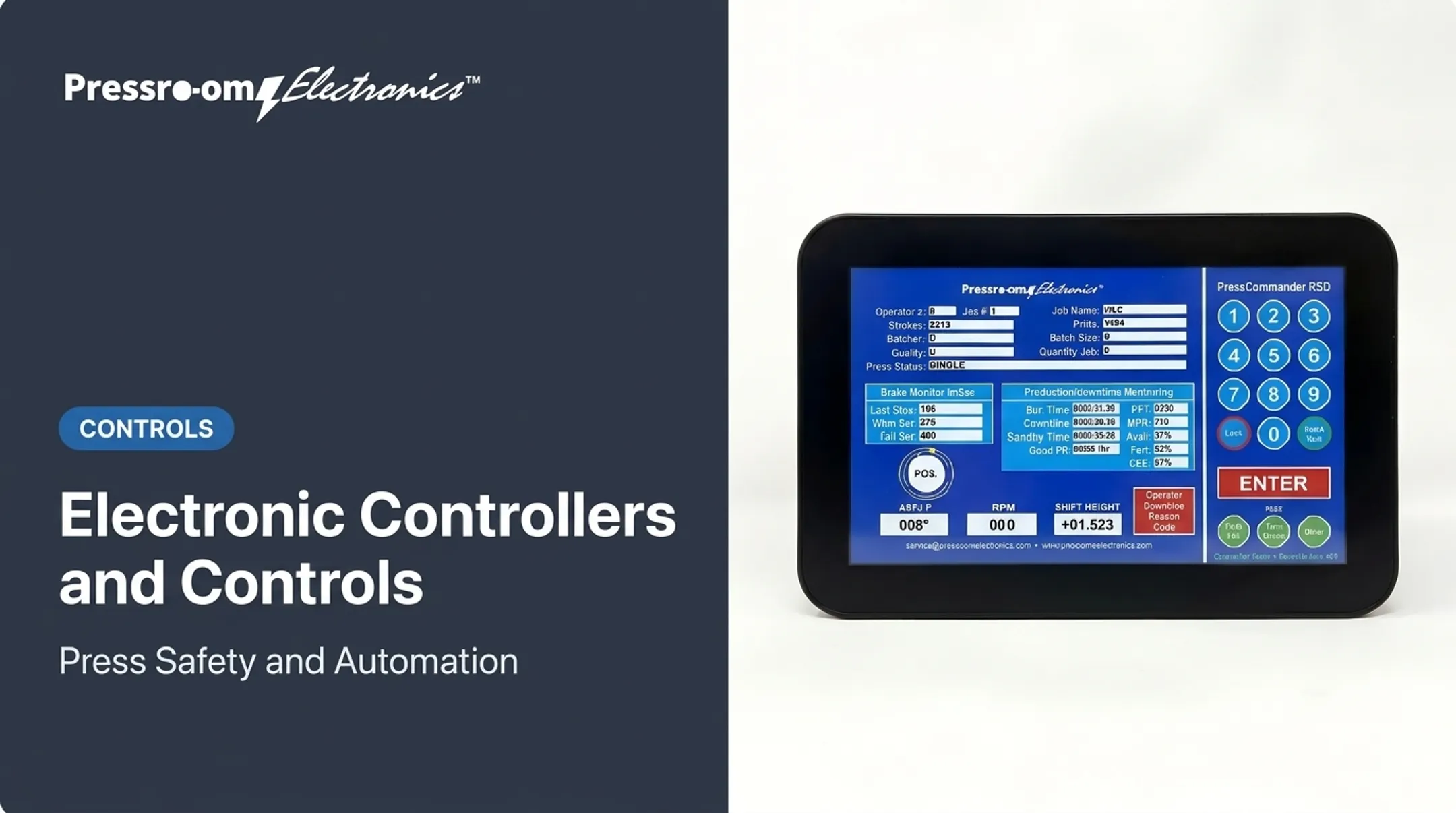
Pressroom Electronics manufactures customized press controls and automation. Its focus includes:
- Programmable reason codes (up to 20 customizable downtime codes in its monitoring system)
- Production monitoring
- Machine-utilization improvements through custom programming
Results depend on the press, the tooling, and how the plant uses the data.
What Does the Upgrade Process Involve?
Assess the press, controls, and production requirements
Start with an audit. Document:
- Press model, age, and mechanical condition
- Existing control components, wiring, and schematics
- Sensors, clutch/brake arrangement, and safety devices
- Recurring faults and production requirements
- Available downtime for the work
Then write down the outcomes you want before choosing hardware:
- Easier troubleshooting
- Better production data
- Faster changeovers
- Spare-parts availability
- Future automation compatibility
Define the upgrade scope and interfaces
Map every input and output: operator controls, resolvers or rotary cams, drives, sensors, brake monitors, die protection, guarding circuits, and plant-level connections.
Watch for hidden scope:
- Undocumented modifications
- Damaged wiring
- Obsolete peripheral equipment
- Incompatible signals
- Mechanical wear found during assessment
Select the control architecture and custom functions
Choose based on the press application, not the controller brand. Weigh processing needs, safety functions, serviceability, expansion, documentation, and operator usability.
Rebuilt or non-standard presses often need custom programming:
- Machine-specific sequences and fault logic
- Setup modes and production tracking
- Interfaces to existing automation
Test, install, and commission methodically
- Program offline where possible to shorten the cutover.
- Verify I/O and test in stages.
- Test safety functions and simulate faults, including antirepeat and brake-monitor checks.
- Train operators and plan a defined cutover window.
Commissioning records should include:
- Updated drawings and software backups
- Parameter settings and test results
- Spare-parts information and maintenance guidance
OSHA 1910.217 also expects an inspection program and competent maintenance personnel.

Plan for post-upgrade support
After cutover:
- Keep documentation accessible and software backed up
- Train staff and stock critical spares
- Agree on a process for later adjustments or remote troubleshooting
Control Upgrade vs. Press Replacement: Which Makes Sense?
When a controls upgrade is usually stronger
Upgrade when the frame, drive train, mechanical systems, and tooling interface are in acceptable shape but the controls are obsolete or limiting. PMA's 2025 guidance recommends assessing foreseeable press uses and describes tooling-capability gains from advanced-control retrofits without buying a new press.
When replacement may be more appropriate
- Extensive mechanical wear
- Recurring failures across several major systems
- Inadequate press capacity
- Poor structural condition
- An upgrade scope approaching the value of a new machine
No universal cost percentage settles this. Compare project-specific quotes. New-press lead time also varies with builder capacity and component supply, so get delivery dates in writing.
A practical comparison
| Factor | Controls upgrade | New press |
|---|---|---|
| Upfront capital | Project-specific, usually lower | Higher |
| Downtime | Planned cutover window | Installation and tooling transfer |
| Lifespan | Depends on mechanical condition | New mechanical life |
| Capability | Limited by existing press | Can add capacity |
| Retraining | Operator interface changes | Broader retraining |
| Lead time | Hardware and programming | Builder schedule |
Involve maintenance, production, safety, engineering, and finance. The decision should reflect technical condition and business priorities, not control age alone.
How to Choose a Control Upgrade Solution for a Metal Stamping Press
Questions to ask before selecting a supplier
Ask suppliers about experience with:
- Mechanical punch presses and clutch/brake applications
- Press safety, brake monitoring, and die protection
- Machine-specific programming and documentation
- Testing and post-upgrade support
Request a scope that separates:
- Control hardware and programming
- Safety devices and wiring
- Mechanical work
- Testing and training
- Optional production-monitoring functions
Customization and future flexibility
A factory-written program built for your press often beats forcing a generic package onto a non-standard machine. Pressroom Electronics offers customized clutch/brake controls and punch press control applications, with factory programming and remote field upgrades delivered as encrypted files through an onboard USB port.
Match the solution to your operating model
- Job shops: stored job recipes, die-protection setup, quick changeovers
- High-volume automotive or appliance stampers: coordination with coil lines, transfers, and robots
- Press rebuilders and OEMs: panel-ready control assemblies and custom logic
- Maintenance contractors: serviceability, documentation, and diagnostics
Before specifying an upgrade, talk with Pressroom Electronics about your press model, current control symptoms, safety needs, and desired production outcomes.
Frequently Asked Questions
What is a control system upgrade?
It modernizes the electrical controls, programming, interfaces, and related monitoring or safety functions that run existing equipment. The press itself is not necessarily replaced.
When should a mechanical punch press control system be upgraded?
Consider it when parts are obsolete, downtime recurs, diagnostics are inadequate, or hardware is unsupported. Safety concerns and the need for monitoring or automation are also triggers.
What is included in a press control system upgrade?
Typically an assessment, control hardware, programming, wiring or I/O changes, and operator interfaces. Safety and monitoring devices, testing, documentation, and training are added as the project requires.
Is it better to upgrade controls or replace the press?
It depends on mechanical condition, capacity, safety needs, upgrade scope, budget, downtime tolerance, and remaining service life. Sound mechanics with failing controls favor an upgrade.
How can a control upgrade reduce press downtime?
Better diagnostics, programmable reason codes, available components, and clearer documentation speed repairs. Production monitoring shows which causes recur so you can fix them.
How can a control system upgrade improve press safety?
It can support engineered clutch/brake controls, guarding, interlocks, brake monitoring, die protection, and emergency functions. Each needs an application-specific risk assessment and validation.