Introduction: Why Front-of-Line Press Automation Matters
A press can be rated for 300 strokes per minute and still deliver a fraction of that. The reason is usually upstream. Operators load coil, nudge material into alignment, tweak feed length, and watch for trouble. Every manual touch costs strokes.
Front-of-line press automation is the coordinated use of material handling, feeding, sensing, press controls, safety systems, and production monitoring in metal stamping. It starts at the coil or sheet stack and ends at the first stroke.
This article covers the system components, retrofit opportunities for existing presses, safeguarding, operational benefits, and a practical implementation process for US stamping plants.
Key Takeaways
- Front-of-line automation spans loading, straightening, feeding, synchronization, and the controls tying them to the press.
- Reliable systems coordinate machinery, sensors, logic, safeguarding, interfaces, and data.
- Many mechanical punch presses can be retrofitted after proper engineering review.
- Baseline your downtime, misfeeds, changeovers, and scrap before choosing equipment.
What Is Front-of-Line Press Automation?
In stamping and forming, front-of-line means everything that prepares and delivers material to the die: coil or sheet loading, uncoiling or destacking, straightening, guiding, feeding, and synchronizing with the press. End-of-line work, such as part stacking, racking, packaging, and bin picking, is a separate topic.
Press brake automation and print prepress fall outside this scope. The focus is punch presses, stamping presses, coil-fed lines, cut-sheet operations, and related forming equipment.
What Processes Are Included at the Front of the Press Line?
A typical upstream sequence looks like this:
- Load the coil or sheet stack.
- Uncoil or destack.
- Straighten and guide the material.
- Feed it forward and confirm its position.
- Synchronize the feed with press position.
- Deliver material into the die.
Automation connects those steps so recipes and sensors cut repeated manual setup. COE's PLC and HMI system, for example, has the operator enter material type, thickness, width, and yield strength, then calculates straightener-roll depth and saves it in a job recipe. Operators still handle exceptions and nonstandard jobs.
A simple example: An operator selects a die number. The recipe loads feed length, speed, and limit-switch timing. Sensors confirm material is present, and the feed advances on the press-angle signal.
If a misfeed or double sheet is detected, the control stops the sequence and displays the cause, rather than letting the press hit the die.

Why Manual Front-End Processes Become Bottlenecks
Manual front-end work cuts effective utilization even when the press is mechanically sound. Common causes include inconsistent positioning and feed length, repeated adjustments, late fault recognition, and operator-dependent setup.
Case results are plant-specific, so use them as illustrations rather than benchmarks:
- At Jireh Metal Products, a new servo press and automated feed line saved roughly five minutes per changeover, according to COE's case study. That figure sits within a broader equipment upgrade.
- At Keats Manufacturing, hydraulic punch presses stopped when operators left the station, and the plant could not quantify availability or performance.
Front-of-Line Automation for New Lines and Existing Presses
In a greenfield line, the feeder, press, controls, guarding, and layout are designed together. Retrofit work fits automation around an installed mechanical punch press, the situation most plants with aging equipment face.
Evaluate these retrofit constraints:
- Press tonnage, stroke, and speed
- Die dimensions and feed direction
- Available floor space
- Electrical and pneumatic interfaces
- Control compatibility (not all sensor outputs work with all controls)
- Planned production mix
- Clutch type: full-revolution clutch machines carry specific restrictions under OSHA 1910.217
A site survey and engineering review must come before anyone promises that a given feeder or control package will work. Pressroom Electronics offers plant surveys, risk assessment, and installation services. Its controls support retrofits across part-revolution/air clutch, pneumatic, and hydraulic presses.
Core Technologies and Controls
Front-of-line automation is layered, not a single device: material handling, feeding, synchronization, controls, sensing, safety, and production visibility. The right configuration depends on material, coil or sheet format, part geometry, press characteristics, volume, changeover frequency, space, and how much operator involvement you want.
Material Handling, Straightening, and Feeding
Each piece has a job:
- Uncoilers pay out coil under control.
- Destackers separate blanks, using spreading magnets, blow nozzles, or bending grippers.
- Straighteners remove coil set and smooth ripples.
- Guides keep the strip tracking true.
- Feeders advance material into the die.
Feeder types compare at a high level like this:
| Type | Strengths | Limits |
|---|---|---|
| Pneumatic | Simple, familiar | Few published accuracy specs |
| Mechanical roll | Adjustable feed length, proven design | Manual or motor adjustment |
| Servo | Programmable, job memory, fast setup | Rated per model and move |
The published numbers are model-specific. CWP's LT IV lists 500-job memory and examples of 6-inch progressions at 250 SPM and 3-inch moves at 300 SPM.
Do not treat any one feeder type as universally fastest or most precise; request application-specific specs from suppliers. COE points to material width and thickness, loop weight, die friction, feed length, feed angle, and press SPM as sizing factors.
Synchronization relies on feedback. Wintriss's SmartPAC PRO uses a resolver driven 1:1 with the crankshaft and lets users choose the crank angle that activates the feed. Rapid-Air's servo feeds couple a resolver directly to the motor. Note that these measure press angle and motor position, not strip position.
PLCs, HMIs, Recipes, and Press Synchronization
The PLC coordinates feeding, press cycling, alarms, permissives, setup modes, and recovery. The HMI gives operators recipes, status, and fault instructions.
Good recipe practice includes:
- Stored, approved job parameters recalled by die number
- Permission levels (program-and-run, program-only, password-required)
- Backups to a network drive or USB, with care that a restore overwrites existing settings
- Controlled changes, so nobody relies on undocumented adjustments
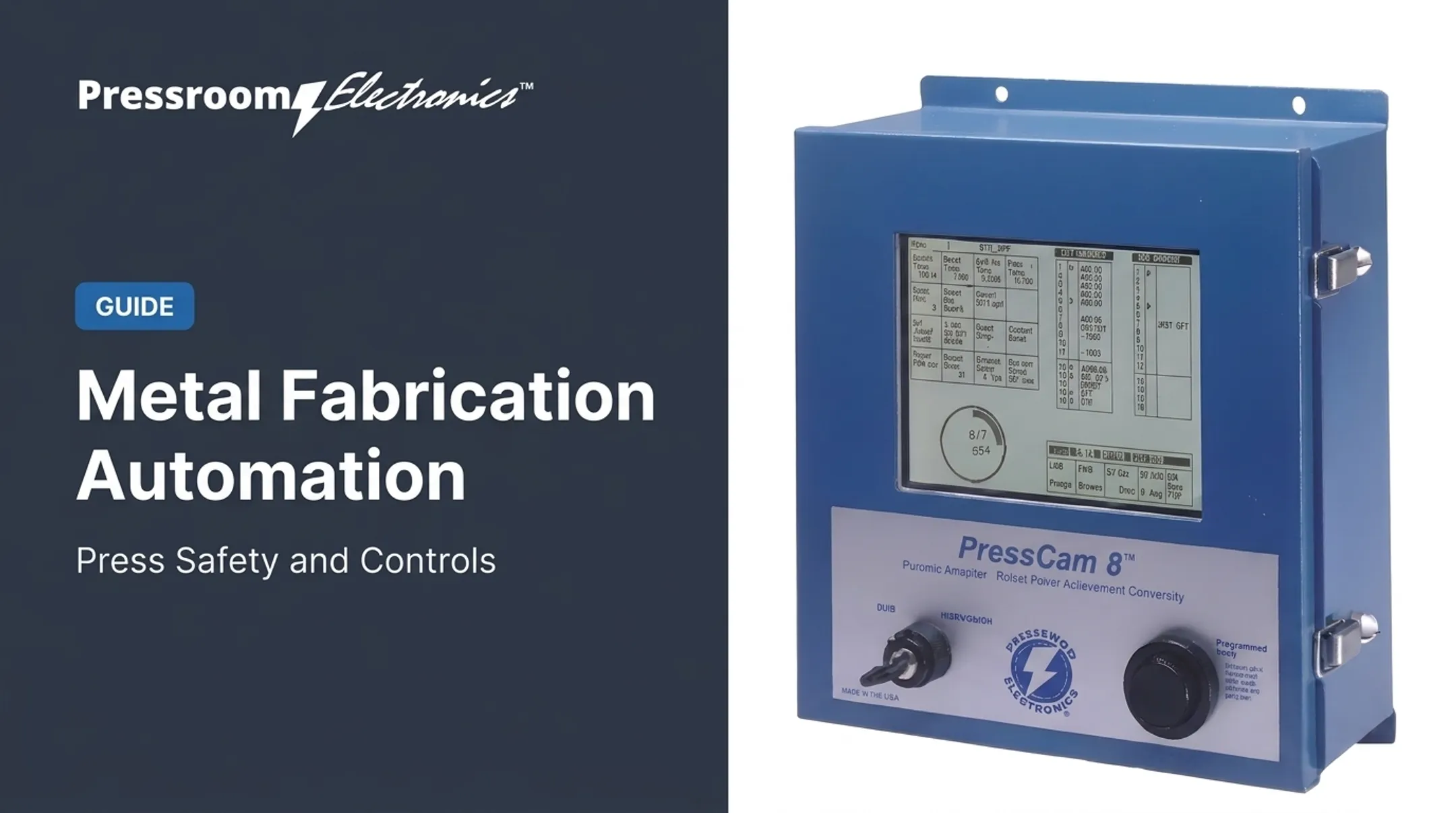
Pressroom Electronics' PressCam 8 stores 100 programs in non-volatile job memory, recalled by die number, with a RUN/PROG keyswitch and password protection. It includes a built-in servo feed interface and 11 programmable limit-switch outputs.
Define safe states and fault responses for the control, press, and feeder before commissioning.
Press Controls, Monitoring, and Custom Programming
Pressroom Electronics makes pressroom electronic controls: customized clutch/brake controls, brake monitoring, die protection, guarding, and production monitoring. It is not a turnkey feeder manufacturer. Its Servo Feed Interface integrates and controls servo-driven feeds from other suppliers.
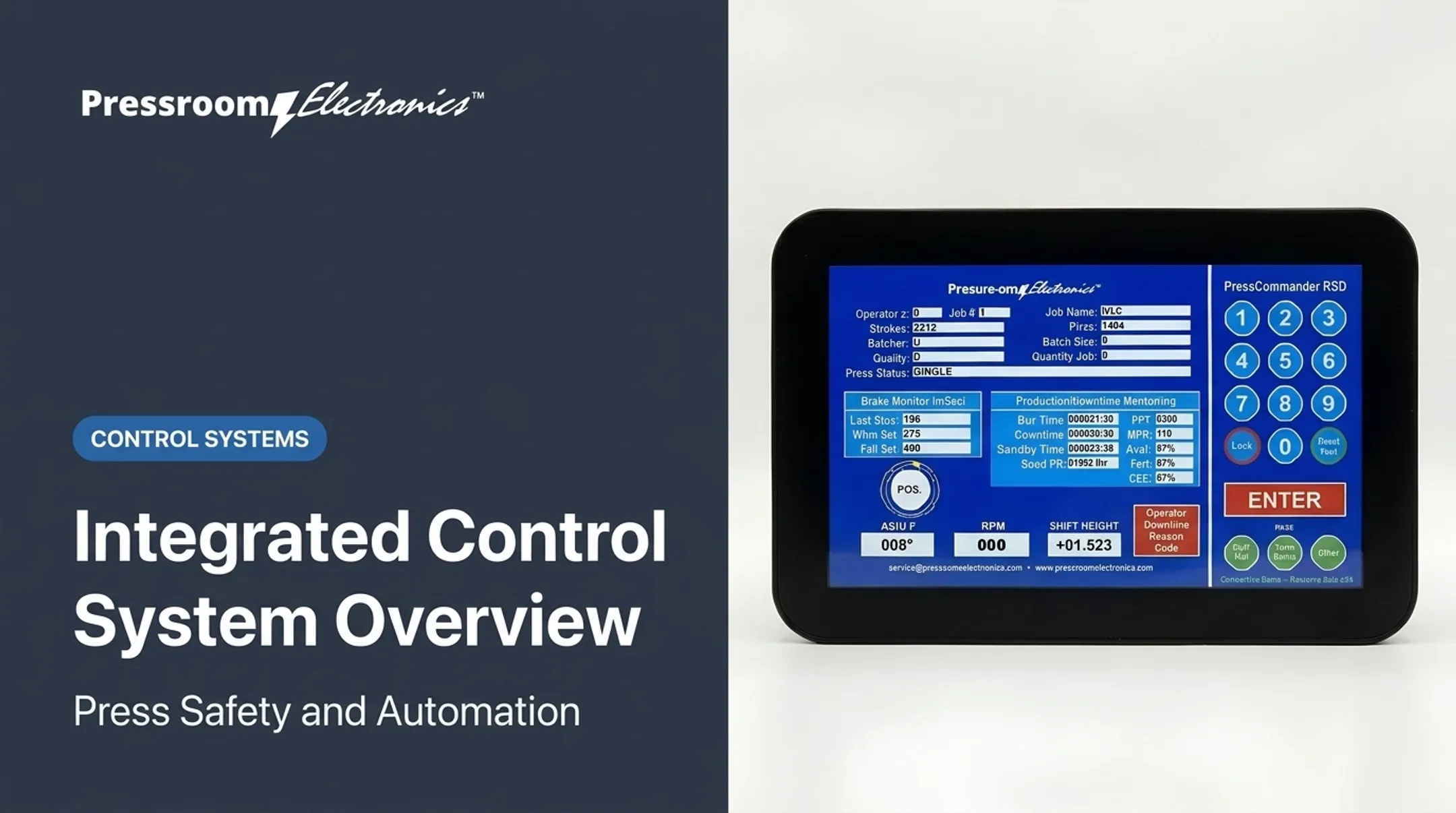
Its production and downtime monitoring system supports up to 20 customizable downtime codes. Programmable reason codes turn a generic stop into a category, such as die sensor fault or material change. Maintenance and production teams can then see recurring causes and direct resources accordingly.
Confirm with the supplier which control, monitoring, safety, and programming functions suit your specific press.
Sensors, Die Protection, and Fault Detection
Presence, position, feed-length, misfeed, and die-protection sensors confirm material and tooling are ready for the next cycle. Clear fault messages beat a generic stop signal. PressCam 8, for example, produces plain-English error messages for all system faults and flags a die sensor fault when a transition is missed outside its declared window.
Examples of protection in practice:
- Klaschka monitors detect two or more stuck sheets during destacking so the process can stop before tool damage.
- ifm's condition-monitoring case at an automotive stamper found a linkage about 20°F hotter than other press corners, traced to an off-center die. ifm estimates $500,000 in avoided maintenance and five weeks of downtime (vendor estimates, not measured savings).

Validate sensor selection and placement against your die and process. FSMdirect notes the critical angle is the last crank position at which a stop can still prevent die closure.
Safeguarding and US Compliance Considerations
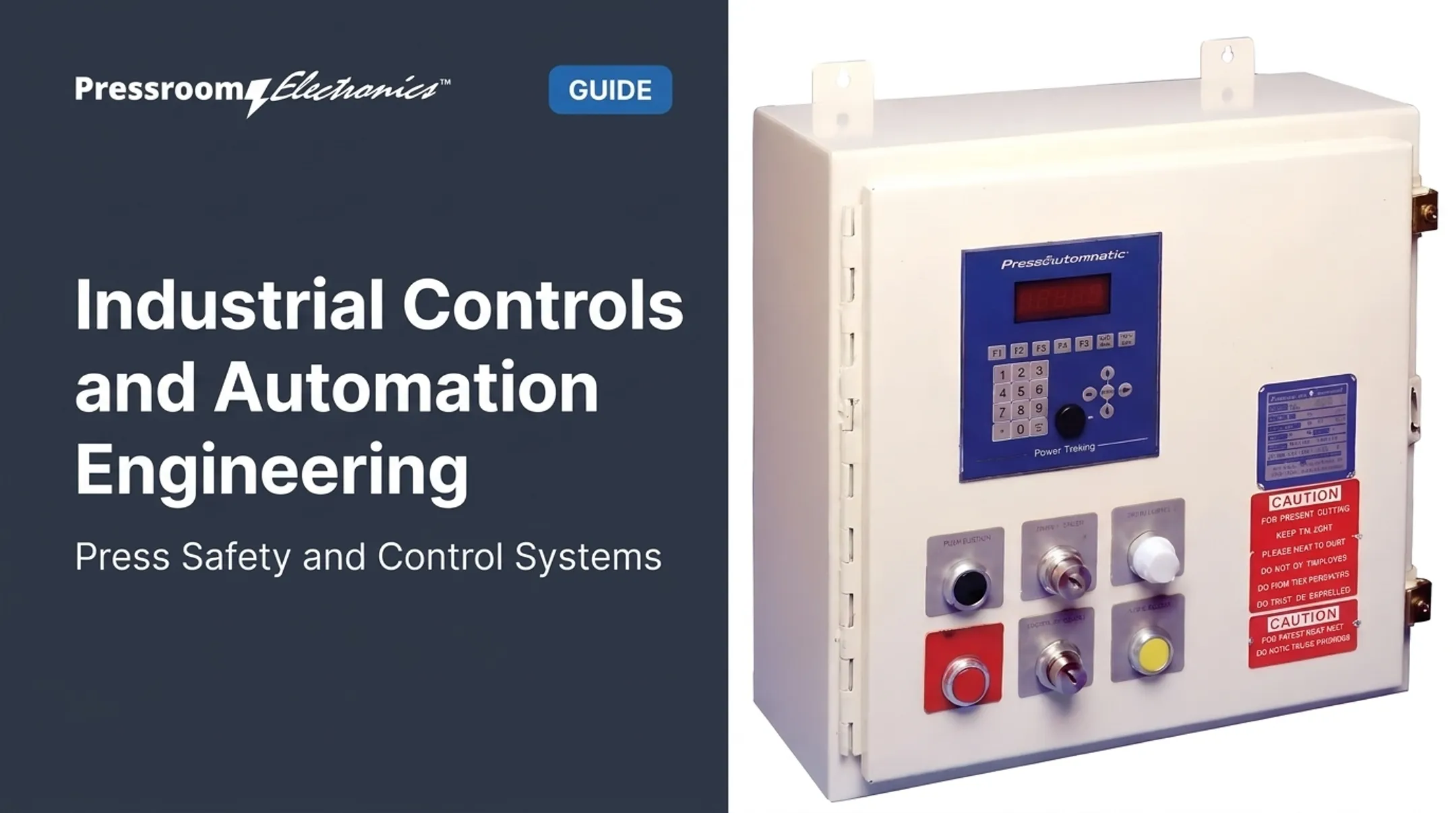
Front-of-line automation typically includes light curtains, guarding, interlocks, palm buttons, emergency stops, safety-rated control circuits, and lockout/tagout. Automation reduces exposure to hazardous or repetitive tasks. It does not remove the need for trained operators, maintenance staff, or safety procedures.
Key US points to verify:
- OSHA 1910.217(c)(1)(i) requires point-of-operation guards or properly applied devices on every mechanical press operation.
- Presence-sensing devices may not be used on full-revolution-clutch machines, and may not initiate slide motion except under the PSDI provisions of paragraph (h).
- Certain hand-in-die applications require control reliability and brake monitoring.
- OSHA 1910.147 covers lockout/tagout, with annual inspection of procedures and retraining when assignments or hazards change.
- ANSI B11.1-2009 (R2020) covers mechanical power presses; B11.19 addresses safeguarding performance; B11.0-2023 covers risk assessment.
Pressroom Electronics designs systems to exceed OSHA 1910.217 and ANSI B11.1-2009 (R2020). Check current requirements for your press and retrofit scope. This article does not replace a formal risk assessment.
Benefits of Front-of-Line Press Automation
- Less waiting between cycles: Faster, more consistent handling cuts manual adjustment and changeover delays. Some operations, such as Jireh, have cut changeover to five minutes.
- Better repeatability: Controlled feeding, die protection, and fault detection limit scrap and catch conditions that could damage tooling.
- Reduced exposure: Automated safeguarding and less hands-on contact with the material path improve safety. Reduced exposure is not eliminated risk.
- Shared visibility: Monitoring and reason codes show utilization, downtime causes, and output.
A PressCommander real-time screen example logged 2,319 strokes, 1,486 parts, 97% availability, 65% performance, and 63% OEE.
OEE is availability × performance × quality, per OEE.com's formulas. That example shows how performance, not availability, can be the hidden gap.

How to Implement Front-of-Line Press Automation
Treat this as an engineering and change-management project, not a feeder purchase.
Audit the Existing Press and Establish a Baseline
Document the current state of the cell:
- Press specs and die types
- Material formats and current feeding method
- Cycle limits, space, and utilities
- Control hardware, guarding, and maintenance history
Then measure:
- Strokes and parts produced
- Setup and changeover time
- Downtime by reason
- Misfeeds and scrap
- Manual interventions
- Safety incidents and near misses
- Maintenance response time
The baseline reveals whether your main opportunity is feeding, synchronization, safety, diagnostics, tooling protection, visibility, or a mix.
Select the Right Automation Scope
A focused retrofit, such as a new feeder or control upgrade, costs less and disrupts less. A broader project combines feeding, press controls, monitoring, die protection, and guarding.
Volume, part variety, changeover frequency, labor availability, space, budget, and growth should drive the choice.
Ask suppliers about:
- Equipment compatibility
- Custom programming and recipe management
- Data ownership
- Spare parts and remote field upgrades
- Training, documentation, and post-installation support
Engineer the Safety and Control Architecture
Require a formal risk assessment. Document normal operation, setup, maintenance, fault recovery, emergency stop behavior, and safe restart.
Validate safety devices, logic, interlocks, guarding, synchronization, sensor placement, and feeder-to-press communication before release.
Set acceptance criteria for:
- Feed accuracy
- Fault detection
- Safe stops
- Recovery procedures
- Operator access
Commission, Train, and Maintain the System
Stage commissioning in this order:
- Dry runs
- Controlled material trials
- Recipe verification
- Fault testing
- Production trials
- Documentation handoff
COE simulates the feed loop and press before shipping, and SmartPAC PRO installation checks include resolver direction, top-stop, and e-stop tests.
Train operators, maintenance, supervisors, and safety staff on operation, alarms, changeovers, backups, and safe intervention.
OSHA 1910.217(e) requires periodic inspections of presses and safeguards, with records. Add preventive maintenance, spare parts, software backups, and periodic safety reviews to keep the gains.

Measure Results and Improve the Configuration
Compare post-installation results to your baseline: utilization, reason codes, changeover time, scrap, misfeeds, output, and safety observations. Review regularly to separate equipment problems from tooling, material, setup, or training issues.
Payback depends on starting condition, production mix, avoided losses, and scope. Neither Jireh's changeover savings nor Keats's measurement gains, documented by NIST, offer a transferable payback period. Build your own from your baseline.
Conclusion: Build Automation Around the Press Process
Front-of-line automation works best when feeding, controls, sensing, safeguarding, diagnostics, and data are engineered as one system. Start with a documented assessment of your existing press. Then talk with Pressroom Electronics about control, monitoring, safety, or customization requirements before you define the retrofit scope.
Frequently Asked Questions
What is front-of-line press automation?
It automates material loading, straightening, alignment, feeding, sensing, press synchronization, controls, and safeguarding before and at the press.
Which machines and processes can be automated at the front of a press line?
Coil-fed stamping presses, mechanical punch presses, and cut-sheet operations, using uncoilers, destackers, straighteners, feeders, guides, sensors, and controls. Suitability depends on the application.
Can existing mechanical punch presses be automated?
Many can be retrofitted after a site survey covering press specs, die requirements, controls, space, safety, and equipment compatibility.
What components are included in a front-of-line press automation system?
Material handling, feeders, encoders or resolvers and sensors, PLC and HMI controls, synchronization, die protection, guarding, fault diagnostics, and production monitoring.
How does front-of-line automation improve press safety?
Guarding, light curtains, interlocks, safety controls, and less manual exposure reduce risk. A formal risk assessment and compliant implementation remain essential.
How do you measure the ROI of front-of-line press automation?
Compare baseline and post-installation downtime, changeover time, scrap, output, utilization, maintenance costs, labor allocation, and safety-related losses against the project cost.