Introduction
A press runs. A light curtain sits on one circuit, a die sensor on another, and the production count lives on a clipboard. When a stop happens, nobody can say why. That is what disconnected controls look like in a stamping plant.
An integrated control system fixes this by coordinating controllers, sensors, machine outputs, safety functions, operator interfaces, and data tools so they control and monitor a process together. This article covers how that works in metal stamping and forming, why it matters, and how to plan an upgrade.
Key Takeaways
- Integrated controls let machine-level equipment and information systems exchange data and act on shared logic.
- Core elements: controllers, sensors, actuators, safety devices, HMIs, monitoring tools, and networks.
- In stamping, integration supports safer operation, die protection, faster diagnosis, and better tracking.
- Success depends on compatibility planning, validated safety, cybersecurity, training, and a legacy-equipment strategy.
What Is an Integrated Control System?
An integrated control system combines control and monitoring functions into one coordinated architecture. Each device or machine does not operate in isolation. The CSIA describes integration as designing industrial controls and connecting plant equipment to automate manufacturing from the shop floor to the enterprise.
Three terms that get mixed up
- Integrated control system: the finished, coordinated arrangement.
- Standalone machine controller: one controller running one machine, such as a PLC on a smaller discrete process.
- Control system integration: the engineering work of connecting the pieces.
The basic layers
- Field devices sense conditions, such as position, material feed, or a blocked light curtain.
- A controller evaluates programmed logic.
- Outputs act on equipment: clutch/brake commands, valves, alarms.
- Interfaces let people monitor and adjust operations.
Common examples and categories
Examples include a connected punch press, a line with centralized monitoring, a process plant running an ICSS, and a cell that combines machine control, safety, and quality monitoring.
Categories you will meet:
- Machine control
- Process control
- Supervisory control (such as SCADA)
- Safety control
- Production monitoring
Real installations usually blend several. A press may have machine and safety control at the machine, with monitoring layered on top.
How Does an Integrated Control System Work?
Inputs
Inputs tell the controller what the machine is doing. On presses, these commonly include:
- Resolvers, which turn with the crankshaft and report position every stroke
- Rotary or electronic cams that sequence auxiliary functions
- Proximity and limit switches that confirm position
- Photoelectric and proximity sensors for die protection, such as feed, ejection, and end-of-material
- Safety devices such as light curtains, mats, and interlocks
The Controller
A PLC, a dedicated press controller, or an industrial computer reads inputs, checks programmed conditions, and decides whether the machine continues, stops, alarms, or changes state. Dedicated press controllers handle clutch/brake logic on part-revolution presses. One boundary matters: programmable cam outputs for auxiliary functions are not for clutch/brake control or light-curtain muting.

Outputs
Outputs include clutch/brake commands, motor or drive signals, valves, alarms, and interlocks. They must follow validated control and safety logic, not convenience logic.
Interfaces and Monitoring
HMIs show status, faults, and operator prompts. Monitoring software adds cycle information and downtime reasons. Real-time control is time-critical and separate from those layers. NIST guidance notes SCADA centralizes monitoring in near real time, while reporting layers look back at what happened.
A Stamping Example
- A position or safety input is detected.
- The controller checks permissives and programmed conditions.
- The press runs its sequence.
- Die protection spots an abnormal condition, such as a misfeed.
- The system stops the press or signals the issue.
- A reason code is recorded so someone can act on it.
Why Integrated Control Systems Matter in Metal Stamping
Root-cause analysis
Connected data links each stop to reason codes, machine conditions, and operator inputs. At Wiegel Tool Works in Illinois, required downtime reasons exposed coil and tool staging, packaging, and labor issues. MetalForming reported a 20% drop in changeover time and 10% higher OEE. It is a 2016 plant-reported case, not a controlled study, so treat it as an illustration.

Production visibility and utilization
Monitoring lets supervisors compare planned and actual performance, spot recurring bottlenecks, and see which presses sit idle or get interrupted often. Gains depend on how consistently the plant codes downtime and acts on the data.
Safety
Coordinated clutch/brake control, brake monitoring, die protection, and guarding support safer operation and faster response to abnormal conditions. OSHA 1910.217 requires brake monitoring that prevents successive strokes when stopping performance deteriorates. Final design, installation, and validation must follow OSHA, ANSI, and equipment requirements.
Quality and die protection
Integrated controls protect dies and hold part quality with:
- Repeatable sequences from stored job setups
- Timely detection of buckling, misfeeds, and improper ejection
- Protection of expensive dies
- Consistent setup information from job to job
A Pressroom Electronics example
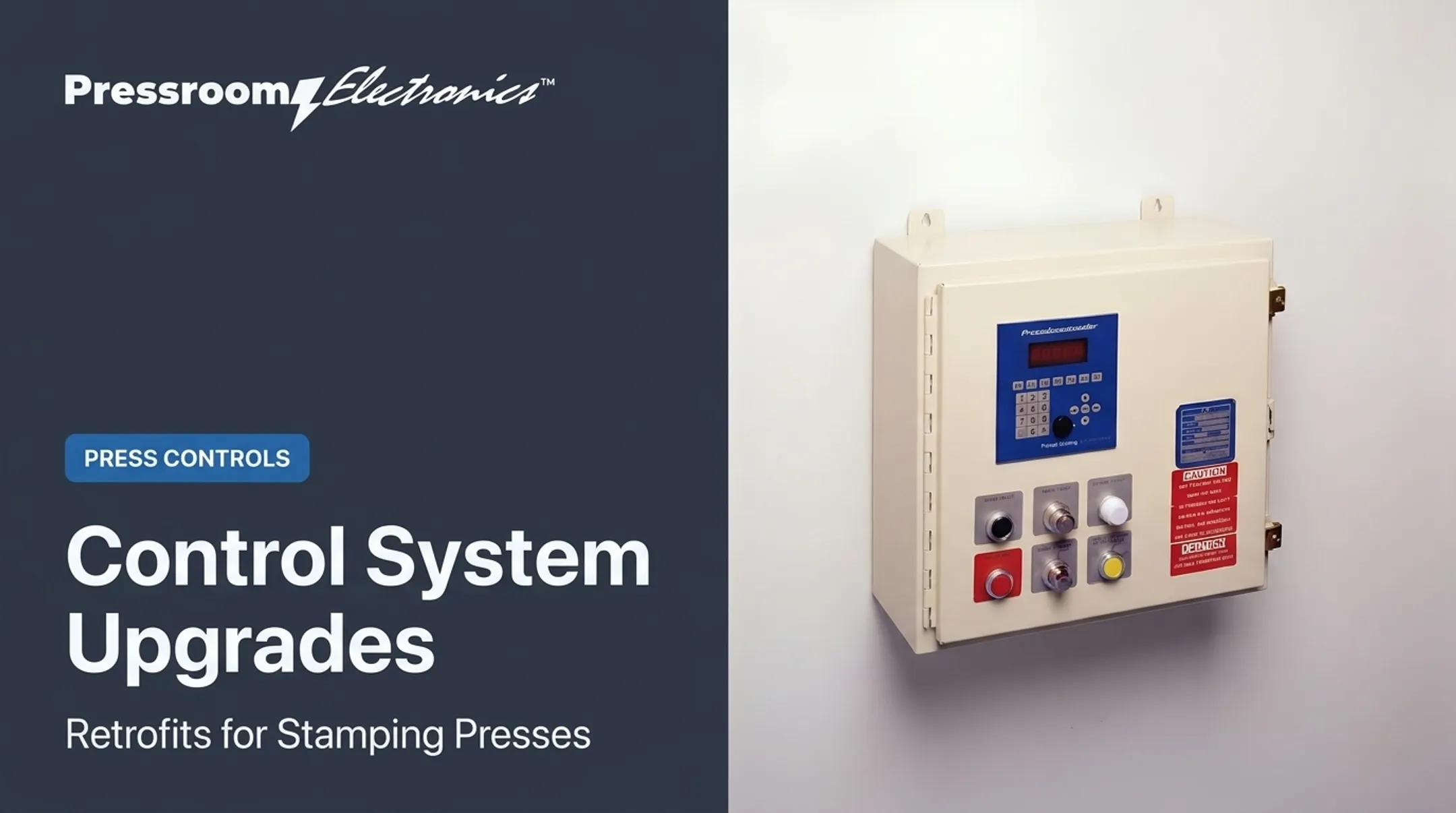
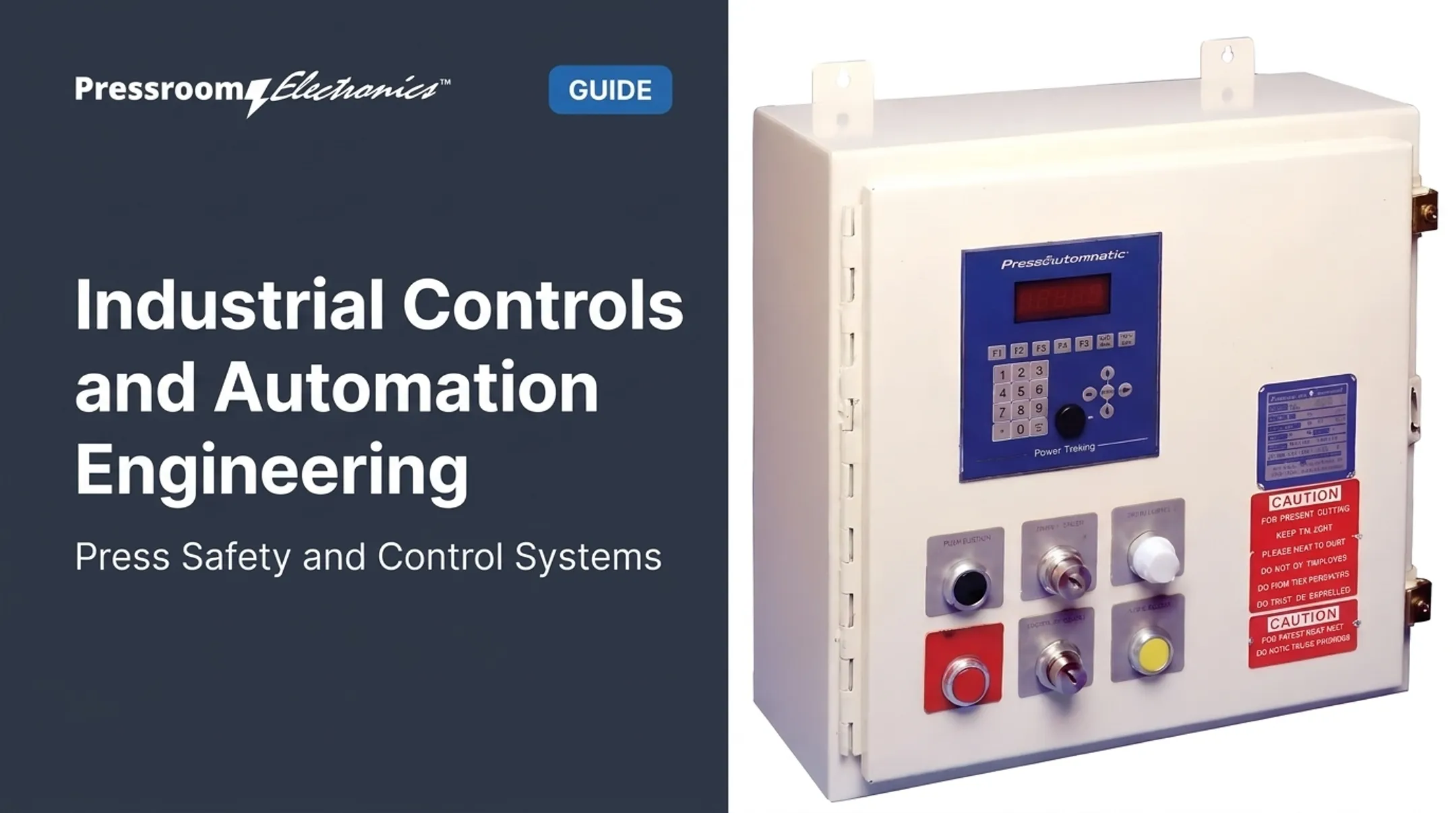
Pressroom Electronics designs and builds press controls in the USA for stampers with aging mechanical presses and newer lines. Its PressCommander is a resolver-based control that includes:
- Redundant CPUs and brake monitoring
- Die protection and programmable limit-switch outputs
- Job memory for stored setups
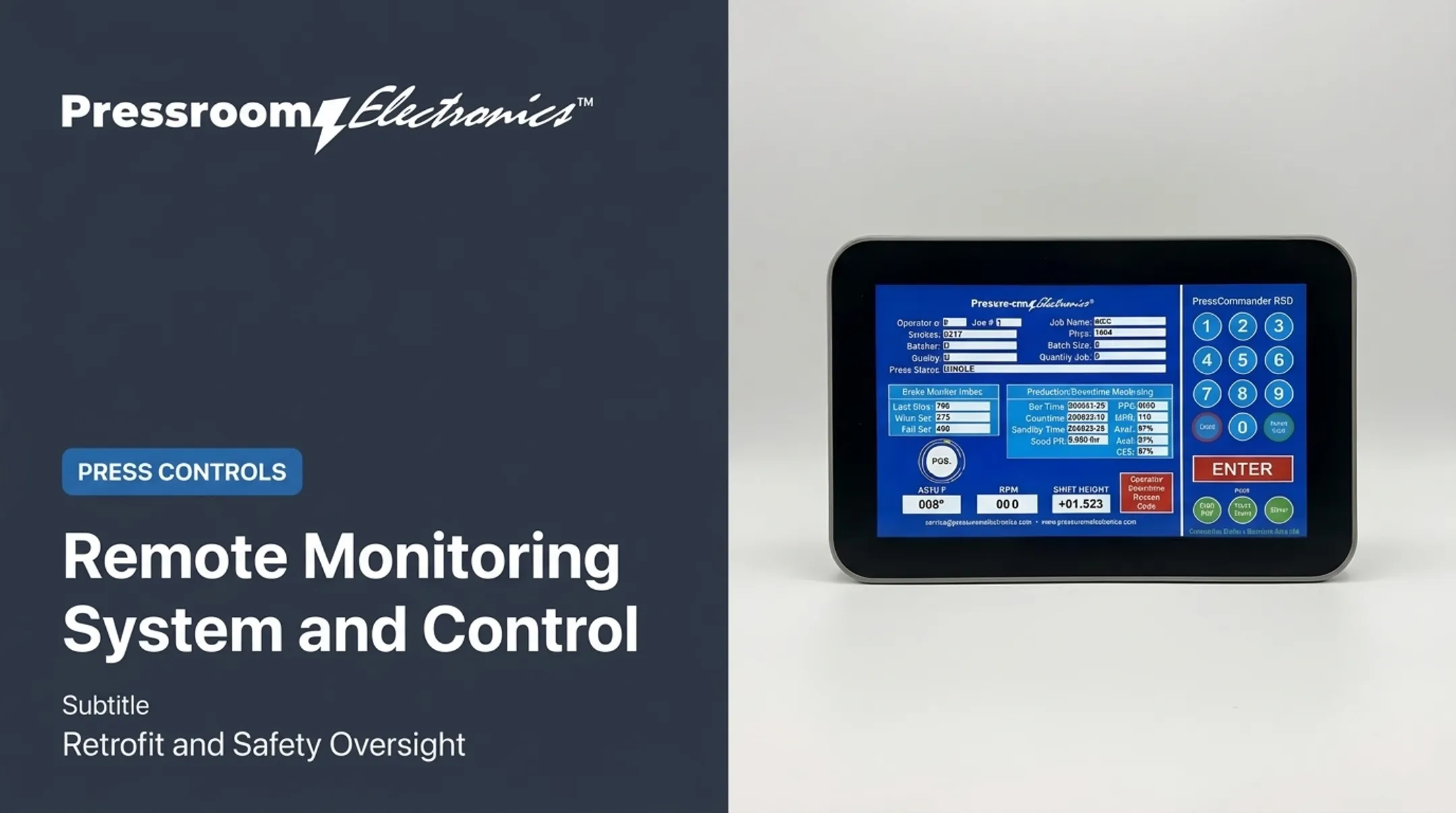
An optional 10.1-inch touchscreen adds production monitoring with automatic OEE calculation and 20 programmable downtime codes. Machine signals such as die protection or misfeed can trigger those codes, and data is logged to Excel files.
How to Plan and Implement an Integrated Control System
Start with an assessment
Document the press or line and its constraints before you specify controls:
- Control hardware, sensors, safety circuits, and communication interfaces
- Recurring faults, production goals, and legacy limits
- Model, serial number, manufacturer, and tonnage
Vendors typically request these details when preparing a proposal.
Define requirements first
Settle these before choosing hardware:
- Required control functions
- Safety validation approach (ISO 13849-2 covers validation by analysis and testing)
- Data visibility and interoperability with existing equipment
- Cybersecurity, including IT/OT segmentation and least-privilege remote access
- Operator access, expandability, and maintenance responsibilities
Phase the work
- Design review of control architecture, I/O mapping, and safety circuits
- Programming of logic, interfaces, and operator functions
- Installation of hardware, wiring, and safeguarding devices
- Commissioning with functional and safety testing
- Operator training, which OSHA requires before a covered operation starts
- Documentation handoff and post-installation support
Some systems simplify later changes. Pressroom Electronics, for example, delivers factory-created custom programs as encrypted files through an onboard USB port, and its FPC control supports field upgrades the same way.

Frequently Asked Questions
What is an integrated control system?
It is coordinated hardware, software, sensors, safety functions, and operator interfaces that together control and monitor an industrial process.
What are some examples of integrated control systems?
A connected punch press, an automated production line, a process-control installation, and an integrated control and safety system are common examples.
What are the different types of control systems?
Machine, process, supervisory, safety, distributed, and production-monitoring systems are the main types. Industrial installations often combine several.
What does ICSS stand for?
ICSS commonly means Integrated Control and Safety System. It is mainly a process-industry term, such as DCS plus emergency shutdown, and is narrower than the generic phrase.
What are industrial automation controls?
They are the controllers, sensors, actuators, safety devices, networks, HMIs, and software used to automate, monitor, and protect machinery and processes.