Introduction
Metal fabrication automation is no longer just a robotic arm in a weld cell. Programmable controls, sensors, CNC equipment, safety systems, production monitoring, and connected software can now coordinate work across the whole shop floor.
Most shops come to it with the same problems: tight labor, inconsistent output, unplanned downtime, safety exposure, aging machinery, and pressure to move more parts. The U.S. manufacturing sector could need as many as 3.8 million new employees between 2024 and 2033. Doing more with the people you have is the practical path forward.
This guide covers what automation is, where it shows up in fabrication, what it delivers, and how to evaluate a project without overspending.
Key Takeaways
- Automation means programmed logic, sensors, and feedback that cut manual work, not robots alone.
- The right target depends on volume, repeatability, changeovers, safety risk, and skills on hand.
- Existing equipment can often be upgraded with compatible controls, monitoring, and guarding.
- People still handle programming, setup, quality, maintenance, and troubleshooting.
What Is Metal Fabrication Automation?
Definition and scope
Metal fabrication automation uses programmable machines, controls, sensors, and software to perform, coordinate, monitor, or adjust fabrication tasks with limited human intervention.
Three levels clarify the difference:
- Manual: the operator supplies both power and control.
- Mechanization: powered assistance, but the operator stays actively in control.
- Automation: programmed sequencing, sensing, and feedback take over parts of the decision-making.
In welding, the AWS distinction is similar: mechanized welding needs manual adjustment based on observation, while automated welding needs little or none.
A simple example: a powered tool the operator guides is mechanization. A system that detects part position and adjusts its own operation is automation.
Core technologies
Per NIST guidance, PLCs manage processes through feedback, sensors measure physical properties, and actuators act on controller commands. Related systems include:
- CNC systems and robots or cobots
- Machine vision
- Safety devices such as light curtains and interlocks
- Human-machine interfaces (HMIs) that show status and let operators adjust parameters
- Monitoring software that records machine states
You don't need all of it at once. Automation might be one press control upgrade, a connected welding cell, an automated material-handling system, or a full line.
Automation across the workflow
Automation can touch every step: job preparation, material loading, cutting, forming, stamping, welding, inspection, handling, and reporting.
What makes it work is the feedback loop. A sensor detects misalignment, tool wear, unsafe access, or process drift, and the controller adjusts, stops, or alerts someone.

Automation and metal stamping
Pressroom automation is its own discipline, especially for mechanical punch presses. Common upgrades include:
- Press and clutch/brake controls
- Brake monitoring
- Die protection
- Guarding
- Production monitoring
These improve operation, safety oversight, and visibility, often without replacing the press.
One boundary matters: die-malfunction detection and OSHA personnel guarding are separate functions. A die protection sensor saves tooling. A guard saves hands.
Common Examples of Metal Fabrication Automation
Automated cutting, drilling, and machining
CNC laser, plasma, and waterjet systems follow programmed tool paths, which improves repeatability and reduces manual positioning. Nesting software such as Hypertherm's ProNest handles part nesting, sequencing, and NC output.
Automated loading, unloading, tool changing, and job selection add another layer. Material type, thickness, geometry, and part mix decide which setup makes sense.
Automated forming, stamping, and press operations
Around punch presses, automation includes:
- Servo feeds, powered straighteners, and coil handling
- Transfer systems
- Programmable press controls and sensors
- Die protection and brake monitoring
A FMA-reported example shows a stamper receiving a servo feed, threading table, powered straightener, and coil reel. Together these coordinate the press cycle, flag abnormal conditions, protect tooling, and give operators clear fault information.
Robotic and collaborative welding
Welding automation means programmed equipment controls torch movement, travel speed, positioning, and sequencing. Operators still handle setup, programming, inspection, and exceptions.
- Industrial robot cells suit structured, repetitive production.
- Cobots suit lower-volume, high-mix, or space-constrained work. NIST notes they run slower than standard automation and have payload and reach limits.
Either way, safety applies to the whole application. ANSI/A3 R15.06-2025 adopts the ISO 10218:2025 provisions, and some cobot applications still need scanners or caging. A risk assessment is required.
Automated material handling and assembly
Conveyors, part feeders, pick-and-place systems, automated storage, AGVs, and AMRs reduce manual movement. FMA describes mobile robots moving parts between cutting, bending, welding, and coating.
Barcodes, RFID, fixtures, and job tracking help route the right material to the next operation.
Automated inspection and production monitoring
Machine vision, dimensional sensing, weld monitoring, and dashboards detect defects and improve traceability. One Houston fabricator added joint-tracking vision to welding robots, so feedback adjusts speed, wire feed, and voltage.

Monitoring also captures cycle status, downtime events, and recurring faults that manual observation misses.
What Are the Benefits of Automating Metal Fabrication?
Higher throughput and machine utilization
Automation removes repetitive steps, steadies cycle times, and keeps equipment running through a shift. Mayville Engineering monitored tower-fed lasers, robotic brake presses, and machining centers and reported 10%-15% uptime gains. That is one customer's result, not an industry benchmark.
Consistency, quality, and less rework
Programmed motion, fixtures, and sensing reduce operator-to-operator variation in cutting, forming, welding, and assembly. The payoff is fewer defects, less scrap, steadier downstream operations, and better quality records.
Magellan Aerospace integrated engineering data and machine communications across 40-plus devices and reported $51,473 lower scrap and rework costs. That was a bundled digital-factory project, not monitoring alone.
Safer work environments
Automation can move people away from heat, fumes, pinch points, and heavy loads. It doesn't remove the need for risk assessments, guarding, interlocks, e-stops, training, and OSHA and ANSI compliance.
The risk is real. OSHA cited a bakeware maker after two amputations when presses cycled during servicing and scrap clearing. Robot electrical systems also add shock, arc-flash, and fire hazards.
Better use of labor and skills
Operators and welders shift toward setup, programming, quality checks, maintenance, and troubleshooting. That requires training in controls, robot or CNC programming, sensor diagnostics, and safe interaction with equipment.
New Millennium, a Nevada steel-joist maker, reported 70% lower downtime and 40% higher efficiency after pairing automation with workforce training. Credit the combination, not the equipment alone.

Downtime visibility and improvement
Machine states, fault histories, and downtime reasons let teams chase root causes instead of symptoms. Measure a baseline first:
- Downtime and changeover time
- Scrap and rework
- Output
- Maintenance events
OEE (availability x performance x quality) is a useful frame. The common 85% target is a convention, not a universal standard.
How to Evaluate and Implement Automation in a Metal Fabrication Operation
Start with the process and business case
Audit before you buy. Look at:
- Bottlenecks and repetitive tasks
- Safety exposures
- Quality losses and downtime causes
- Labor requirements and material-flow delays
Then weigh these business-case factors:
- Volume and part mix
- Tolerances and changeover frequency
- Floor space and utilities
- Machine condition and integration capability
Retrofit, partial automation, or new system
The Society of Manufacturing Engineers (SME) flags structural and mechanical condition, control upgrades, retooling, rigging, and foundations as key factors. Compare:
- Equipment age and control compatibility
- Mechanical condition and spare-parts availability
- Safety gaps
- Downtime during installation
- Future expansion
When full replacement isn't justified, stage it: controls first, then monitoring, die protection, guarding, feeding, or inspection.
Plan integration, safety, training, and measurement
Plan for:
- Controls integration and operator interfaces
- Data connectivity and safety validation
- Maintenance access and programming ownership
- A manual-operation fallback plan
For ROI, count more than purchase price:
- Equipment, engineering, and installation
- Training and ongoing maintenance
- Consumables
- Downtime during deployment
- Labor changes
- Scrap reduction and capacity gains
- Safety-related benefits
NIST's planning guide ties payback to equipment cost and operational performance. It doesn't promise a universal payback.
How Press Controls and Production Data Support Automation
The control layer in a modern pressroom
Automation depends on the control layer coordinating:
- Motion, clutch, and brake operation
- Sequencing and operator inputs
- Safety functions, tooling protection, and fault responses
Under 29 CFR 1910.217, when a part-revolution clutch press uses hand-in-die feeding with two-hand control, presence sensing, or a Type B gate, it needs a compliant control system and brake monitor. The monitor checks performance each stroke. Presence sensing can't be used with full-revolution clutches.
Turning machine events into insight
Programmable reason codes sort downtime into categories. That surfaces recurring root causes, setup delays, and maintenance needs.
Utilization and performance tracking then give production, maintenance, engineering, and management one shared picture, accessible globally.
Pressroom Electronics for stamping and forming
Pressroom Electronics designs, manufactures, and services pressroom controls in the USA. Its lineup includes:
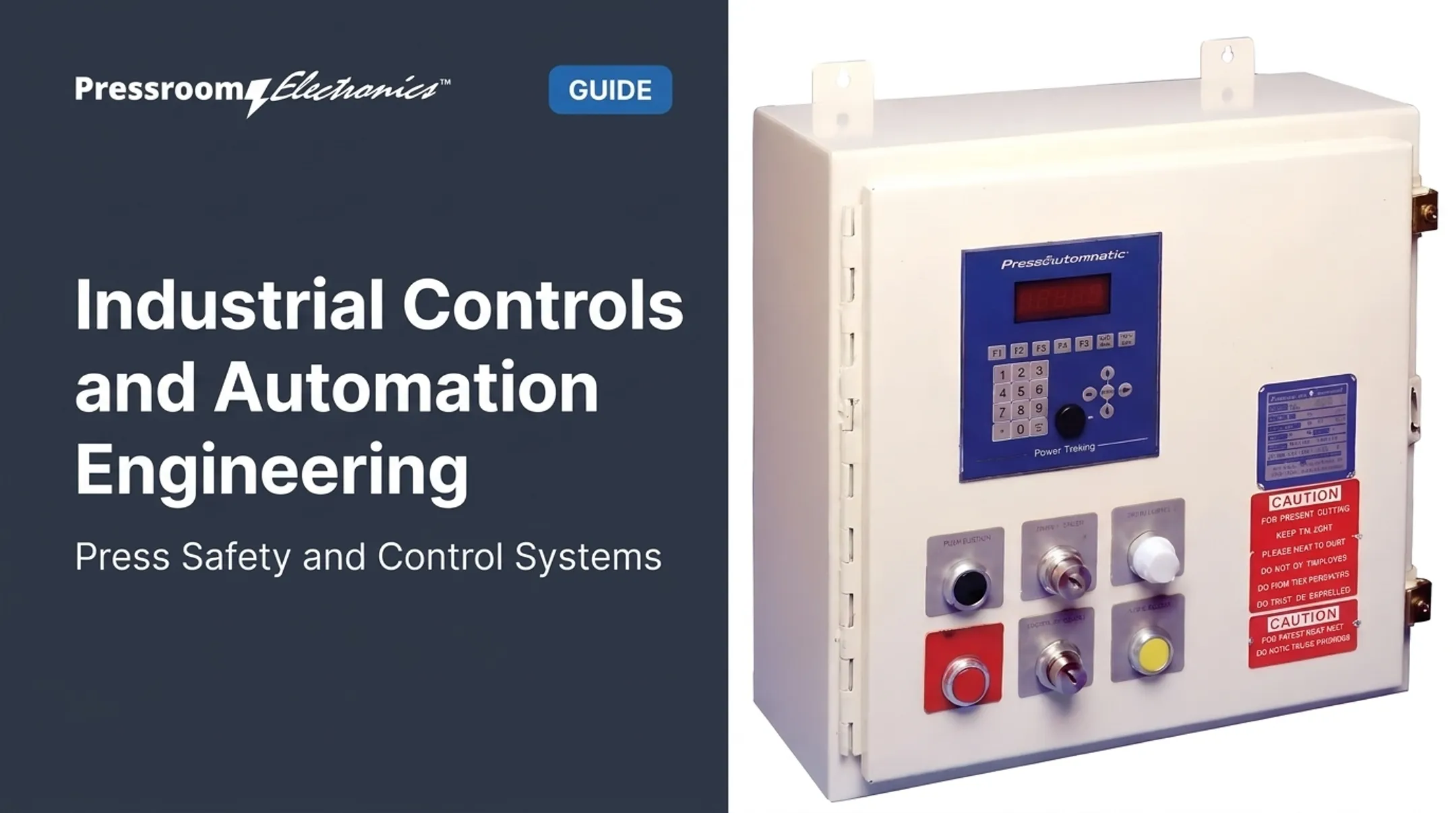
- Resolver-based and rotary-cam-based clutch/brake controls
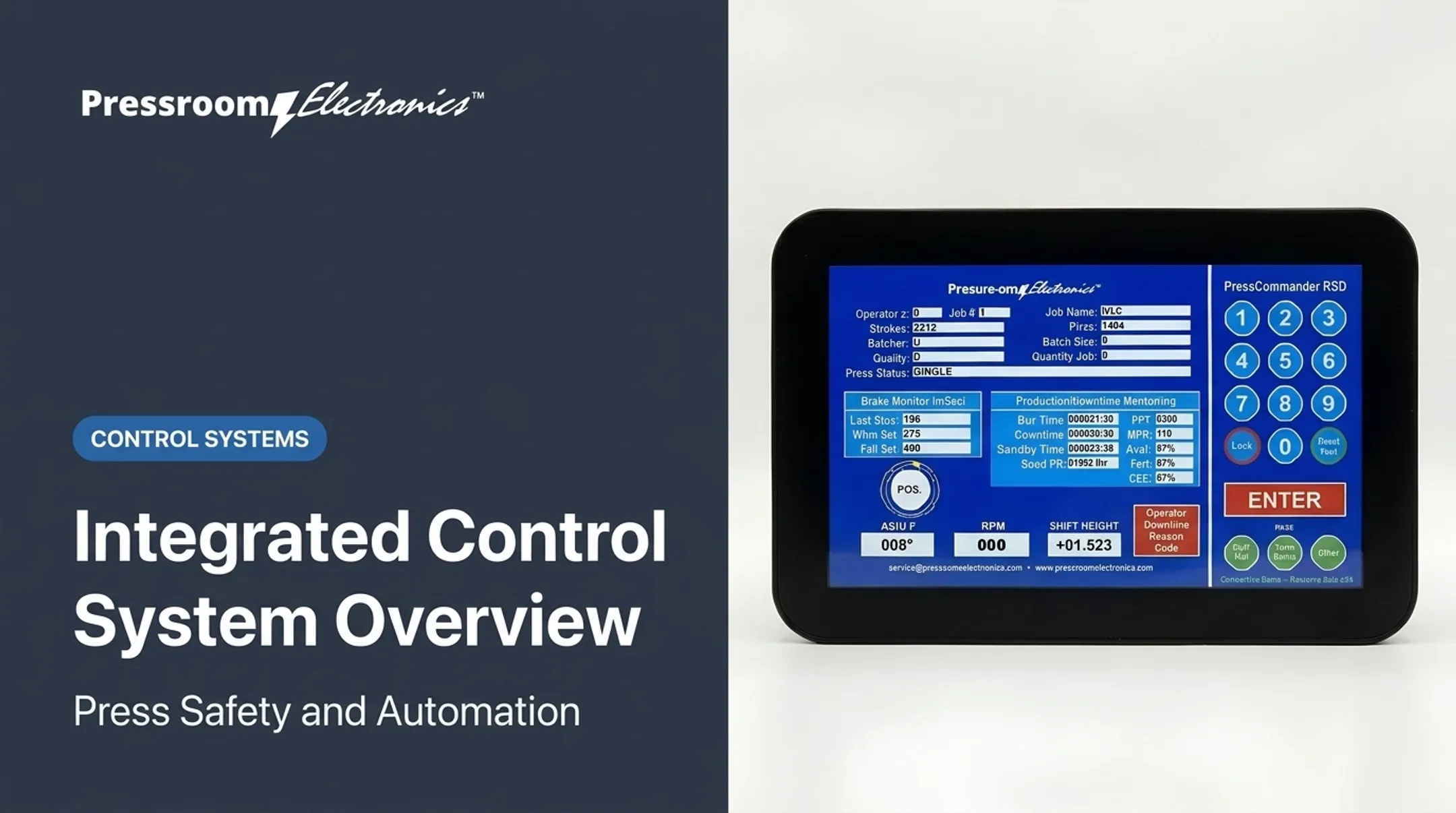
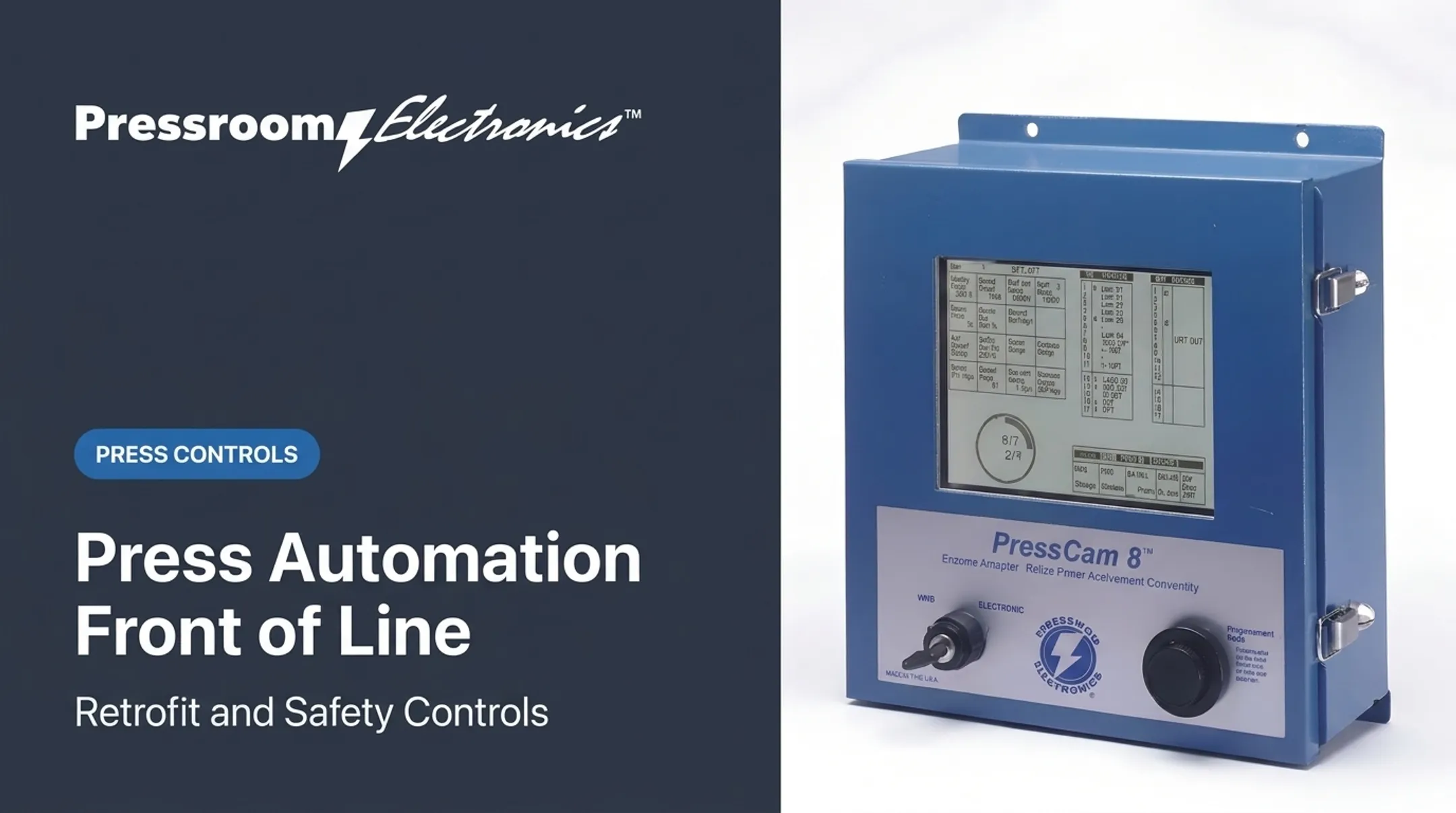
- PressCam 8 and PressCommander, with die protection and programmable limit switches
- A Production & Downtime Monitoring System with up to 20 customizable downtime codes and Excel logging
- Factory programming and remote field upgrades
The systems are built for part-revolution, air-clutch, pneumatic, and hydraulic presses. They are not designed for full-revolution presses.
Stamping plants, press rebuilders, machinery OEMs, maintenance and safety contractors, and distributors can contact Pressroom Electronics at 800-937-4334 or sales@pressroomelectronics.com for press control, monitoring, guarding, or utilization needs.
Frequently Asked Questions
What is welding automation?
Welding automation uses programmed equipment, fixtures, sensors, robots, or cobots to control repetitive welding movements and process steps. People still handle setup, programming, inspection, maintenance, and exceptions.
What are common examples of fabrication automation in manufacturing?
Common examples include automated cutting, CNC machining, forming and stamping, press feeding, robotic or collaborative welding, material handling, inspection, and production monitoring.
Is metal fabrication automation only suitable for high-volume production?
High-volume repetitive work is a strong fit. Cobots, monitoring, modular controls, and staged retrofits can also serve small, mid-sized, and high-mix shops when the business case holds.
Should a manufacturer retrofit an existing punch press or replace it?
Compare machine condition, control compatibility, safety requirements, tooling, downtime, production goals, integration cost, and future capacity. Retrofit often wins when the frame is sound.
Does metal fabrication automation replace workers?
Usually it shifts jobs toward programming, setup, monitoring, quality, maintenance, and troubleshooting. That makes training and safe operating procedures essential.