Introduction
A decade ago, automation in a car plant often meant a robot arm doing one job in one cell. Today the goal is a connected system: machines, sensors, controls, software, and skilled people working off the same data.
The pressure behind it is real. Siemens estimates downtime at $2.3 million per hour for a large automotive plant. Plants also struggle with labor shortages and growing model variation.
This guide covers automation types, where automation shows up on the floor, the core technologies (robots and AI included), and how to start without overreaching.
Key Takeaways
- Automation goes well beyond robot arms: press controls, vision, material handling, and monitoring all count.
- Volume, part mix, and changeover frequency determine the right level of automation.
- People still program, maintain, troubleshoot, and improve every automated system.
- Start with one measurable bottleneck, not the whole plant.
What Is Automotive Manufacturing and Car Industry Automation?
Automotive manufacturing automation uses control systems, robotics, sensors, software, and connected equipment to perform, monitor, or optimize production with less manual intervention. ISA defines automation as technology that monitors and controls the production and delivery of products and services.
Factory automation builds the vehicle and its parts. That work is separate from autonomous driving under SAE J3016, which covers systems that perform driving tasks on public roads.
The automation spectrum
- Manual and mechanized work: people do the task, perhaps with powered tools
- Partially automated cells: a robot or controller handles one step
- Flexible lines: equipment switches between models quickly
- Connected smart manufacturing: systems share data across the plant
"Automated" does not mean unattended. Hyundai's highly automated Georgia plant still has people doing precision work that needs dexterity, vision, and judgment.
Where Automation Is Used in Automotive Manufacturing
Automation touches nearly every stage: material handling, stamping, body-in-white welding, painting, machining, powertrain or battery production, final assembly, inspection, and testing.
Common robotic applications include:
- Spot and arc welding
- Painting and adhesive dispensing
- Fastening and component installation
- Part loading, pick-and-place, and palletizing
- Parts movement with AGVs or AMRs
At Hyundai's Georgia plant, robots stamp and weld, a cobot installs doors, AGVs deliver parts, and Spot robots inspect welds.
BMW reported that a humanoid robot at Spartanburg supported production of more than 30,000 X3 vehicles over 10 months by inserting sheet-metal parts for welding. That figure measures production supported, not labor saved or ROI.

Stamping and forming
Stamping is where much of the vehicle starts, and its automation is often overlooked. A press line typically involves:
- Blank feeding and transfer systems
- Press motion control and clutch/brake control
- Brake monitoring and die protection
- Guarding and part detection
- Production data collection
Press automation and personnel safeguarding are separate functions. A die-protection sensor does not prove operators are protected. OSHA's mechanical press rule requires point-of-operation guarding and, for specified operations, a brake monitor. It also bars presence-sensing devices on full-revolution-clutch machines.
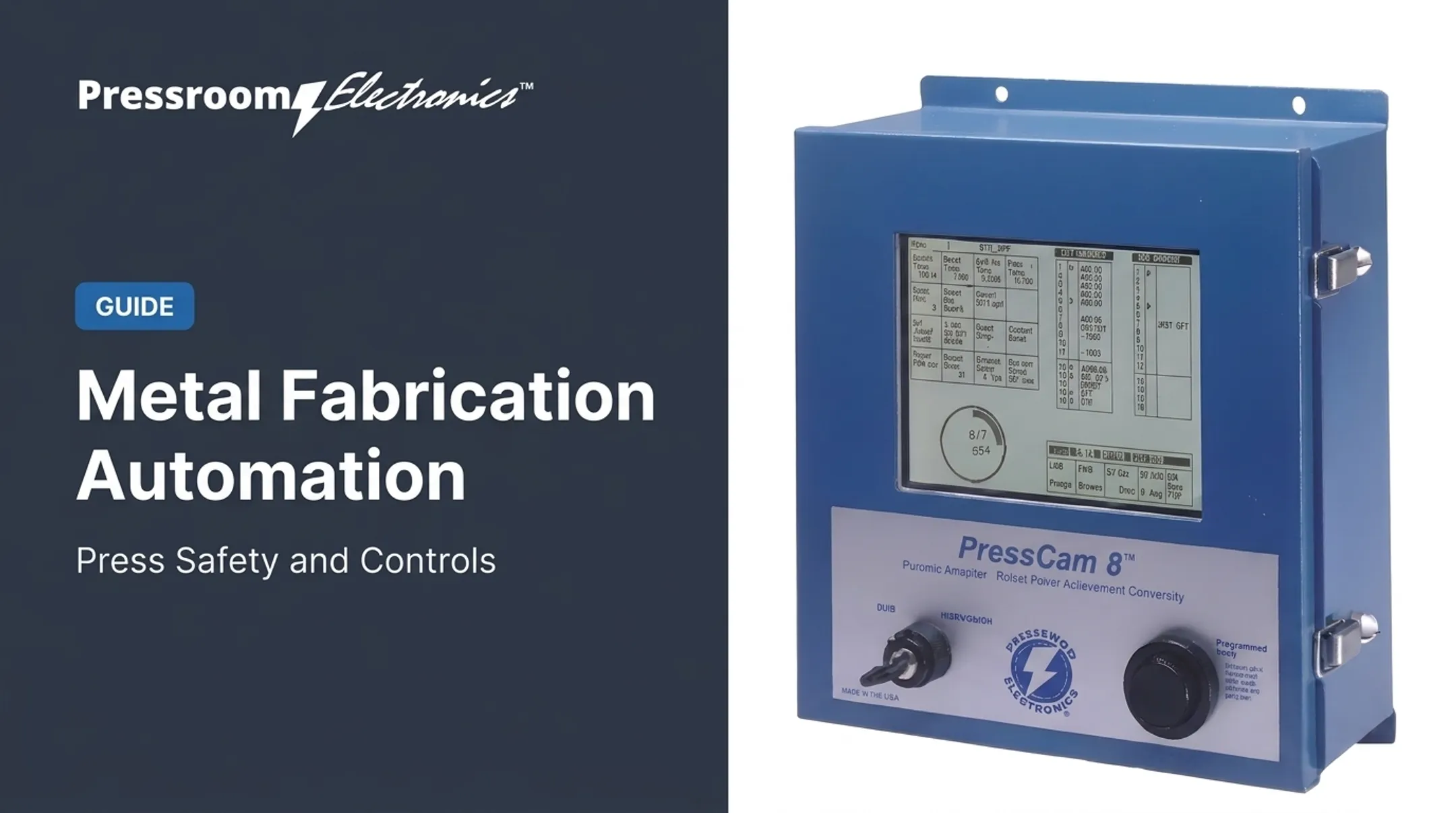
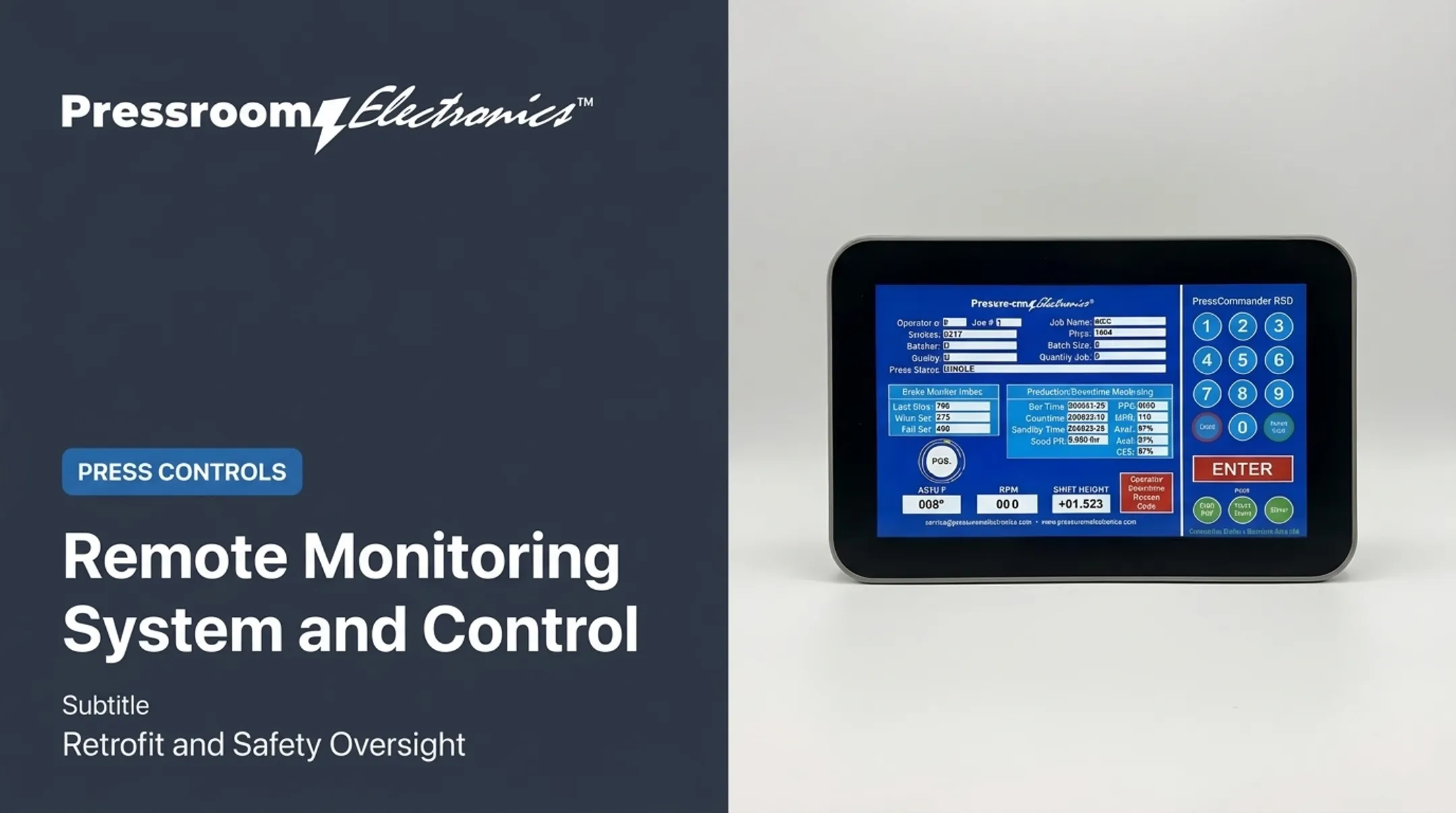
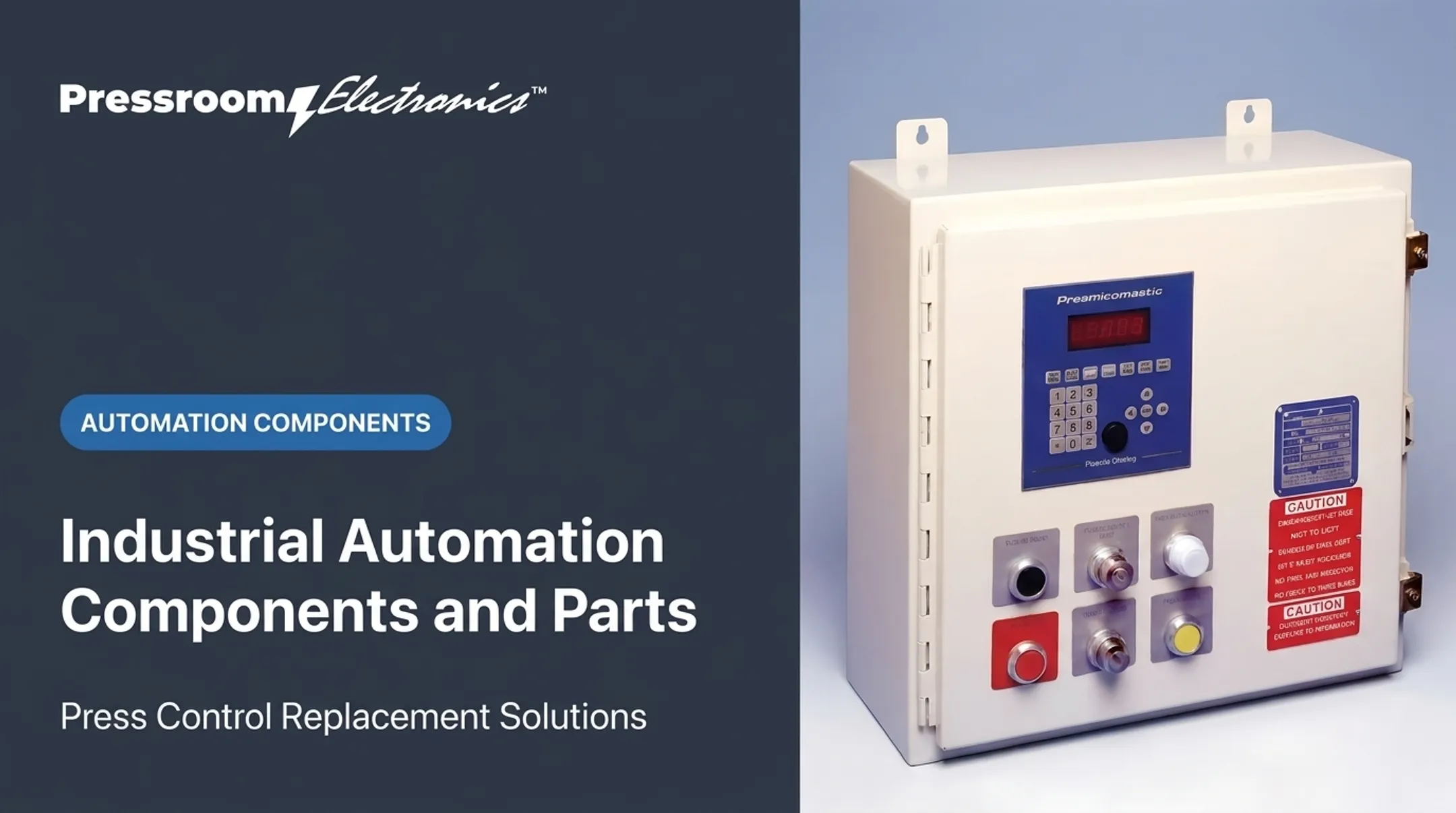
Pressroom Electronics builds customized pressroom controls for this work on mechanical punch presses. Its PressCommander controller combines programmable cam outputs, die-protection inputs, a brake monitor, counters, and servo-feed output, with optional tonnage monitoring and Ethernet. Its focus is safety, machine utilization, visibility, and downtime analysis.
Quality and traceability
After forming and assembly, plants tie quality data to each vehicle:
- Machine vision reads direct-part marks and 2D codes, including 17-character VINs
- Torque and angle tools reject tightenings outside limits and store results by VIN
- Force-displacement monitoring checks press-fits and joins
- Presence/absence and dimensional checks catch assembly errors
IATF 16949 requires identification and traceability, but it does not mandate any particular technology. Ford's customer-specific requirements add lot traceability within their stated program scope.
Newer applications
KUKA describes robotic systems for battery-cell handling, pack assembly, and electric motor assembly. These are supplier-described capabilities, not proof of deployment at a named automaker.
EV and mixed-model lines also lean on flexible logistics. Hyundai's plant pairs mixed-model production with AGV-based internal material flow.
Types of Automation Used in Car Manufacturing
Automation is classified in more than one way. Groover's textbook lists three principal types (fixed, programmable, flexible) and treats computer-integrated manufacturing separately. Many plants describe four types:
| Type | How it works | Automotive example |
|---|---|---|
| Fixed | Equipment configuration sets the sequence; high volume, little changeover flexibility | Dedicated stamping or welding process |
| Programmable | A program changes the sequence for each batch | Machining or assembly cell running batches |
| Flexible | Handles variety with almost no changeover time | Multi-model assembly line |
| Integrated | Links machines, controls, software, and production data | Plant-wide system tying cells to MES |
The categories describe different dimensions: equipment flexibility versus enterprise integration. Flexible automation also means heavy investment in custom engineering.
Picking tasks to automate
NIST MEP's Automation 101 uses four D's: dull, dirty, difficult, dangerous. You will see "delicate" added as a fifth in some places, but it is not a standardized taxonomy. Use the D's as a screening question, not a formula.
Core Technologies Powering Modern Automotive Automation
Robots, cobots, and the systems around them
A robot is only one piece. Grippers, fixtures, end-of-arm tooling, motion control, and safety systems decide whether a cell works.
NIST MEP notes traditional robots generally offer higher speed and payload, while cobots run at lower speed and payload. Choose a traditional robot for heavy parts or fast cycles behind guarding. Choose a cobot where people share the space and loads are light.

Collaboration is a property of the application, not the robot. ANSI/A3 R15.06-2025, which adopts ISO 10218-1 and -2:2025, requires assessing the whole application.
AI and machine learning
Proven uses include predictive maintenance, anomaly detection, defect classification, and scheduling. Newer ones include adaptive robot motion and humanoid handling, as in BMW's pilot. Treat vendor claims of broad ROI with caution, because few public figures isolate AI's contribution.
Even simple diagnostics help. A brake monitor that logs stopping time on every stop can warn of wear before a failure, so maintenance gets scheduled instead of forced.
Vision and sensing
- Cameras for part identification, alignment, and defect detection
- Proximity sensors for presence and position
- Force/torque sensors for press-fit and fastening checks
- Encoders and resolvers for position feedback in closed-loop control
- Safety mats and light curtains for worker detection
Industry 4.0 infrastructure
| Element | Role |
|---|---|
| PLC | Controls discrete processes such as assembly |
| SCADA | Supervisory monitoring and control |
| MES | Connects shop floor to business systems |
| Edge computing | Processes data near the machine |
| Digital twin | Models a system for maintenance and planning |
Data can flow from machine to supervisor to operations leader, but connectivity alone improves nothing. Someone has to act on it.
Pressroom Electronics' touchscreen shows this at the press level: it calculates OEE from live production and downtime status and supports 20 programmable downtime codes, so teams see why a press stopped.
RPA is not robotics
Robotic process automation means software bots doing rules-based digital tasks, such as order entry, inventory updates, or compliance paperwork. It does not weld or assemble. In a connected plant, it needs clean data, system integration, and human approval for exceptions. Those same connections need protection: NIST SP 800-82 Rev. 3 recommends IT/OT segmentation, controlled remote access, and asset inventory.
Benefits, Challenges, and a Practical Adoption Roadmap
Define measurable goals
Set floor-level targets such as:
- Less unplanned downtime and higher utilization
- Consistent quality and safer work
- Faster changeovers and clearer production visibility
Results vary by plant. OEE equals availability × performance × quality. The oft-quoted 85% world-class mark carries its source's own warning against a single target.
A Wisconsin supplier, Charter Automotive, cut setup hours by 51% through quick-changeover training and standard practices. That was a lean result, not automation alone.

Assess your existing line
- Identify the bottleneck that limits throughput
- Document manual interventions operators still perform
- Review downtime and fault history by root cause
- Check part mix and changeover frequency
- Confirm utilities and available floor space
- Inspect controls and network compatibility
- Define safety requirements for the cell
Phase the rollout
- Start with a contained pilot at a high-value constraint
- Run integration testing with production conditions in mind
- Train operators and maintenance staff on the new system
- Validate in production against agreed KPIs
- Expand only after those KPIs are met
Track:
- OEE and downtime by root cause
- Quality defects and scrap
- Changeover time and throughput
- Safety events and maintenance response time
Retrofits are often the practical entry point. Pressroom Electronics, for example, supports retrofitting existing punch presses and OEM integration. Downtime-monitoring rollouts typically follow four phases:
- Understand the mechanics
- Interpret the data
- Use the data
- Improve continuously
Challenges to expect
- Capital cost and installation downtime
- Legacy equipment and interoperability
- Cybersecurity and data ownership
- Limited maintenance capability in-house
- Automating an unstable process
That last one matters most. NIST MEP warns that automating an inefficient process amplifies the inefficiency. Map the process, standardize it, and run root-cause analysis first.
People and compliance
Automation changes tasks more than it removes the need for people. Plan for skills in programming, controls engineering, robot maintenance, data analysis, quality, and safety.
Deloitte and the Manufacturing Institute project about 3.8 million manufacturing hires needed from 2024 to 2033, with roughly 1.9 million potentially unfilled. That is a manufacturing-wide projection.
Key US requirements include:
- OSHA 29 CFR 1910.217 (mechanical power presses)
- 29 CFR 1910.147 (lockout/tagout)
- 29 CFR 1910.212 (machine guarding)
- ANSI B11.1-2009 (R2020) for mechanical presses
- ANSI/A3 R15.06-2025 for industrial robots
- ANSI B11.19-2019 (R2024) for safeguarding performance
Frequently Asked Questions
What is automotive manufacturing automation?
It is the use of robotics, controls, sensors, software, and connected equipment to perform or optimize vehicle and component production. A press control that monitors brake stopping time and protects dies is one example.
How is AI used in the automotive industry?
Proven uses include predictive maintenance, machine vision, defect detection, and scheduling. Adaptive robot motion and humanoid handling are still emerging.
Is there a fully automated car factory?
Some plants are highly automated, but they still rely on people for engineering, maintenance, quality, safety, and exception handling. Fully people-free, end-to-end vehicle factories are not how the industry operates.
What are some examples of robots used in manufacturing?
Welding, painting, assembly, and palletizing robots, mobile robots, cobots, and vision-guided systems. Hyundai's Georgia plant uses a cobot for door installation.
What is robotic process automation?
RPA is software that performs rules-based digital tasks, unlike physical robots. Typical uses are order processing, inventory updates, and supplier or compliance paperwork.
What are the four types of industrial automation?
Fixed, programmable, flexible, and integrated. Sources vary; Groover, for instance, names three principal types and treats integration separately.