NIST defines a PLC as a solid-state control system with programmable memory for I/O, logic, timing, counting, PID, communications, and data processing. In plain terms, it's a rugged industrial computer that reads inputs, runs a stored program, and drives outputs.
This guide covers how PLCs work, their components and types, programming languages, applications, selection criteria, and how they fit into pressroom modernization.
Key Takeaways
- PLCs give machines and production cells repeatable, programmable control.
- Every scan reads inputs, runs logic, updates outputs, and runs diagnostics.
- Fixed, modular, safety, motion-capable, and soft PLCs suit different jobs.
- Selection depends on I/O, environment, communications, safety, and lifecycle support.
What Is a PLC and How Does It Work?
What a PLC does
A PLC watches input devices: push buttons, limit switches, proximity sensors, encoders, temperature and pressure sensors, and operator interfaces. It applies programmed rules and switches outputs accordingly.
On a simple conveyor, that means starting a motor when a part is detected, enforcing an interlock, sounding an alarm on a jam, or stopping on a fault.
The scan cycle
A conventional scan reads inputs, services communications, executes the program, updates outputs, and runs diagnostics, then repeats. Startup adds an initialization step.

Response time isn't identical across controllers. It depends on:
- When an input changes relative to the sampling point
- Program size and complexity
- I/O configuration and communications polling
- The specific controller
Some specialized high-speed I/O tracks encoder pulses independently of the CPU scan.
A pressroom example
On a punch press, the controller evaluates operator commands, crank-angle feedback, guarding status, die-protection sensors, and machine status. Only when every condition is satisfied does an output permit the cycle. If a die sensor trips mid-stroke, the logic interrupts the cycle.
Digital and analog signals
- Digital signals are discrete: on/off, open/closed.
- Analog signals vary continuously, such as pressure, temperature, or position. Common ranges are 4-20 mA and 0-10 V.
Sensors and switches map to inputs. Motors, valves, clutch/brake functions, indicator lights, and alarms map to outputs. Safety functions need a safety-rated architecture and validation. A general-purpose PLC program alone doesn't qualify.
Main Components and Types of PLCs
CPU, memory, and power supply
The CPU executes the program, manages the scan, handles diagnostics, and coordinates communications. Program memory holds instructions; data memory holds timers, counters, and live values.
The power supply feeds the CPU and I/O, and may be integrated or separate. Plan for voltage, grounding, backup needs, and the electrical noise of the plant.
Input and output modules
Digital and analog modules connect the controller to sensors, switches, valves, and drives. Remote or distributed I/O places modules near the equipment, though the controller must support it.
These factors drive module choice:
- I/O count and signal type
- Voltage and current requirements
- Electrical isolation for noisy plant floors
- Response time matched to the process
- Headroom for future expansion
Communications and operator interfaces
PLCs talk to HMIs, SCADA, drives, robots, other PLCs, and production-monitoring systems. Common industrial protocols include EtherNet/IP, PROFINET, Modbus TCP, EtherCAT, OPC UA, and IO-Link. Build the integration plan around protocol compatibility, network design, access control, and diagnostics.

Main PLC types
| Type | Best for |
|---|---|
| Fixed/compact | Smaller machines with predictable I/O and tight panel space |
| Modular/rack-based | Growing systems needing added I/O, communications, or specialty modules |
Specialized and software-based controllers
Safety PLCs, motion-capable controllers, and PACs overlap in features, so treat them as capabilities rather than rigid categories. A safety PLC is a safety-rated controller, not just a packaging choice.
A soft PLC runs control logic on standardized hardware such as an industrial PC, while a traditional PLC uses dedicated hardware. Compare integration effort, lifecycle, determinism, maintenance, and validation for your case. Neither is universally better.
PLC Programming and Related Control Systems
Common programming languages
IEC 61131-3:2025 (edition 4.0, published May 2025) defines the programming languages:
- Ladder Diagram (LD): familiar to electricians, strong for discrete logic and troubleshooting
- Function Block Diagram (FBD): good for reusable blocks and analog or process logic
- Structured Text (ST): suited to math, conditions, and complex algorithms
- Sequential Function Chart (SFC): built for step-by-step sequences
Instruction List no longer appears in the current language suite. Pick the language your maintenance staff can actually support.
PLCs versus relay control
Relay systems implement logic through physical wiring. A PLC stores it in software, so changes replace extensive rewiring, and you gain timers, counters, diagnostics, communications, and analog handling.
Relays still have a place: hardwired safety functions remain appropriate in some applications.
PLC, DCS, SCADA, and PID
- PLC: programmed local control of a machine or process
- DCS: a distributed architecture coordinating local controllers, typically within one site
- SCADA: central monitoring and commands for remote stations; it supervises rather than replaces PLCs
- PID: a feedback algorithm (proportional, integral, derivative) that a PLC or dedicated controller can run
Diagnostics, data, and cybersecurity
Diagnostics, alarms, status LEDs, and HMI screens help maintenance isolate input, output, communication, or program faults. For example, Pressroom Electronics' Model 3200 flags a "SLAVE PROGRAM DOESNT MATCH MASTER" message when program versions differ, pointing technicians to compare chip numbers.
PLC data also feeds production visibility, utilization tracking, and reason codes for root-cause analysis. Keep reporting and analytics separate from control functions where possible.
That same plant connectivity expands the cyber attack surface. Joint CISA guidance from May 2025 recommends these practices:
- Separate IT and OT networks, using a DMZ for shared data
- Remove public-internet exposure and change default passwords
- Use VPN, strong authentication, and phishing-resistant MFA for remote access
- Restrict permissions and disable dormant accounts
- Keep tested backups and approved configurations
- Test firmware and patches offline, and plan mitigation or replacement for unsupported legacy equipment
Programming and maintenance practices
- Use consistent naming conventions and comment your logic
- Keep version-controlled backups
- Follow approved change procedures and test every revision
- Keep electrical drawings current
Good maintenance needs controls knowledge plus a practical grasp of the machine, including safe isolation and validation after changes.
Industrial Applications, Benefits, and Limitations
Where PLCs are used
- Assembly and material handling: sequencing and interlocking
- Packaging: timing and motion coordination
- Stamping and forming: cycle permissives, die protection, brake monitoring
- Machine tools and inspection: feedback and data collection
- Water and wastewater: pump-station control and pressure monitoring
- Building systems: HVAC valve and fan-drive control
NIST also documents PLCs inside SCADA and DCS architectures in energy and process industries.
Benefits for manufacturers
When applied well, PLCs improve:
- Repeatability across shifts and runs
- Flexibility when products or sequences change
- Troubleshooting through structured logic
- Machine coordination on linked equipment
- Response to abnormal conditions
Siemens reports $129M in average annual downtime cost per Fortune Global 500 plant. That figure covers global large enterprises, so don't read it as a press-shop ROI benchmark.
Limitations and tradeoffs
- Hardware and integration costs
- Vendor lock-in and specialized programming skills
- Legacy compatibility and difficult migrations
- Network exposure on connected plant systems
- Even small logic changes may need testing and downtime
A PLC doesn't make a machine safe or efficient by itself. Outcomes rest on engineering, safety design, commissioning, training, and preventive maintenance.
Choosing and Integrating a PLC in Manufacturing
Define the application first
Build a checklist before choosing hardware:
- Machine sequence and I/O count and type
- Required scan and response performance
- Motion or process-control needs
- Environment and enclosure limits
- Safety functions
- Communications and HMI needs
- Expansion plans and available programming expertise
Then review existing electrical drawings, sensors, actuators, drives, network infrastructure, machine age, spare parts, and production-critical functions before specifying a replacement.
Applying PLC concepts to pressroom modernization
A press upgrade involves clutch/brake controls, brake monitoring, die protection, guarding, operator stations, and production data together. The PLC is never an isolated part.

The regulatory context matters. OSHA's 29 CFR 1910.217 covers mechanical power presses, and ANSI B11.1-2009 (R2020) remains the current edition listed by B11 Standards. Under B11.1, safety distance must be recalculated when the stopping-performance monitor timer or stop-position sensor changes.
Company example: Pressroom Electronics isn't a general-purpose PLC manufacturer. It builds controls specifically for metal stamping and forming.
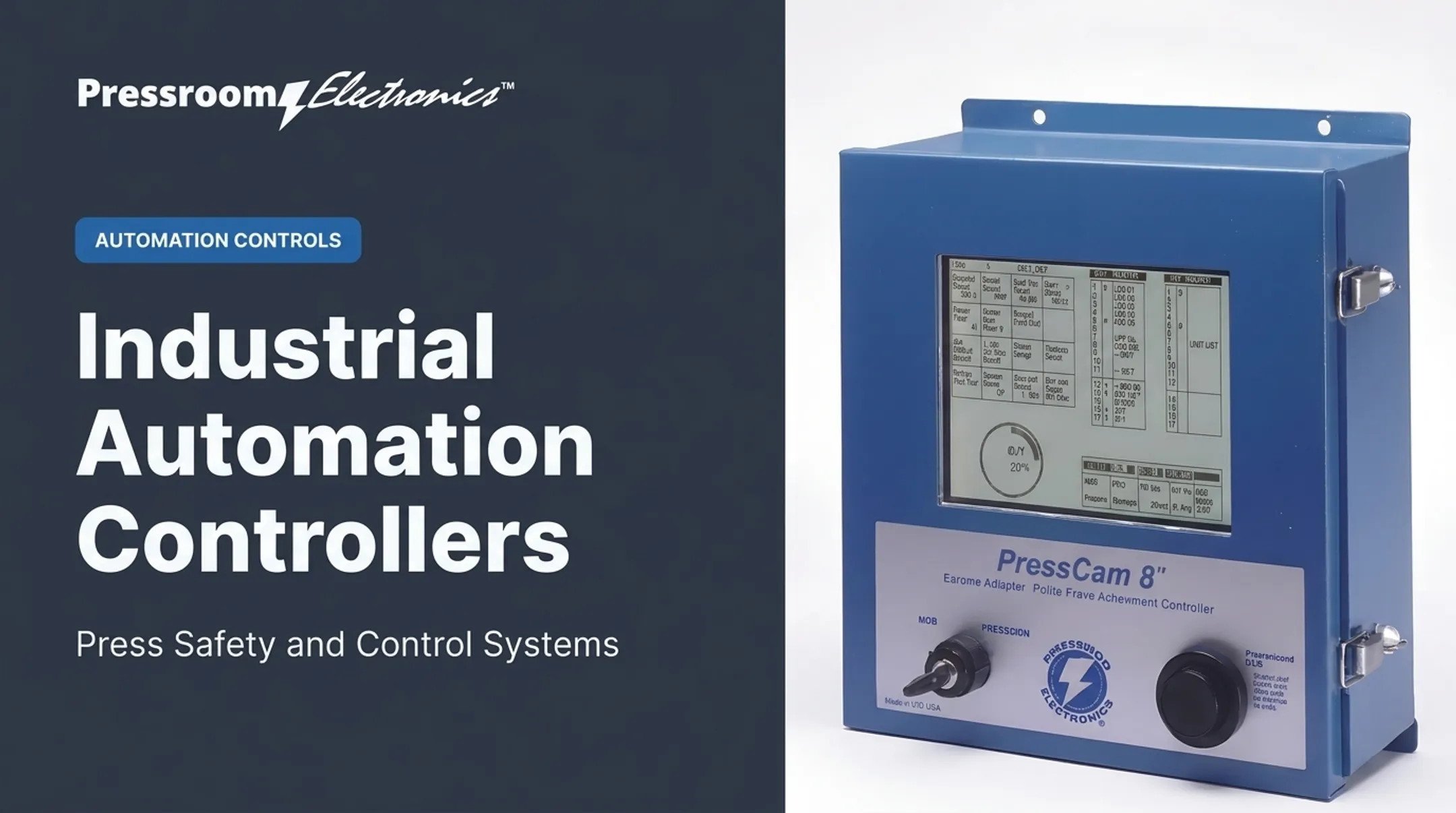
Its 3200SS clutch/brake control with built-in PressCam 8 synchronizes press operation with feeds, die protection, lubrication, and blow-offs. PressCommander adds:
- Time-based brake monitoring
- Six die-protection inputs
- Six programmable limit-switch outputs
- Optional 10.1-inch touchscreen with production monitoring for OEE
The company states these controls meet OSHA and ANSI requirements. Overall system performance still depends on the surrounding equipment and installation.
A transfer-press retrofit shows the practical gains. MetalForming Magazine reported that Dura Automotive replaced a proprietary system with open-architecture PLC controls and saw reduced wiring and quicker changeover. The article didn't quantify ROI or certify safety, and setup gains alone don't prove compliance.
Commissioning and lifecycle support
- Document the existing system
- Define safety requirements
- Select compatible hardware
- Develop and test logic
- Commission under controlled conditions
- Train operators and maintenance staff
- Preserve backups and revision records
Plan spares, vendor support, remote or field upgrades, cybersecurity updates, and periodic safety reviews before installation. Check the vendor's lifecycle stages too. Rockwell, for example, separates Active Mature, End of Life, and Discontinued, and parts get harder to find near end of life.
Frequently Asked Questions
What is a programmable logic controller (PLC) used for?
A PLC monitors inputs, executes programmed logic, and controls outputs. Typical uses include machine sequencing, production lines, interlocks, alarms, and process equipment.
Are programmable logic controllers (PLCs) still used?
Yes. ARC's 2025 research documents continuing PLC and PAC use, alongside virtualization and edge architectures. Soft PLCs are growing, but they haven't displaced hardware controllers.
What is the difference between PLC, DCS, and SCADA?
A PLC is a controller. A DCS is a distributed architecture coordinating local controllers, and SCADA is a supervisory monitoring and data layer. They often work together.
What is the main difference between a PLC and a relay control system?
Relays implement logic through physical wiring. A PLC implements it in software, so changes, diagnostics, and expansion are easier, though execution timing needs attention.
What are the main types of PLCs?
Fixed/compact and modular are the core formats. Safety, motion-capable, and software-based controllers add capabilities, and the right type depends on the application.
What are the main components of a PLC system?
The CPU, memory, power supply, local or remote I/O modules, communications interfaces, and programming software. HMIs and specialty modules are optional.