Introduction
OSHA's 2024 severe injury report records 1,348 manufacturing amputations in 2024. That figure covers federal OSHA-covered employers only, roughly half of US workers, and it isn't limited to machinery. Still, it shows how often hands and fingers meet moving equipment.
Behind each case sits real cost:
- A hurt worker and a stopped production line
- Equipment damage and a formal investigation
- Workers' compensation exposure and potential OSHA citations
Safeguarding applies to punch presses, press brakes, conveyors, fabrication equipment, and any machine with moving, electrical, hydraulic, pneumatic, thermal, or stored-energy hazards. Safeguards have to be designed, installed, and maintained. They can't be an afterthought.
This guide covers where machine hazards show up, how common safeguards work, and what it takes to design, install, and maintain them so they stay effective.
Key Takeaways
- Safeguards must block access to hazardous motion or stop it before exposure; training and PPE only support them.
- A good safeguard prevents contact, stays secure, and creates no new hazard.
- Revisit hazard assessments and lockout/tagout after any equipment, tooling, or control change.
- Requirements vary by machine, so verify the applicable standard.
Safety Guidelines for Machine Safeguarding
What Machine Safeguarding Covers
Machine safeguarding uses physical guards, protective devices, safe distance or location, feeding and ejection methods, and supporting procedures to control exposure. OSHA's 1910.212(a)(1) requires that one or more methods must protect the operator and other employees in the machine area.
Common hazards include:
- Points of operation, where work is performed on the material
- In-running nip points
- Rotating, reciprocating, and transverse motion
- Flying chips and sparks
- Electrical energy, hydraulic or pneumatic pressure, hot surfaces
- Unexpected or stored energy
Primary Safeguards vs. Supplemental Measures
Primary safeguards physically prevent access or interrupt dangerous motion. Guards and devices fall here. Signs, training, PPE, and awareness barriers are supplemental measures. Special handtools also support required guarding but do not replace it.
OSHA's machine guarding eTool lists six minimum requirements:
- Prevent contact
- Secure the safeguard
- Protect from falling objects
- Create no new hazards
- Create no interference
- Allow safe lubrication where possible
Standards to Review
- 1910.212: general requirements for all machines
- 1910.217: mechanical power presses (press brakes and hydraulic/pneumatic presses are excluded)
- 1910.219: mechanical power-transmission apparatus
- ANSI B11.1-2009 (R2020), B11.19-2019 (R2024), B11.0-2023: consensus standards for presses, safeguarding performance, and risk assessment
Confirm current editions and machine-specific requirements before you act. Treat safeguarding as a full system: design, installation, inspection, maintenance, employee input, and reassessment after changes or incidents.
General Safety Precautions
Before operation, run a baseline inspection and job hazard analysis. Cover:
- Access points and the point of operation
- Nearby workers, visibility, lighting, and housekeeping
- Noise, tools, and energy sources
- Clothing, jewelry, and hair
PPE and Entanglement
OSHA 1910.132 requires a written PPE hazard assessment, proper selection and fit, and training. Match PPE to the site: eye, face, hearing, foot, or hand protection.
Watch entanglement risks closely. OSHA 3170 notes drill-press amputations involving gloves, loose clothing, or jewelry caught on rotating bits, and says no gloves, jewelry, or loose clothing near grinders. Those are machine-specific cautions, not a blanket glove ban.
Access, Clearances, and Training
- Keep clearances and emergency access unobstructed
- Stabilize work areas and control access
- Secure guards and devices against tampering
- Give task-specific instruction to anyone who operates, services, adjusts, or works near the machine
- Ensure everyone knows how to report a damaged, missing, or bypassed safeguard
Safety During Installation
Qualified personnel should handle installation, retrofit, and control integration, using manufacturer documentation, an energy-control procedure, and a machine-specific hazard assessment. Key risks include lifting, positioning, electrical, pneumatic, hydraulic, and unexpected startup.
Energy Control
Lockout/tagout is required before work begins. Under OSHA 1910.147, the authorized employee verifies isolation and deenergization. Stored energy must be relieved, restrained, or otherwise made safe. That includes elevated parts, counterbalances, pressure, and residual motion.
Commissioning Checks
Before release, verify:
- Guard security and access control
- Interlocks and presence-sensing devices
- Two-hand controls and emergency stops
- Stopping performance
- Safe reset behavior

Stop installation if hazards, wiring, control architecture, stopping time, or safeguard performance can't be verified, or if a proposed guard interferes with safe operation or maintenance.
Safety While Using or Operating Machine Safeguarding
Pre-Start Check
Before each start, confirm:
- Guards are present and secure
- Safety devices function as intended
- Controls are clearly labeled
- The work area is clear and nobody is in a danger zone
What Operators Must Never Do
Operators must never:
- Reach into a die, point of operation, nip point, or moving assembly
- Bypass an interlock, defeat a light curtain, or remove a guard
- Clear a jam while hazardous motion or energy remains possible
OSHA's Hagel Metal Fabrication release shows the stakes: a worker was fatally crushed by an automated laser-cutting machine, and OSHA cited bypassed safeguards and failure to lock out hazardous energy. Those are citation allegations, not a final settlement.
Abnormal Conditions
Watch for:
- Odd noise or unexpected movement
- Control faults or damaged guards
- Braking problems or sensor faults
- Repeated nuisance trips
Each calls for the same response: stop the machine, isolate energy as required, and report it.
A Metal-Stamping Example
On a part-revolution press, several elements work together:
- Control reliability: a failure can't prevent normal stopping and must block the next stroke until corrected
- Brake monitoring: a deteriorating stopping time that makes the safety distance inadequate must prevent the next stroke
- Presence sensing: interlocked into the control circuit to stop slide motion; prohibited on full-revolution-clutch presses
- Die protection: protects tooling alongside the guarding

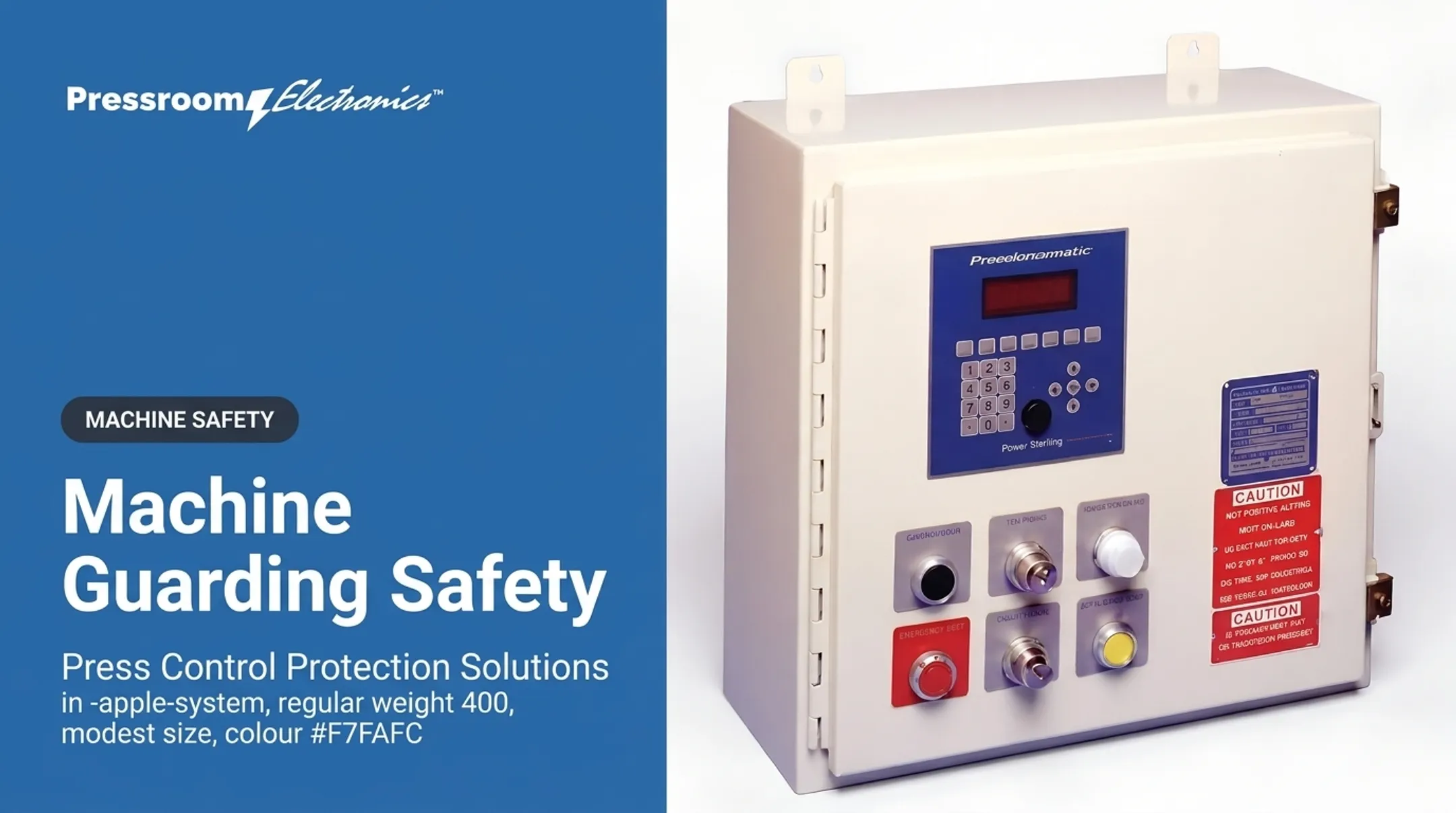
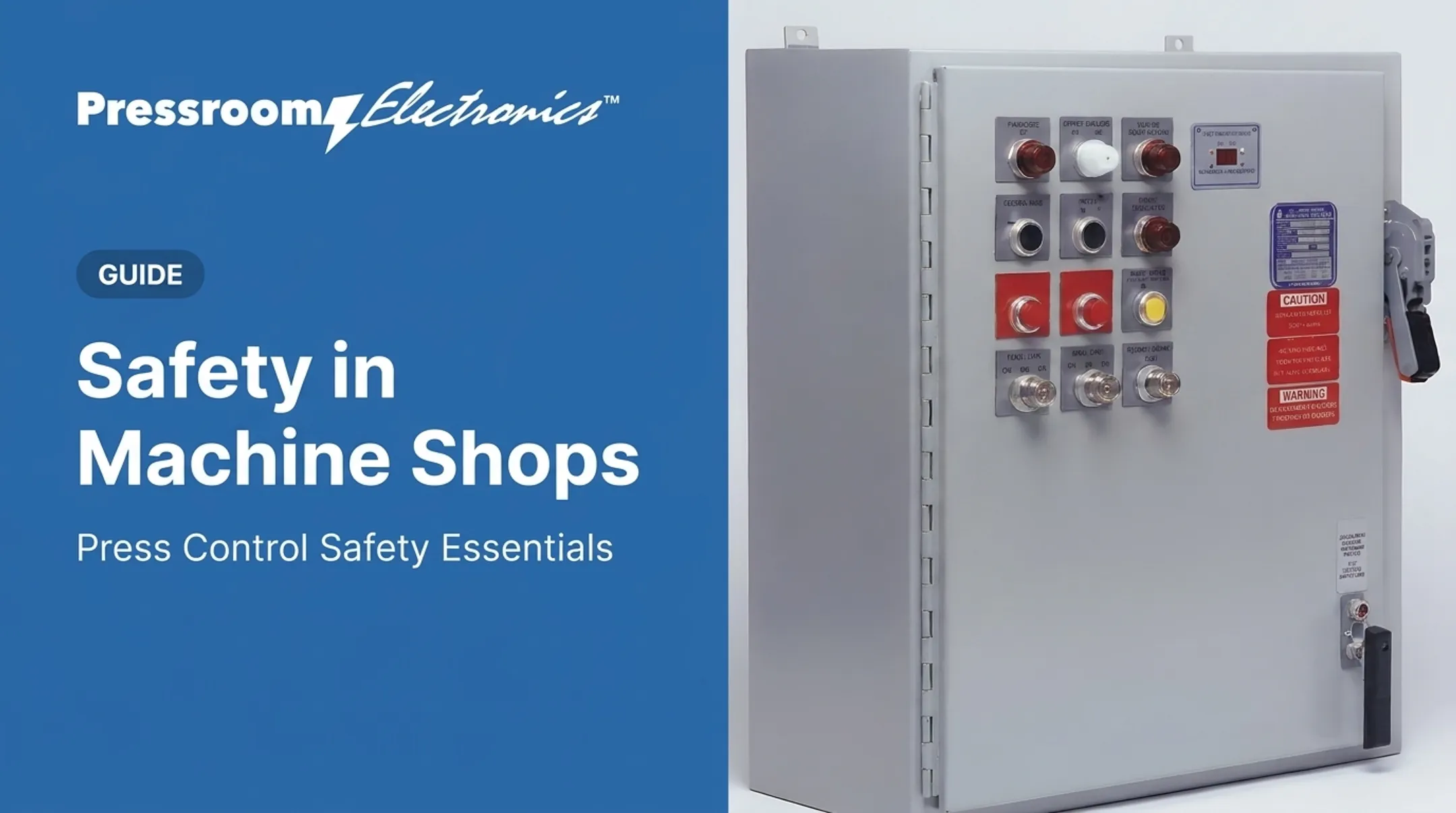
Pressroom Electronics, for example, makes resolver- and rotary-cam-based clutch/brake controls, brake monitors, and light curtains for these applications. Still, the right solution depends on application-specific assessment, integration, and validation.
Environmental and System Safety Considerations
Vibration, dust, moisture, heat, noise, lighting, production speed, tooling changes, and material flow all affect guard and device reliability. Manufacturer manuals make this concrete.
SICK's deTec4 manual notes that strong vibration affects mounting, reflective surfaces need clearance from the protective field, and electronic-ballast fluorescent lamps can interfere. Those limits are product-specific, not universal.
Look Beyond a Single Guard
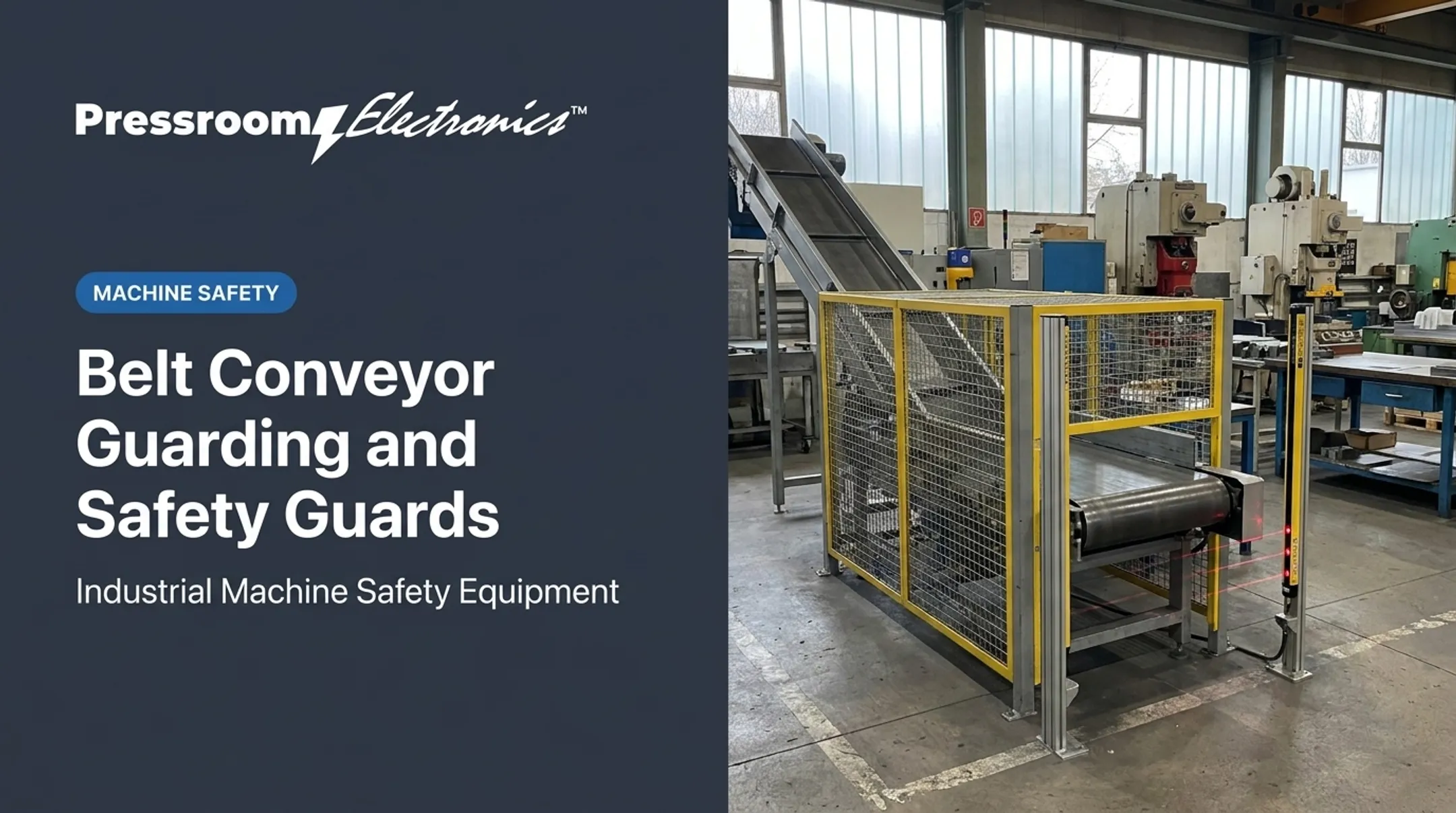
Check safe access, visibility, reach distances, ejected material, and adjacent workstations. Conveyors, robots, and nearby equipment can introduce exposures that one guard doesn't cover.
Inspect, Maintain, Document
- Schedule inspections and preventive maintenance for guards, interlocks, sensors, controls, and brake monitors
- Run functional tests and document corrective actions
- On mechanical power presses, 1910.217(e) requires periodic inspections with certification records
- Test clutch/brake, antirepeat, and single-stroke mechanisms weekly (exception for presses meeting (b)(13)-(14))
Re-Review After Changes
Tooling, programming, press speed, guarding, layout, or control logic changes call for a new hazard review and post-change testing. ANSI B11.0-2023 covers modified and rebuilt machines.
A safeguard that was acceptable at installation can become inadequate after a modification. Changing a stopping-time monitor or stop-position sensor, for example, means recalculating the safety distance.
Common Safety Mistakes to Avoid
Relying on Training, PPE, Signs, or E-Stops Alone
These reduce exposure or support response. They don't prevent access to every hazard during normal operation.
Bypassing or Poorly Positioning Guards
Defeating protection to save time invites crushing, amputation, and flying-object injuries.
In a December 2019 citation under 1910.212(a)(3)(ii), OSHA alleged employees ran press brakes by foot pedal with light curtains disabled and no other guarding. One employee lost five digits across both hands. The record lists a willful citation and an informal settlement dated January 2, 2020.

Positioning matters too. The sensing field must stop motion before an operator can reach the hazard, and any entry not covered by presence sensing needs a guard.
Skipping Lockout/Tagout
Adjusting, clearing jams, cleaning, lubricating, or maintaining without shutdown and lockout is dangerous. Electrical, hydraulic, pneumatic, gravitational, or mechanical energy can linger after the machine stops.
The minor-servicing exception applies only to routine, repetitive, production-integral work with effective alternative protection.
Not Updating After Near Misses or Changes
After a near miss, injury, recurring fault, modification, tooling change, or process change, inspect and update the system:
- Investigate and document
- Take corrective action
- Gather worker feedback
- Retrain where procedures change
Conclusion
Effective safeguarding combines several practices working together:
- Hazard identification
- Engineered guards and devices
- Safe work procedures
- Energy control
- Competent installation
- Ongoing inspection
It works best when plant leaders, operators, maintenance teams, and EHS staff treat it as part of equipment reliability and production planning, not a separate compliance chore.
For machine-specific evaluations and modifications, engage qualified specialists who know your equipment and the applicable OSHA and ANSI requirements.
Frequently Asked Questions
What is machine guarding?
It is the use of barriers, devices, safe distance, and related controls to protect workers from hazardous machine motion and related exposures. OSHA 1910.212(a)(1) requires one or more methods to protect the operator and others in the machine area.
What does OSHA require for machine guarding?
Requirements depend on the machine and hazard. 1910.212 covers general machines, 1910.217 covers mechanical power presses, and 1910.219 covers power-transmission apparatus. Verify the current text rather than relying on a generic checklist.
What is required for a machine safeguard?
It must prevent contact, be securely attached, and create no new hazards or unacceptable interference. It should protect from falling objects or projectiles where applicable and allow safe lubrication and maintenance access.
What are some examples of machine hazards?
Points of operation, nip points, rotating or reciprocating parts, flying chips, sparks, electrical energy, pressure, heat, and stored energy. A punch press's die area is a classic point-of-operation hazard.
What are the basic machine safety rules?
Inspect before starting, keep guards in place, stay out of danger zones, and follow procedures. Use required PPE, report defects, and apply lockout/tagout whenever servicing.
What are the five types of machine safeguards?
An OSHA-hosted training handout groups methods into guards, devices, location/distance, automated feeding and ejection, and miscellaneous aids. It isn't regulatory text. Guards and devices are primary; training and signage never substitute for engineered protection.