Introduction: What Is a Press Feeder?
A press feeder is the equipment that advances and accurately positions strip, sheet, or coil stock for a stamping press. This article covers metal forming, not printing presses or bulk-material handling.
A poorly matched feeder shows up fast: inconsistent feed length, strip misalignment, slippage, die interference, damaged tooling, scrap, and downtime. Most of these trace back to selection, setup, or timing rather than a single bad part.
Below, we cover how feeders work, the four main types, how to choose one, and how to set up and troubleshoot it.
Key Takeaways
- A feeder moves stock into the die at the right length, position, and moment in each press cycle.
- Servo, mechanical roll, air, and gripper feeders suit different materials, speeds, and die demands.
- Alignment, straightening, pilot release, and press signals matter as much as the feeder itself.
- Choose based on the whole press line and future jobs, not the equipment name.
What Are Press Feeders and How Do They Work?
What a press feeder does in a stamping line
The feeder indexes material from an upstream source into the die, repeating the move on every press stroke. SME's coil processing guide describes these mechanisms as slide, roll, or gripper systems that can be press-driven or independently driven.
It controls two things: feed length and strip position (front to back, side to side, and square to the tooling).
Typical uses include progressive-die stamping, blanking, punching, and forming. A feeder is not a transfer system. Transfer tooling moves individual blanks between stations, while progressive tooling runs a continuous strip.
The basic material path
The usual sequence runs:
- Decoiler or pay-off reel
- Straightener or leveler
- Feeder
- Optional lubricator at press entry
- Press and die
Upstream loops matter. A free, stable loop lets the feeder pull without fighting the straightener. Some lines use integrated feeder-levelers instead. Either way, the feeder must match the decoiler, straightener, press, and die.
Feed length, indexing, and synchronization
Feed length (pitch) is the distance the stock advances per cycle. In a progressive die it equals the constant spacing between stations. Material advances as the press opens, and die work happens as it closes.
The feeder times each move from press signals, cam or resolver outputs, encoder feedback, or a mechanical link. Its feed window depends on press speed, die engagement, and material travel. A feed that finishes late causes a collision or misfeed.

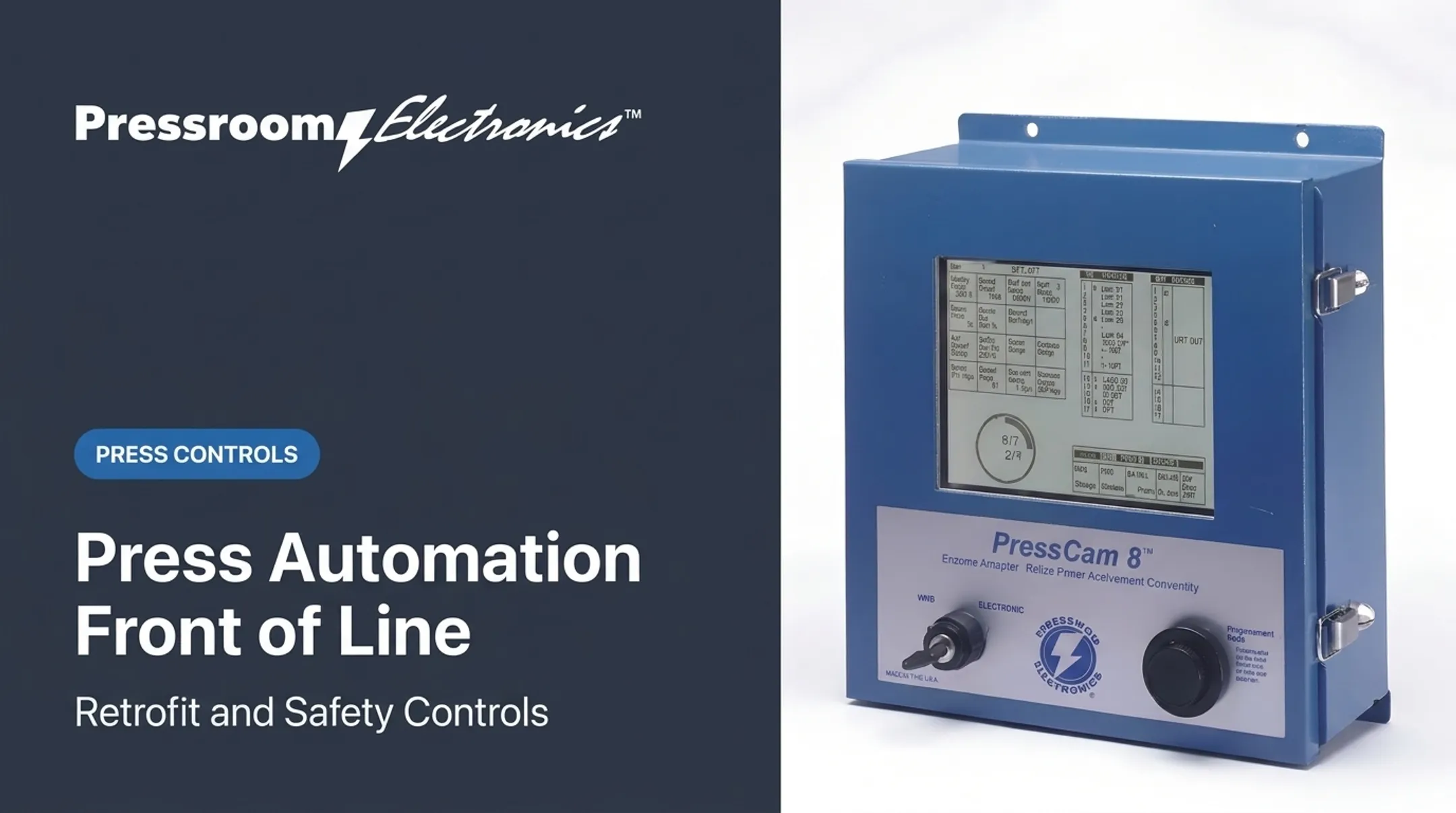
Modern press controls help here. Pressroom Electronics' PressCam 8, for example, offers programmable timing signals that trip at any press position and can control feeds and indexing, with ±1° timing accuracy.
Pilot release and feed release
Pilot release opens the feeder's grip so pilot pins can correct strip position in a progressive die. MetalForming magazine describes lifting the upper roll just after the pilot tips enter the strip.
Timing is critical. Release too early or late and you get short feeds, long feeds, strip movement, and tool wear.
Why accuracy depends on the whole system
The feeder can work perfectly and still feed badly. Common culprits:
- Coil camber or poor straightening
- Wrong roll pressure
- Loose or off-center mounting
- Worn guides
- A misplaced die
Here's a simple case. A guide sits 0.5 mm off center. The strip skews slightly, a pilot fights it every stroke, the hole elongates, and parts drift out of tolerance. Eventually the pilot shears or the strip jams, and the press stops.
Types of Press Feeders
Press-driven mechanical roll feeders
These draw motion from the press itself, so they stay in sync with press rotation. Examples include cam-driven designs such as Sankyo's V Series and BRUDERER's BBV, which uses a main-shaft and cardan drive.
- Strengths: robust timing for high-speed work, little reliance on electronics
- Limits: less flexible feed-length changes, mechanical changeovers, limited data exchange
Servo-driven roll feeders
A servo motor, drive, feedback device, and programmable controller turn the rolls to a set length. Setups can be stored as recipes, with multi-step patterns and diagnostics.
They fit progressive dies, variable production, and frequent changeovers. Servo does not fix poor alignment or bad release timing, though.
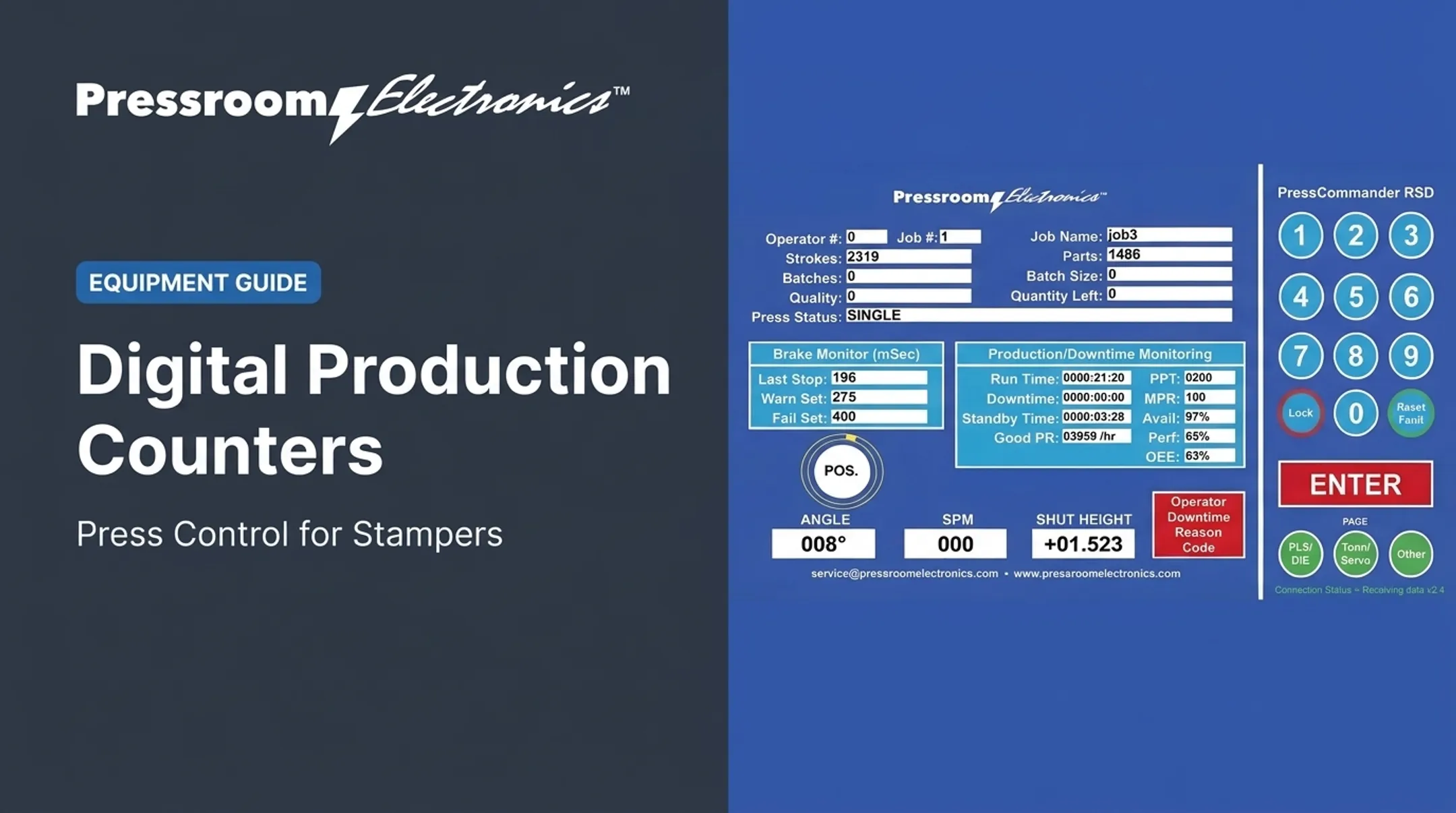
Pressroom Electronics' PressCommander stores servo setup information for each job. PressCam 8 Junior supports protocols including Indramat, Rapid-Air S32H, P/A Industries SFI, and Dallas Industries.
Air or pneumatic feeders
Air feeders use pneumatic motion and clamping to advance stock. They suit simpler, lighter work. Rapid-Air's published specs show the range: the A2 handles up to 2 in of feed at a recommended 260 cycles per minute, while the LX12 handles 12 in at 50.

Check air supply, feed length, speed, and repeatability. Also ask whether the job tolerates less programmable control than servo.
Gripper feeders
Gripper and retainer clamps alternately hold and advance the strip. Clamp timing prevents rollback. Vamco's SG servo gripper, for instance, uses distributed-pressure pads for delicate or plated stock such as connectors and lead frames.
Tradeoffs to weigh:
- Floor space and return stroke
- Top speed for the application
- Setup adjustment effort
How to compare feeder types
| Factor | What to weigh |
|---|---|
| Feed length and speed | Longest pitch and fastest rate you'll run |
| Material | Width, thickness, surface sensitivity |
| Die and pilots | Release method and feed window |
| Setup | Changeover frequency |
| Controls | Integration, diagnostics |
| Cost | Maintenance and total operating cost, not price alone |
A dedicated high-speed line may favor synchronization. A job shop usually values programmable changeovers and accessible diagnostics.
How to Choose a Press Feeder for Metal Stamping
Confirm material and coil requirements
Material type, width, thickness, tensile behavior, surface, camber, and coil weight set roller, guide, clamping, and upstream needs. Checklist:
- One material or a wide mix of jobs?
- Surface-sensitive or plated stock needing gentler contact?
- Coil weight and dimensions the line must carry?
Match width and thickness together. Dallas Industries' installation at Orick Stamping, for example, is rated for 36 in x 0.135 in or 18 in x 0.210 in stock, with 20,000-lb reel capacity.
Match the feeder to the press and die
Factor in press speed, stroke, feed window, die height, feed direction, progression, strip lift, pilot design, and mounting space. Size for the extremes: the longest feed, highest speed, and most demanding die.
COE's sizing guidance calls for progression, available feed angle, and strokes per minute. Longer dies add friction; heavier loops add motor load.
Select the control and release method
Release can be mechanical, pneumatic, or programmable. Each affects adjustment, pilot release, and how quickly you change jobs. Before purchase, verify:
- Press interface and encoder or resolver feedback
- Control voltage and I/O signals
- Emergency-stop logic
- Communication needs
Consider the complete line
Evaluate the feeder alongside the rest of the line:
- Decoiler, straightener, and leveler
- Lubricator
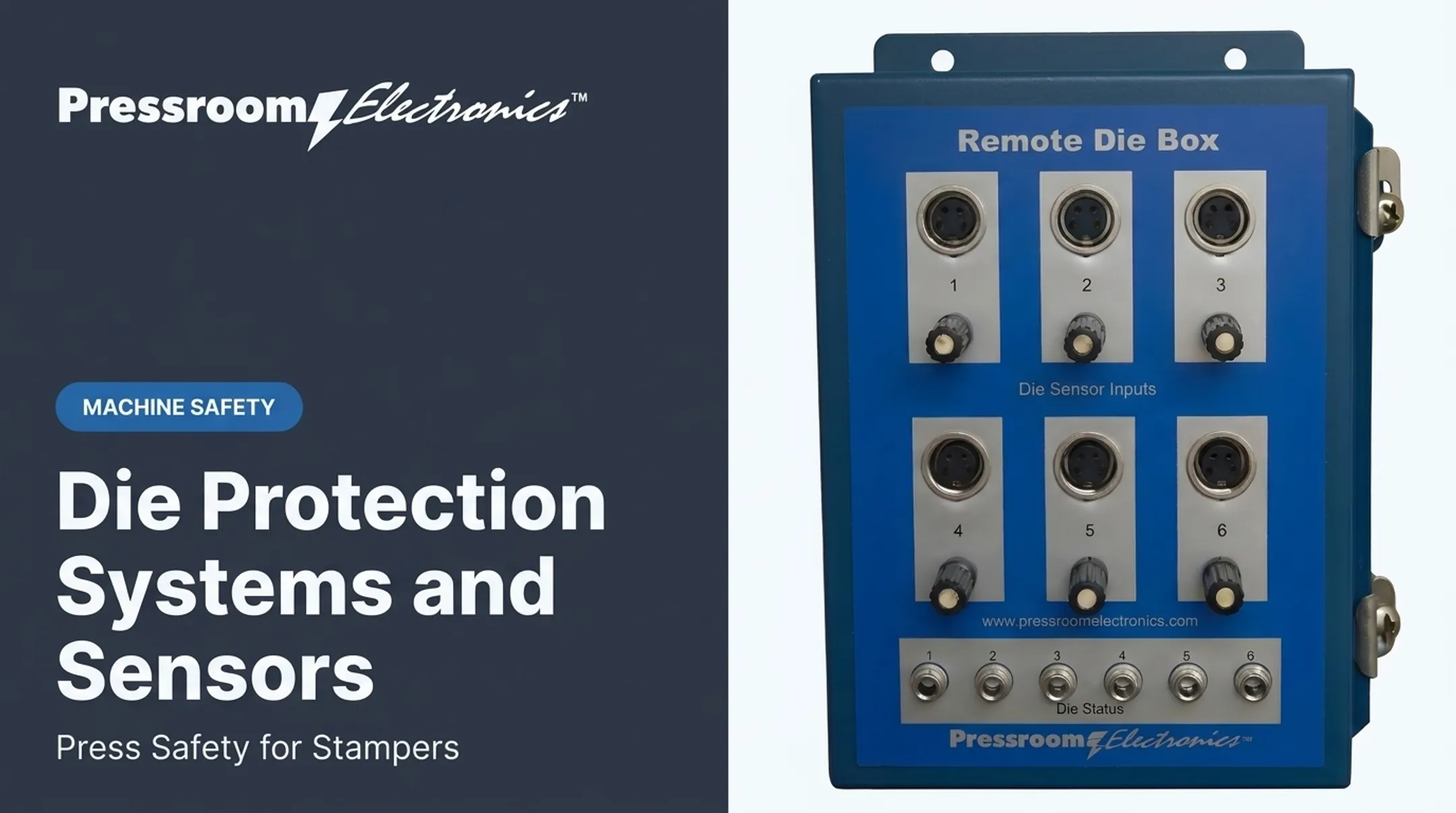
- Die protection, guarding, and press controls
- Production monitoring
Safety stays separate: under OSHA 1910.217, automatic feeding does not replace required point-of-operation guards or devices.
Pressroom Electronics provides customized press controls and automation that complement feeder integration, machine safety, and production visibility. It does not supply complete feeder units.
Evaluate productivity, maintenance, and lifecycle
Weigh these lifecycle factors before you buy:
- Setup time and changeover frequency
- Spare parts, service access, and operator training
- Diagnostics plus air or power needs
- Cost of misfeeds and unplanned stops
Published specs can vary widely. Nidec SYS lists ±0.02 mm feed accuracy for its feed systems, but that is a manufacturer figure, not a stamping-wide tolerance. Ask vendors for application-specific documentation, installation requirements, acceptance criteria, and commissioning support before you buy.
Setup, Timing, and Troubleshooting Essentials
Align and commission the feeder correctly
Start with rigid mounting, centerline alignment, and squareness to the die. Set side guides, roller pressure, and threading properly. Then commission in order:
- Jog or run slowly to confirm free movement.
- Verify feed length and registration match the setup.
- Check pilot release against the longest pilot.
- Step up to production speed gradually.
Diagnose common feed problems
| Symptom | Likely causes |
|---|---|
| Short feed | Slippage, weak grip, low air pressure, loose clamps, dirty stock |
| Long feed | Release timing, trapped material, excess speed, oily stock, slitting burrs |
| Skew | Guides, alignment, camber |
| Repeated stops | Control, sensor, overload, interlock, or loop fault |
Before changing programmed feed length, check:
- Material path and roll condition
- Pressure and guides
- Press signals and release timing
- Die setup and fault history
Use controls and data to reduce recurring downtime
Fault messages, reason codes, and downtime records help separate operator setup errors from mechanical, electrical, material, or tooling causes. PressCam 8 displays fault messages in real time, and PressCommander includes a diagnostics screen, downtime monitoring, and log files.

Pressroom Electronics also offers programmable reason codes, production monitoring, remote field upgrades, and custom programming to find root causes and improve machine utilization.
Frequently Asked Questions
What does feeder mean?
A feeder repeatedly moves material or components into a machine. In metal stamping, a press feeder advances and positions strip, sheet, or coil stock for the die.
What is a screw feeder used for?
A screw feeder meters and moves bulk materials such as powders, granules, or pellets. It differs from the roll, servo, air, or gripper feeders that advance metal stock into a press.
What is a press feeder used for?
It automatically feeds stock into stamping, punching, blanking, or forming equipment. The benefits are repeatable feed length and operation synchronized with the press.
What is the difference between a servo feeder and a mechanical feeder?
Servo feeders offer programmable motion and electronic integration. Mechanical feeders stay synchronized through the press drive. The best choice depends on speed, flexibility, die needs, and production mix.
How do you choose a press feeder?
Evaluate material dimensions, feed length, press speed, die and pilot needs, release method, line integration, safety, maintenance, and future production plans.
How do you troubleshoot a press feeder that is misfeeding?
Check alignment, strip straightness, roller pressure, slippage, guides, release timing, press signals, die setup, sensors, and fault history before altering feed-length settings.