Introduction
An industrial control panel sits at the center of machine operation. It also exposes workers to shock, arc flash, unexpected startup, and stored energy when it is poorly designed, labeled, maintained, or accessed.
BLS recorded 130 electrical fatalities in 2024 across all industries, and manufacturing accounted for 8 of them. Those are not panel-specific counts, but they set the stakes.
This guide covers industrial electrical safety control panels used with machinery and production systems, not residential service panels or basic breaker boxes. It defines the panel's role, explains hazards and safety functions, covers design and maintenance, and applies the guidance to metal stamping presses.
Key Takeaways
- Panel design, guarding, interlocks, e-stops, procedures, training, and maintenance must work as one system.
- A documented risk assessment sets the safety functions, ratings, and validation for each machine.
- Lockout/tagout, voltage verification, labeling, and documented testing still apply to programmable panels.
- A press retrofit counts only as a validated, complete machine-safety solution.
What Is an Electrical Safety Control Panel?
What distinguishes a safety control panel from a standard control enclosure?
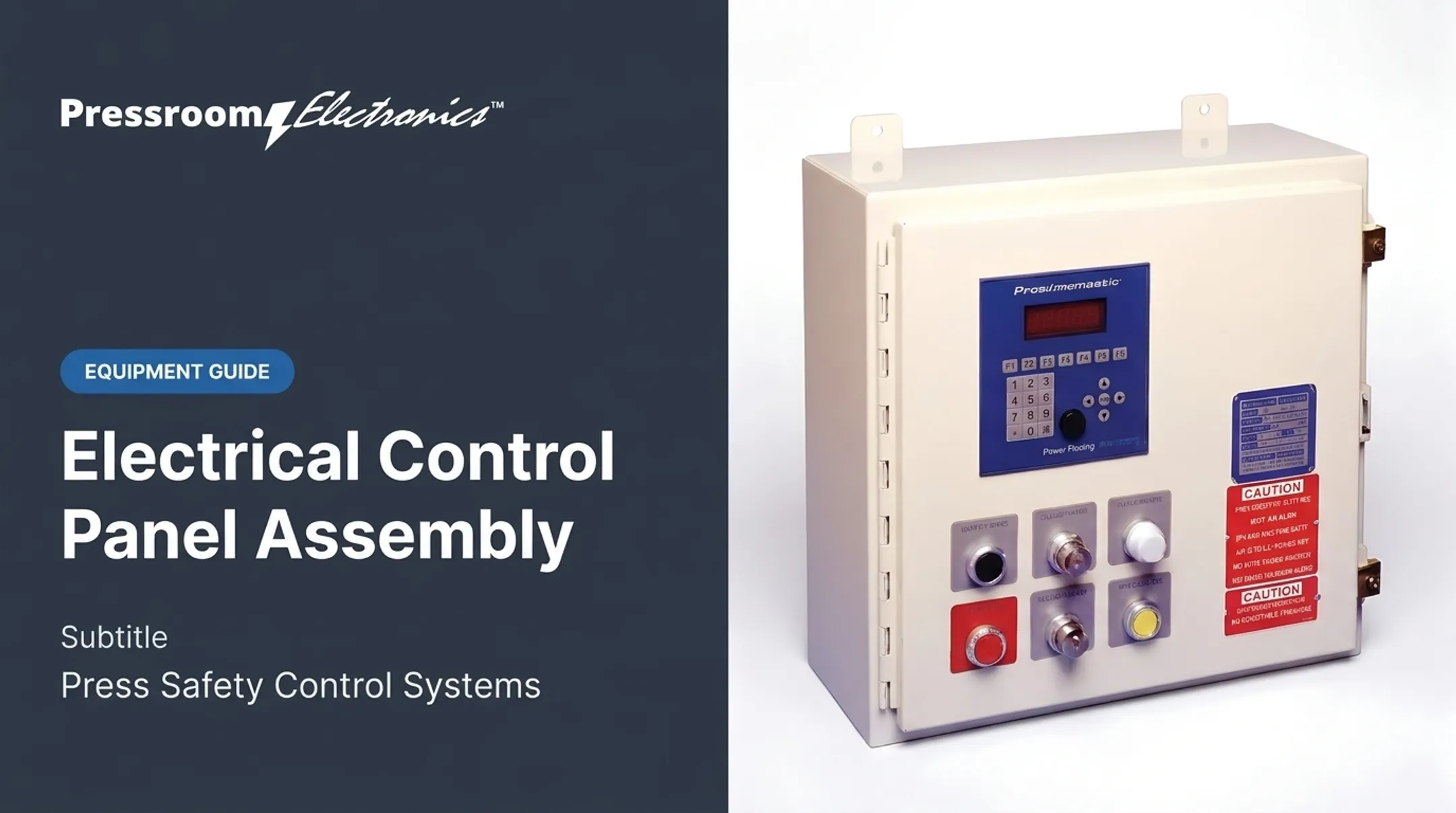
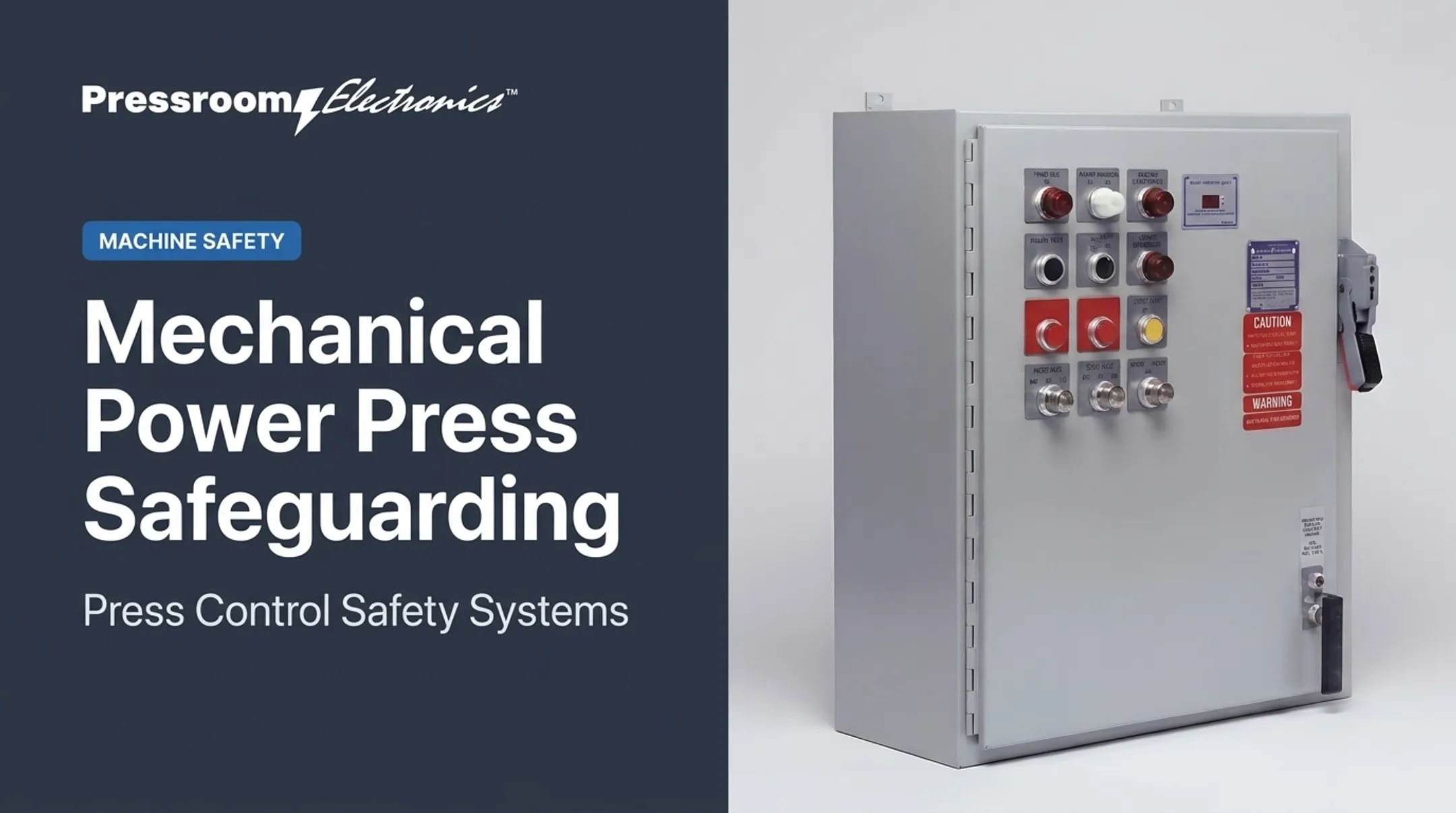
An industrial control panel is an enclosure housing power distribution, control, monitoring, and safety-related components used to operate or stop machinery. Ordinary production controls start and run the machine. Safety-related circuits do more:
- Respond deliberately to faults
- Monitor protective devices
- Prevent unexpected restart where the risk assessment requires it
Certification scope matters here. UL states that panel certification does not cover the connected loads or equipment the panel controls. A certified panel does not make a certified press.
How safety functions connect to machinery
The panel receives and processes signals from:
- Emergency stops and guard interlocks
- Light curtains and safety mats
- Two-hand controls and limit devices
Its response varies by design. It may remove energy from hazardous motion, block a restart, signal a fault, or require a controlled reset.
Who interacts with these panels?
Several roles work with these panels:
- Operators and maintenance technicians
- Electricians and engineers
- EHS staff and machine builders
- Service contractors
Only qualified personnel should perform energized diagnostics or internal panel work.
Electrical Hazards a Safety Control Panel Must Address
Shock, arc flash, and electrical contact
Exposed conductors, incorrect wiring, damaged insulation, loose terminations, and opening an energized enclosure all create shock or arc-flash risk. OSHA 1910.333 requires live parts to be deenergized before work unless the employer demonstrates infeasibility or added hazard. Only qualified persons may work on equipment that is not deenergized.
OSHA's 2024 arc-flash guidance describes an electrically safe work condition as disconnection, lockout/tagout, and verification of absence of voltage. Shock boundaries and the arc-flash boundary are separate concepts: one addresses shock, the other thermal exposure.

NFPA 70E ties qualification and PPE selection to the specific task and equipment. Treat this article as background, not a substitute for a site-specific safety program.
Unexpected movement and stored energy
On a press, electrical hazards become mechanical: unexpected cycling, ram movement, rotating flywheels, air or hydraulic pressure, and gravity-held tooling.
Shutting off electricity does not prove every energy source is controlled. Under OSHA 1910.147, pushbuttons and selector switches are not energy-isolating devices. Under 1910.333, interlocks do not replace electrical lockout/tagout. Evaluate e-stops, interlocks, disconnects, and isolation procedures together.
Overcurrent, short circuits, and component failure
Correct selection of these items reduces fire and equipment failure risk:
- Overcurrent protection and disconnects
- Grounding and bonding
- Conductor sizing
- Components with interrupting and short-circuit ratings that match available fault current
OSHA 1910.303 through .305 cover listed equipment, interrupting ratings, and grounding. Confirm which enclosure, panel-construction, and machine-control requirements apply to your installation. Some designs add protection, such as a ground fault detector that monitors press grounding whenever control power is on.
Environmental and physical hazards
Moisture, dust, oil, heat, vibration, corrosion, conductive debris, and cramped working space degrade components and raise maintenance risk. Match enclosure type, cooling, cable entry, housekeeping, and inspection frequency to the actual environment.
NEMA enclosure types and IEC IP codes are not interchangeable. NEMA states an IP designation cannot substitute for a NEMA type. Pressrooms with oil mist and vibration often use NEMA 12 enclosures, and vibration-prone controllers should be shock-mounted.
Labeling, access, and human factors
Durable, legible labels should identify disconnects, circuits, devices, emergency shutoffs, stored-energy sources, and required PPE. OSHA 1910.303 sets working space at the equipment width or 30 inches, whichever is greater, with doors opening at least 90 degrees. That space is not storage.
Update labels and drawings after every modification.
How to Design and Select a Safe Electrical Control Panel
Begin with a documented machine risk assessment
ISO 12100 frames risk assessment as hazard identification, risk estimation, reduction, and verification. Cover:
- Normal operation, setup, adjustment, cleaning, troubleshooting, and maintenance
- Foreseeable misuse
- Operating modes, stop behavior, and access points
- Energy sources and operator workflow
- Environment and the consequences of a wiring or component fault

Select components and ratings for the application
Select disconnects, circuit protection, contactors, safety relays or controllers, terminals, wiring, enclosures, and power supplies for the application. Rate each device against:
- Voltage and current
- Fault conditions
- Temperature, vibration, and contamination
- Duty cycle
Different standards answer different questions:
| Question | Where to look |
|---|---|
| Panel construction and SCCR marking | UL 508A, NEC Article 409 |
| Machinery electrical equipment | NFPA 79 |
| Enclosure protection | NEMA 250, IEC 60529 |
| Safety-function performance | ISO 13849-1, IEC 62061 |
| Press safeguarding | OSHA 1910.217, ANSI B11 series |
Qualified engineers should review the final design.
Build fault-tolerant, monitored safety functions
Where risk demands higher performance, use redundancy, monitoring, diagnostics, forced-guided contacts, and cross-fault detection so failures leave the machine safe. Document the required performance level (ISO 13849-1) or safety integrity target, then validate that the architecture achieves it. The standard does not prescribe a level for your application. Your risk estimation does.
Design for safe human interaction
Place e-stops, reset controls, disconnects, selector switches, and indicators where operators can see and reach them. Keep interaction rules simple:
- A reset must never automatically restart hazardous motion
- Make bypasses, abnormal conditions, and safety-device faults obvious
- Use plain-language diagnostic messages
Plan documentation and future changes
Keep current schematics, terminal schedules, device lists, layouts, safety-circuit descriptions, and software records. For programmable panels, also maintain:
- Version control and authorized-change records
- Backups and change review
- Post-change validation
Installation, Validation, and Ongoing Maintenance
Install under controlled procedures
Qualified personnel who understand the drawings, machine hazards, and energy isolation should install or supervise. Cover:
- Conductor identification and secure terminations
- Separation of power and control wiring
- Grounding and bonding, including a dedicated earth ground
- Strain relief, enclosure sealing, and protection from abrasion
Resolver cables and remote switch wiring should stay clear of high-current lines or run in separate conduit to avoid nuisance faults.
Test every safety function before production
Check these functions before production:
- E-stops, guards, interlocks, and light curtains
- Two-hand controls, reset behavior, and restart prevention
- Fault detection, disconnects, and clutch/brake monitoring
Record for each test:
- Device, expected response, and observed response
- Tester, date, and deficiencies
- Corrective actions and return-to-service approval
Verify de-energization and safe access
A control switch in the off position does not isolate all hazardous energy. Follow site lockout/tagout procedures and verify absence of voltage and stored energy. Restrict panel opening and energized troubleshooting to qualified personnel with proper work practices, PPE, tools, and justification.

Inspect for deterioration
Watch for:
- Loose or overheated connections, discoloration, odor
- Corrosion, moisture, dust or oil buildup
- Damaged insulation, failed cooling, cracked enclosures
- Missing labels, bypassed devices, repeated nuisance trips
There is no universal schedule. NFPA 70B-2026 uses a potential-failure method to set maximum maintenance intervals. Base yours on age, duty cycle, environment, manufacturer guidance, and incident history.
These OSHA rules sit apart from the NFPA 70B intervals. OSHA 1910.147 requires an annual review of the energy-control procedure, and 1910.217 requires clutch/brake and antirepeat testing at least weekly on mechanical power presses.
Update after repairs, retrofits, or process changes
Changes to tooling, speed, guarding, sensors, software, power distribution, or modes can alter the original risk profile. Require design review and renewed validation, then update schematics, labels, training, spare-parts records, and test documentation.
Applying Electrical Safety Control Panels to Metal Stamping Presses
Press-specific hazards and safety functions
Presses add point-of-operation exposure, unexpected slide movement, clutch and brake faults, die access, misfeeds, and repeat cycling.
OSHA 1910.217 requires control reliability: a control failure must not prevent normal stopping, must block a successive stroke until corrected, and must be detectable. Brake monitoring must inhibit the next stroke if stopping performance deteriorates beyond the safety distance.
Depending on the risk assessment, a press panel may coordinate:
- E-stops, guards, and palm buttons or two-hand controls
- Brake monitoring and die protection
- Permissive logic and restart prevention
OSHA documented a case where a press double-cycled during a jam, costing a worker three fingers. The OSHA bulletin found the presence-sensing device wired incorrectly from a faulty schematic. Component swaps alone did not fix it. Integration did.

Retrofit and replacement considerations for aging presses
Before you start a retrofit, review:
- Compatibility with the existing clutch/brake, sensors, and wiring
- Mechanical condition of the press
- Available fault information and operator workflow
- Enclosure space and required documentation
Validate the retrofit as a complete machine-safety solution. A new panel or control board does not make the press compliant by itself. Annual third-party revalidation applies specifically to presence-sensing device initiation, so do not generalize it to every retrofit.
Where Pressroom Electronics fits
Pressroom Electronics designs and manufactures press controls in the USA for metal stamping and forming. Its offering includes:
- Resolver and rotary-cam clutch/brake controls
- Time-based brake monitors and die protection
- Light curtains, safety mats, and palm buttons
- Production monitoring
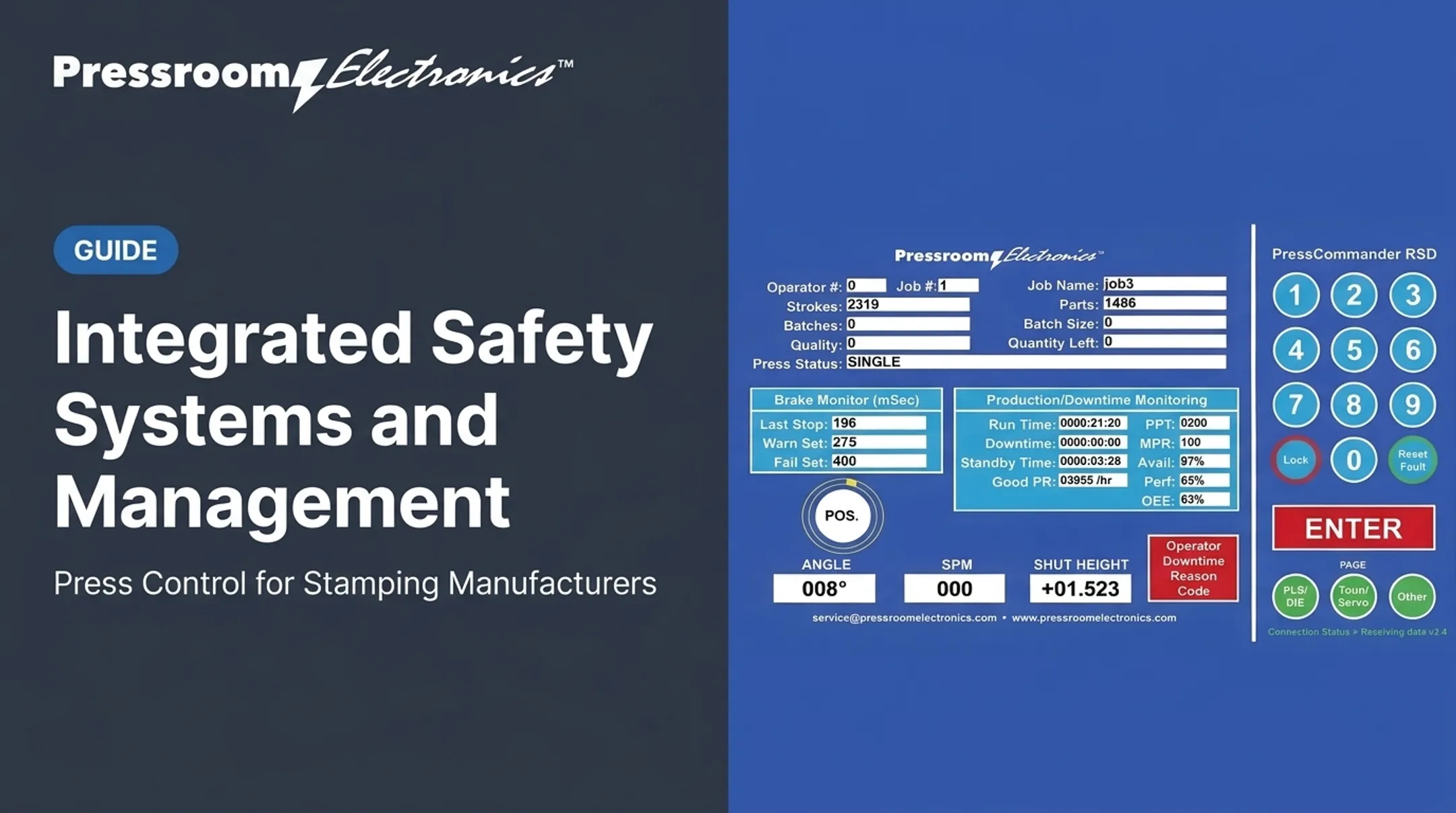
The PressCommander line uses triple CPU redundancy and force-guided Form B safety relays. It includes six die-protection inputs and retrofits into existing panels. The company states these controls are designed to exceed OSHA 1910.217 and ANSI B11.1-2009 (R2020). It also notes that overall system performance depends on equipment and factors it does not control.
Ordering starts with the press manufacturer, model, serial number, and speed. To discuss a control upgrade, request an application review at sales@pressroomelectronics.com or 800-937-4334. Outcomes depend on evaluating your machine first.
Frequently Asked Questions
What is an electrical safety control panel?
An industrial enclosure housing control and safety-related components used to monitor, control, or safely stop machinery. It differs from a residential breaker panel, which only distributes power and protects circuits.
How does a safety control panel protect workers?
It processes signals from protective devices and can initiate safe stopping, fault detection, restart prevention, or energy removal. That works only when properly designed and validated.
What should be inside an industrial safety control panel?
Typical contents include disconnects, protective devices, terminals, control components, safety relays or controllers, power supplies, interface devices, and documented wiring. Exact contents depend on the application.
What standards apply to electrical control panel safety in the US?
Evaluate current OSHA, NFPA, ANSI, UL, and machine-specific requirements with qualified professionals. Requirements vary by equipment, installation, and task.
Can existing machinery be retrofitted with a safety control panel?
Many machines are candidates. First review compatibility, machine condition, hazard assessment, component ratings, guarding, stopping performance, documentation, and validation.
How often should electrical control panels be inspected?
Frequency should reflect manufacturer guidance, environment, use, equipment age, incident history, and site risk. Inspect again after modifications, faults, or unusual conditions.