Introduction
An electronic controller is the hardware and software that reads inputs, applies programmed logic, and commands outputs on a device, machine, or process. Simple enough on paper. On a 30-year-old mechanical press, the picture gets messier.
Most plants raise the same problems:
- Aging equipment
- Unplanned downtime
- Machine-safety exposure
- Thin production visibility
- Trouble pairing modern controls with legacy machinery
The cost of stoppages is real. The commonly quoted Siemens downtime study puts $2.3M per unproductive hour on large automotive plants, not typical stamping shops.
This article covers controllers versus control systems, feedback and motor control, major controller types, metal-stamping applications, and how to select controls.
Key Takeaways
- A controller makes decisions; a control system adds sensors, actuators, feedback, and communications.
- Loop type, signal type, and platform (PLC or microcontroller) classify controls on separate axes.
- Pick press controls for compatibility, safety functions, diagnostics, programmability, and upgrade path.
- Qualified professionals must validate OSHA, ANSI, and site requirements for each installation.
What Are Electronic Controllers and Control Systems?
What is an electronic controller?
A controller receives information from sensors, switches, encoders, or operator interfaces. It processes that information using programmed logic and commands outputs such as motors, valves, relays, solenoids, or clutch/brake systems.
A simple switch only opens or closes a circuit. A controller does more:
- Interprets changing conditions
- Sequences operations
- Applies interlocks
- Records faults
How is a controller different from a control system?
NIST separates the two. The NIST OT guide describes a controller as a device or program that regulates a controlled variable. A control system includes everything used to guide a process toward a target value.
A press shows the difference. The controller is one board or unit. The control system also includes the resolver, sensors, operator stations, clutch/brake, the press itself, and the display.
Open-loop and closed-loop control
An open-loop system sends a command without measuring the result. A timed machine sequence is an example. A closed-loop system measures the result, compares it with a target, and corrects.
The trade-offs differ:
- Open-loop is simpler and cheaper, but cannot catch drift
- Closed-loop is more accurate and diagnosable, but needs sensors and careful tuning
Press stopping-time monitoring is a closed-loop check: it measures actual stopping time against a programmed limit.
Common terminology
- Setpoint: the target value
- Feedback: measured output returned for comparison
- Actuator: converts energy into motion
- Interlock: makes one operation depend on another device's state
- Alarm: indication of an abnormal condition needing operator response
- Fault: inability to perform as required
- HMI: the screen or panel for monitoring status and changing parameters
Terms such as analog, digital, discrete, programmable, and networked describe system characteristics. Most press control setups mix several of these at once.
How Electronic Controllers Work
Sensing and receiving inputs
Sensors, switches, encoders, and resolvers measure position, speed, pressure, presence, and machine status. Plants are electrically noisy, so signal quality matters. Rockwell documents signal conditioning via isolation, amplification, and linearization, plus noise control through shielding, filtering, and segregation.
Pressroom Electronics' PressCam 8 puts this into practice: 17 optically isolated inputs, a built-in +12 VDC sensor supply, and a passive resolver designed for shock, vibration, oil, and coolant mist.
Processing logic
The controller checks input states against sequences, setpoints, timers, limits, interlocks, and fault conditions. Fixed-function controls, like a dedicated temperature controller, offer predefined behavior and adjustable settings. Programmable controllers run user-written logic, so they adapt to a specific machine.
Custom programming extends that idea. Pressroom Electronics factory staff can create special programs for a unique machine and deliver them as an encrypted file through the onboard USB port.
Sending commands to actuators
Outputs drive relays, contactors, drives, valves, solenoids, and clutch/brake assemblies. They are not interchangeable:
- Relay contacts handle AC or DC loads but wear mechanically
- Transistor outputs suit DC loads and have polarity limits
- Triacs suit AC loads and have leakage limits
- Solid-state relays switch fast but still have surge limits
Match voltage, current, switching frequency, and load type to manufacturer specifications. PressCam 8 offers solid-state or relay outputs, and replaceable solid-state modules come in different ratings, so specify the type when ordering.
Feedback and correction
The loop runs: measure, compare to target, calculate correction, command the actuator, measure again. A well-tuned loop delivers accuracy, stability, and fault detection. Poor tuning causes hunting and oscillation; excessive integral gain in PID control is a classic cause.

Safety, diagnostics, and communication
Controllers can support interlocks, e-stop interfaces, fault states, alarms, and controlled restart, but only as part of an appropriately validated safety system. Communications to HMIs and monitoring platforms add fault records and reason codes. They help teams investigate downtime, though data alone doesn't solve root causes.
Types of Electronic Controllers and Control Systems
Types based on signal and logic
- Analog: continuously varying signals, such as a 4-20 mA pressure signal
- Digital: coded values processed by a microprocessor
- Discrete: defined states such as on/off or ready/fault
Modern equipment combines all three. A tonnage monitor may output an analog signal while a controller handles discrete interlocks digitally.
Types based on controller platform
| Platform | Typical use |
|---|---|
| Microcontroller | Compact embedded products and motor electronics |
| PLC | Machine sequencing, built for industrial robustness |
| Industrial PC | Machine-data monitoring, image processing, gateways |
| Motion controller | Axis speed, position, multi-axis coordination |
| Motor drive | Speed and torque control |
These overlap. Siemens documents drive-level speed control with position control in a higher-level controller, so platform labels don't tell you where each loop runs.
PLCs and dedicated industrial controllers usually suit machine automation. Microcontrollers fit compact or specialized products.
Types based on feedback architecture
Industrial systems commonly use these feedback architectures:
- Open-loop: command output without measuring the result
- Closed-loop: feedback corrects output toward a setpoint
- Combined or supervisory: higher-level control over multiple loops
Feedback architecture is a separate axis from signal type or hardware platform. Keep it distinct when you classify a controller; textbooks do not share one universal "three types" list.
How Electronic Controllers Are Used in Metal Stamping
Punch press clutch, brake, and safety controls
Press controls coordinate the machine cycle, operator commands, and clutch engagement and brake application, using position feedback. Two common approaches are resolver-based and rotary-cam-based control. Resolver systems give absolute shaft-position feedback and programmable timing. PressCam 8 reports ±1° resolution up to 700 RPM; check product documentation for model-specific ratings.
Brake monitoring, die protection, and guarding work alongside those controls:
- Brake monitors measure stopping time and flag deterioration. OSHA 1910.217(b)(14) requires monitoring where applicable.
- Die protection detects misfeeds, non-ejected parts, and tooling problems.
- Guarding such as light curtains and safety mats detects people in hazardous zones.
Production control is not safeguarding. Selection, installation, risk assessment, and validation must follow the requirements for the specific machine. OSHA 1910.217 covers mechanical power presses and excludes hydraulic and pneumatic ones.
Production monitoring and programmable reason codes
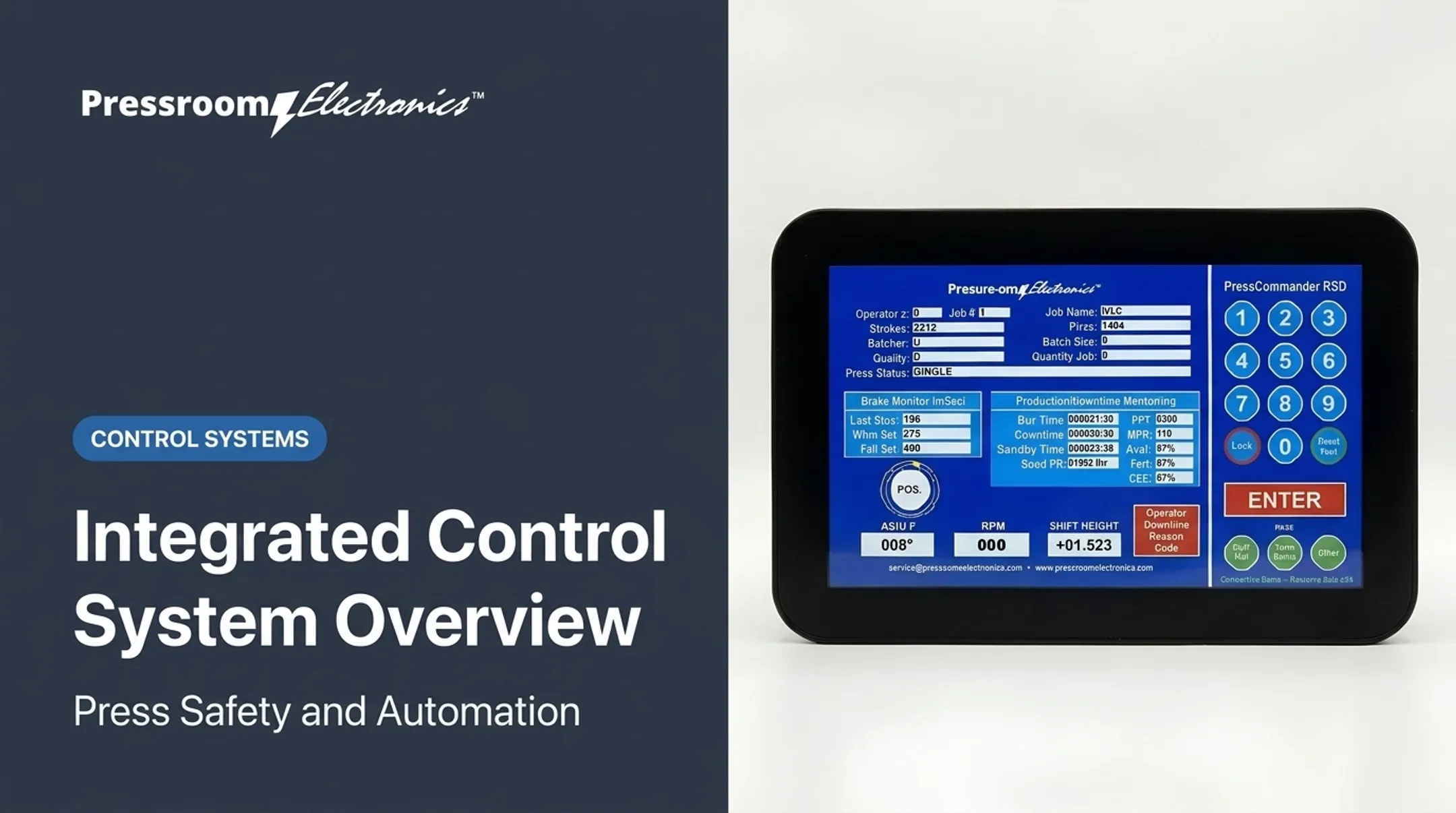
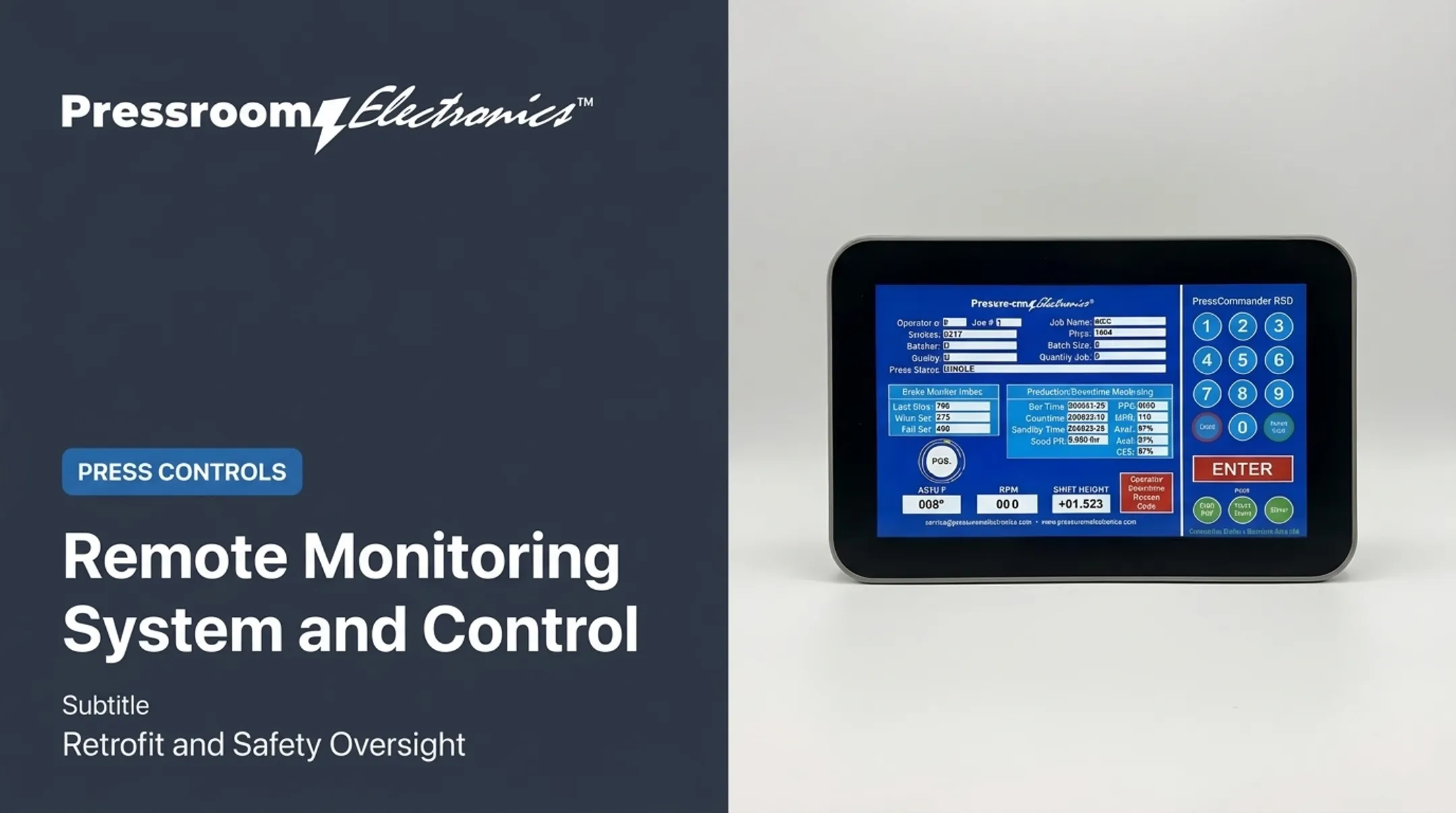
Monitoring captures status, cycle counts, and downtime causes. Pressroom Electronics' Production & Downtime Monitoring System supports up to 20 customizable downtime codes. Codes are entered at the touchscreen or triggered by machine signals, with data written to Excel files. The touchscreen shows strokes, run time, downtime, availability, performance, and OEE.

Recurring reason codes show where losses cluster. Treat the commonly cited 85% OEE figure carefully: no universal benchmark fits every shop.
Retrofits and integrated pressroom solutions
Small and mid-size stampers and rebuilders should check:
- Existing sensors and wiring
- Panel space and power (PressCommander runs at 24VDC, 110VAC, or 240/440VAC)
- Operating modes (off, inch, single, continuous)
- Compatibility with current safety devices
Document the machine, define desired functions, test every operating mode, and obtain maintenance documentation and training. Wintriss documentation, for example, calls for final checkout after any press or control change.
Pressroom Electronics, a US manufacturer in Batavia, Illinois, serves metal stamping and forming with press controls, automation, brake monitoring, die protection, guarding, and production monitoring. PressCommander retrofits into an existing control panel. Factory custom programs and field upgrades are available. Match the package to your press type, safety devices, and production goals.
How to Choose and Implement Electronic Controls
Define the machine and process requirements
Document before you request a quote:
- Machine type and cycle speed
- Operating modes
- Input/output list and feedback devices
- Environmental conditions
- Data needs
- Consequences of a control failure
Then separate essential control, monitoring, operator convenience, and safety-related functions.
Evaluate compatibility and customization
Verify these compatibility points before you buy:
- Electrical and mechanical interfaces with legacy components
- Communication protocols (PressCommander offers DeviceNet and Ethernet)
- Panel size, spare-part availability, and software access
- Expansion room for future stations
One example: expander boards raise PressCommander die-protection capacity from six to twelve stations.
Ask whether the supplier provides application-specific programming, documentation, testing, training, field support, and upgrade paths, not just a generic box. Programming ownership deserves a direct question.
Plan for safety, commissioning, and lifecycle support
- Complete a documented risk assessment under ANSI B11.0
- Use qualified installers for press controls and safeguarding
- Verify safety functions; ISO 13849-2 covers validation
- Commission under controlled conditions before production
- Train operators and set preventive maintenance

Compare lifecycle impact across downtime exposure, diagnostics, replacement strategy, access controls, and support. Rockwell-style lifecycle stages (Active through Discontinued) are a useful check on how long a platform stays supported.
Frequently Asked Questions
What are controllers in electronics?
A controller is an electronic device or programmed component that processes inputs and commands outputs to manage a device, machine, or process.
What is a control system in electronics?
It is the controller plus its sensors, actuators, controlled process, feedback, interfaces, and communications.
What are some examples of electronic controls?
Microcontrollers, PLCs, motor controllers, temperature controllers, press controls, brake monitors, die-protection systems, and guarding controls.
What is motor control and how does it work?
Motor control regulates starting, stopping, direction, speed, torque, or position. It uses commands and, where needed, encoder or resolver feedback.
What are the three types of control systems?
Classifications vary. Open-loop and closed-loop describe feedback architecture, often with a combined form. Analog, digital, and discrete is a separate three-part split by signal type.