Machine guarding safety devices are engineering controls. They block access to a hazard, detect unsafe access, or stop hazardous motion. Training and PPE support them but cannot replace them.
This article covers device types, US requirements, selection criteria, and implementation practices for equipment such as punch presses, forming machines, conveyors, and robotic cells.
Key Takeaways
- Select safeguards from a documented hazard assessment, not from habit.
- Guards, interlocks, light curtains, two-hand controls, and trip devices each solve different access problems.
- Training and PPE never replace engineering controls.
- Test, inspect, and document every device, and watch for bypassing.
What Hazards Do Machine Guarding Safety Devices Control?
Point-of-Operation and Access Hazards
The point of operation is where work is performed on material. Punch presses, shears, and forming equipment need protection against hand or body entry there. OSHA's 29 CFR 1910.212 requires guarding against point-of-operation, ingoing nip-point, rotating-part, flying-chip, and spark hazards.
How often people reach in matters. Loading, unloading, adjustment, inspection, cleaning, and maintenance each call for different safeguards. A part fed by hand every cycle needs something different from a panel opened once a month.
Mechanical Motions and Injury Sources
OSHA's guidance on amputations lists the motions to look for:
- Rotating parts that grip clothing or limbs
- In-running nip points between rollers or transmission parts
- Reciprocating and transverse motion that strikes or pinches
- Cutting, punching, shearing, and bending actions
- Power-transmission components such as gears, belts, chains, and pulleys
These motions cause caught-in, struck-by, crushing, laceration, burn, and eye injuries, including amputations.
Secondary Hazards
Secondary risks still need controls:
- Flying chips and sparks
- Hot surfaces
- Unexpected startup and stored energy
- Ejected material
One guard rarely controls every hazard.
Your assessment should cover more than operators. Include setup staff, maintenance personnel, contractors, and anyone else who may enter the machine area.
What Are the Main Types of Machine Guarding Safety Devices?
OSHA separates guards (physical barriers) from safeguarding devices (which detect or prevent inadvertent access). These are not interchangeable.
Physical Machine Guards
| Type | How it works |
|---|---|
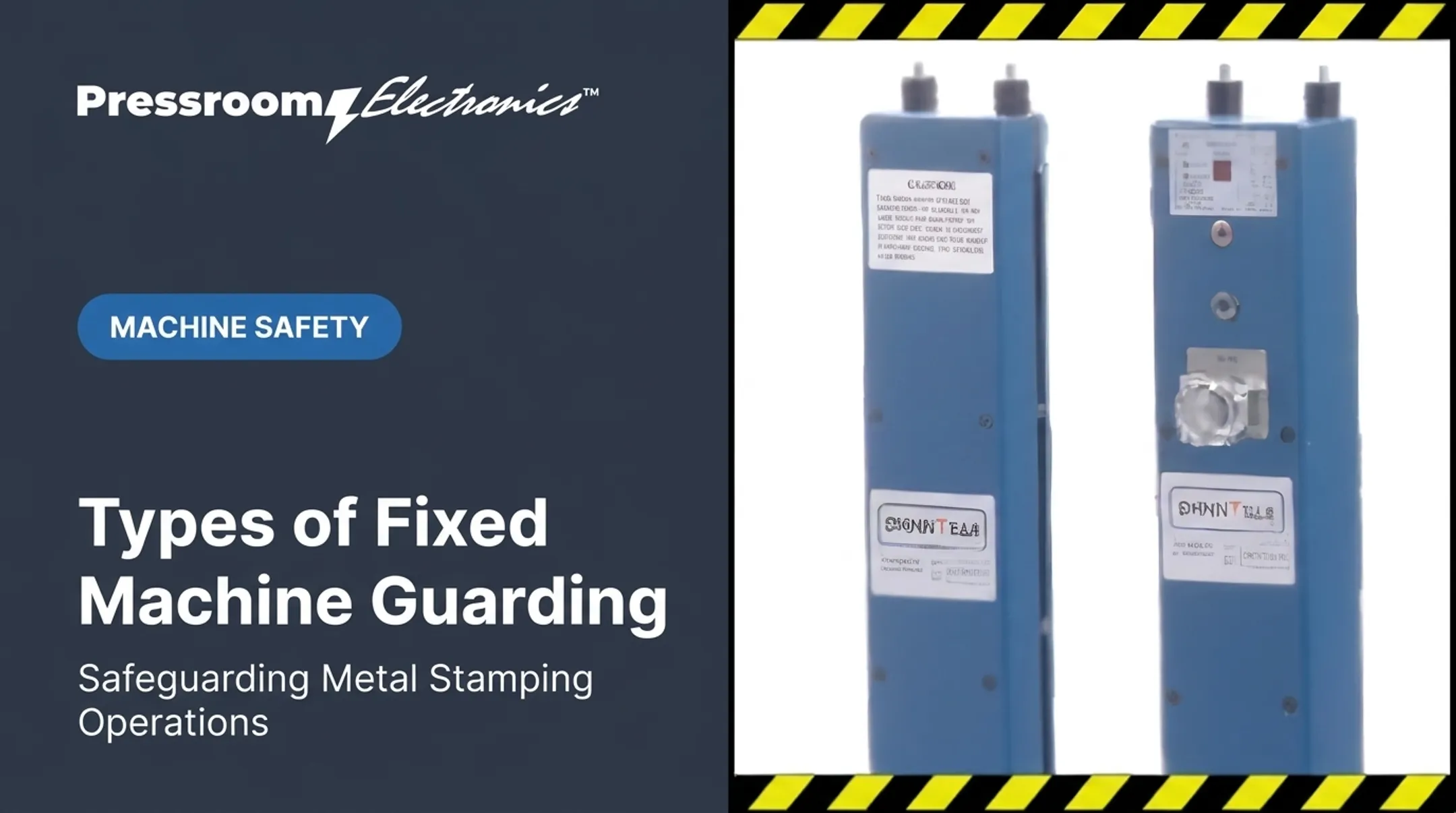
| Fixed | Permanent barrier independent of moving parts |
| Adjustable | Set for stock size; wrong setup leaves gaps |
| Self-adjusting | Stock pushes it open; it returns afterward |
| Perimeter | Encloses a cell or area |
| Power-transmission | Covers gears, belts, chains, and pulleys |
Good guards are secure, durable, hard to defeat, and visible enough for safe work. They shouldn't create new hazards or needlessly obstruct production.
Interlocked Guards and Guard Switches
An interlocked door, gate, or panel stops the machine or prevents cycling when opened. Closing it must not restart the machine automatically. Look for monitored interlocks, controlled reset, and confirmation that motion has stopped before anyone can enter.
Presence-Sensing Devices
Light curtains, laser scanners, and safety mats detect a person but don't physically block access. The machine must stop before the person reaches the hazard.
Placement depends on stopping time, approach speed, resolution, bypass routes, reset location, and the full hazard zone. Under 1910.217, presence sensing is prohibited on full-revolution clutch presses and can't initiate slide motion. Entry routes it doesn't cover need guards.
Point-of-Operation Controls
- Two-hand controls require continuous, concurrent actuation; releasing a hand stops the slide.
- Two-hand trips start the cycle with concurrent actuation, then free the hands.
- Palm buttons serve as the hand inputs.
Look for anti-tie-down, synchronization, protected wiring, and anti-repeat logic. Nothing should let the operator defeat the control sequence.
Trip, Pullback, and Restraint Devices
Safety trip bars and cables stop the machine when pushed or pulled. Pullbacks withdraw the hands as the machine cycles. Restraints hold the hands back from the danger zone without retracting them. All depend on the machine layout, operator position, and reach distance, so none is a general-purpose fix.
Supplementary Pressroom Controls
Emergency stops, brake monitoring, die protection, and clutch/brake controls complement guarding. OSHA does not classify emergency stops as machine safeguarding.
A stamping example: a light curtain guards the front opening, fixed guards cover the sides and rear, and a brake monitor prevents another stroke if stopping time degrades. Follow the manufacturer's instructions and OSHA/ANSI requirements.

How to Choose the Right Device for a Machine
Start With a Documented Risk Assessment
- Identify hazardous motions and energy sources.
- Locate the danger zones.
- Determine who needs access, and when.
- Evaluate the severity and likelihood of harm.

Cover normal production, setup, troubleshooting, cleaning, die changes, inspection, and maintenance. ANSI B11.0 covers lifecycle hazard identification, risk evaluation, and verification.
Match the Safeguard to Access
- Fixed guards suit infrequent access.
- Interlocked guards suit recurring access.
- Presence-sensing devices suit open loading areas.
- Two-hand controls or palm buttons suit point-of-operation applications.
Material size, feed direction, line speed, cycle, visibility, and ergonomics all affect which option fits.
Check Stopping Performance and Safety Distance
A light curtain only works if the machine stops before a hand arrives. OSHA's press equation is Ds = 63 in/sec x Ts, with Ts measured at roughly 90 degrees of crankshaft rotation, per OSHA's eTool.
ANSI B11.19 uses a broader formula that adds control response, sensor response, and a penetration allowance.
Measure stop time at the fastest speed with the heaviest tooling. Clutch air, counterbalance air, tooling weight, cycle speed, and brake wear can all change it, so recalculate when they do. Trained personnel should measure and validate the result.
Confirm Compatibility, Reset, and Fault Response
- Compatibility with the control system, clutch/brake, and pneumatic or hydraulic circuits
- Monitored reset placed where the operator can see the whole danger zone
- Fault indication and controlled restart
- Defined response to a failed sensor, broken wire, or power loss
Under OSHA 1910.217(b)(13), a control failure must not prevent stopping and must block another stroke until corrected.
Apply It to Pressroom Equipment
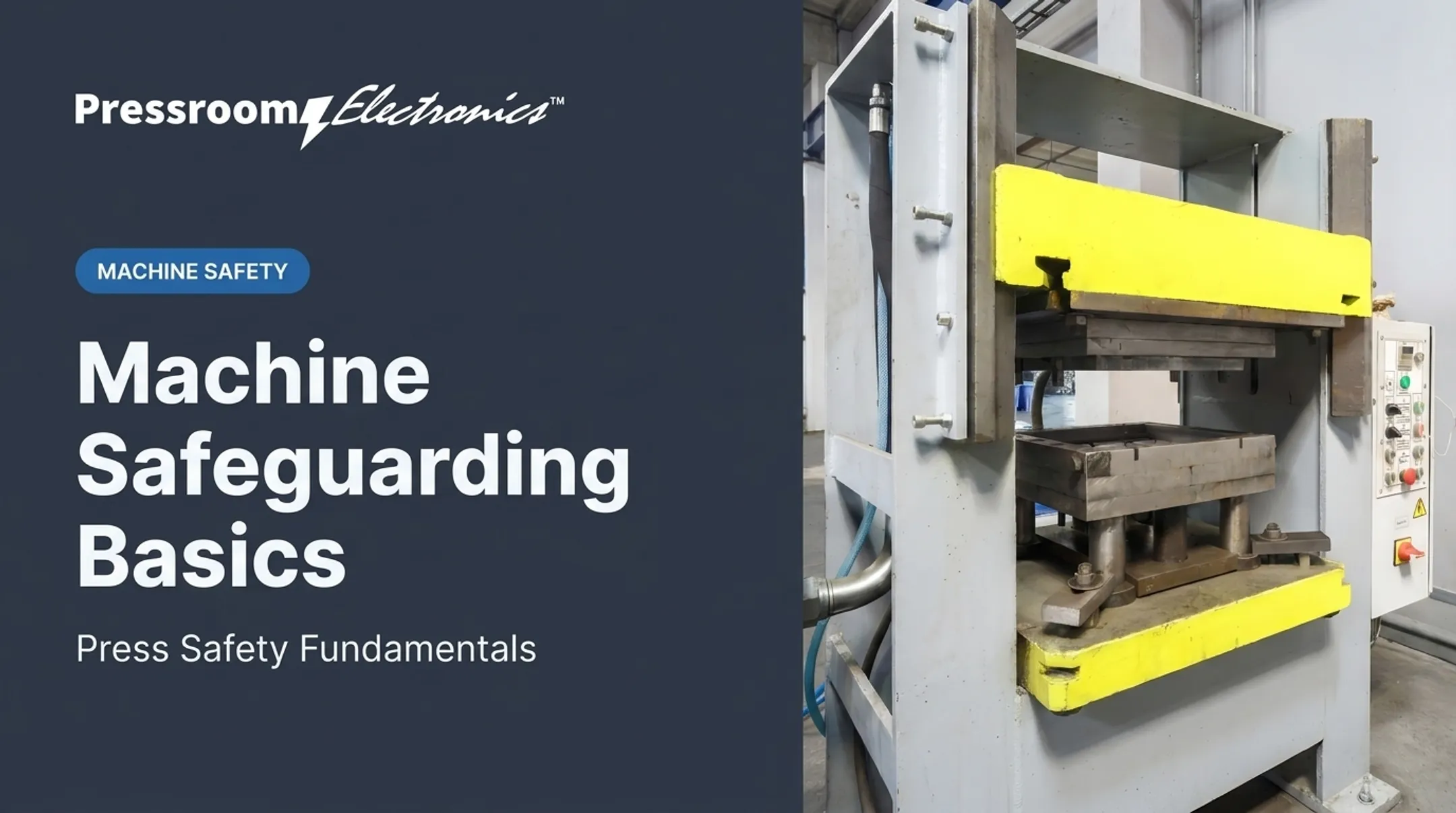
A mechanical press may need point-of-operation guarding, light curtains or palm buttons, die protection, brake monitoring, and clutch/brake controls working as one package.
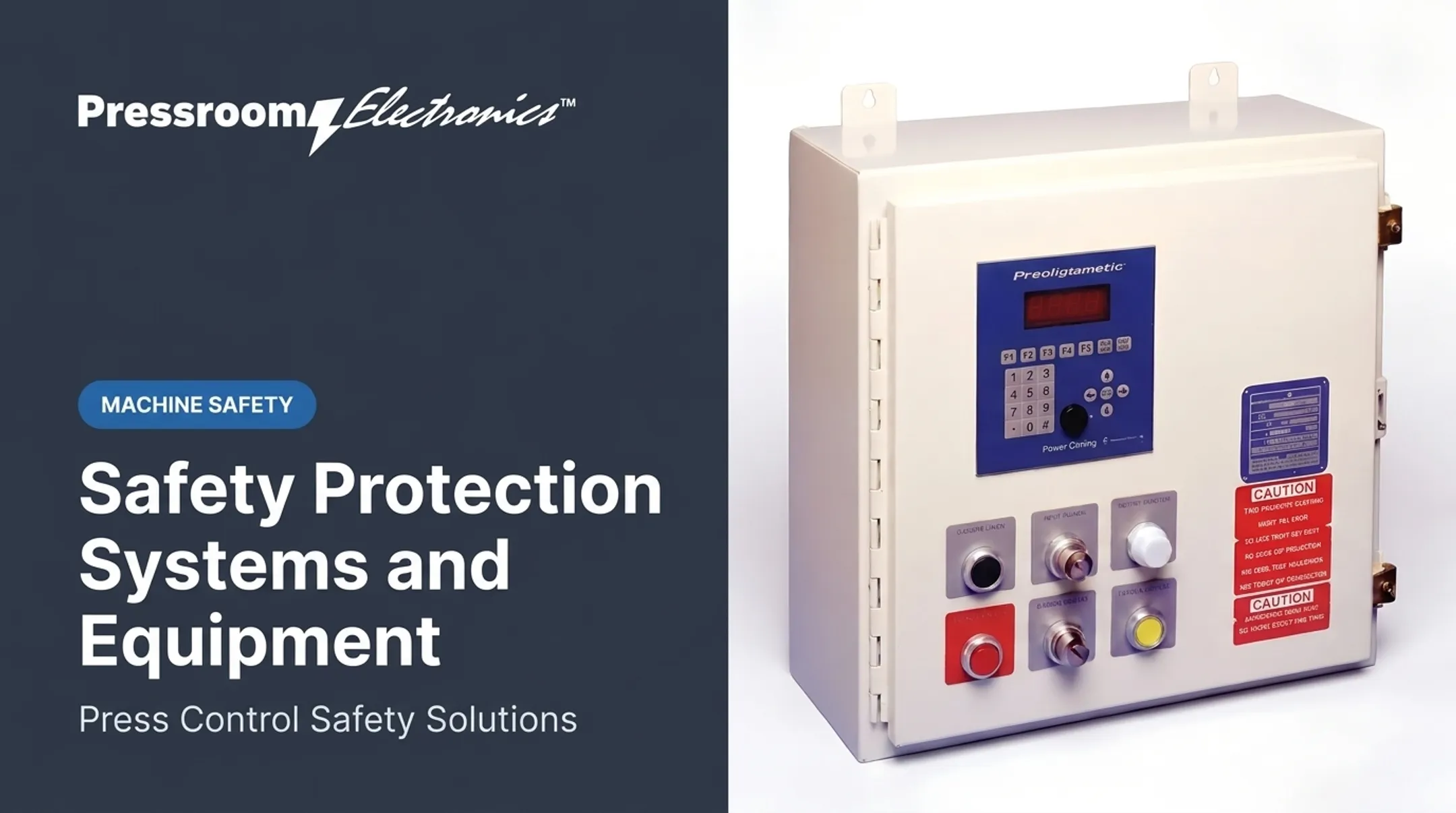
Pressroom Electronics designs and manufactures press controls and safeguarding for metal stamping. That includes light curtains, safety mats, ergonomic palm buttons, brake monitors, and plant survey and risk assessment services. For any product, ask for the application documentation before specifying it.
U.S. Standards and Guarding Requirements
OSHA Requirements
- 1910.212 requires one or more guarding methods to protect operators and other employees. Guards should be secure and must not create additional hazards.
- 1910.217 covers mechanical power presses. Paragraph (a)(5) excludes press brakes and hydraulic or pneumatic presses.
- 1910.147 governs hazardous energy control during servicing.
ANSI and Equipment-Specific Standards
The right standard depends on the machine:
- ANSI B11.1-2009 (R2020): mechanical power presses
- ANSI B11.2-2013 (R2020): hydraulic and pneumatic presses
- ANSI B11.3-2022: power press brakes
- ANSI B11.19-2019 (R2024): safeguarding performance requirements
- ANSI B11.26-2024: functional safety of control systems
OSHA regulations are enforceable. Consensus standards are voluntary unless adopted, though meeting them doesn't excuse weaker protection. Manufacturer instructions and company procedures add a further layer. None substitutes for the others.
Documentation and Professional Review
Keep these on file:
- Risk assessments and device specifications
- Control schematics and stopping-time measurements
- Commissioning and inspection records
- Training records and corrective actions
A device label or a supplier's compliance claim does not prove a complete installation meets every requirement. Bring in qualified safety professionals and the equipment manufacturer for complex applications.
How to Implement, Test, and Maintain Safeguards
Build a Safeguarding Baseline
Inventory machines, guards, devices, access points, energy sources, and tasks. For each device, record:
- Protective function
- Who may reset it
- What permits restart
- How faults get reported
Commission and Validate
Check wiring, guard alignment, sensor position, reset behavior, and stopping performance under representative conditions. Confirm the device stops hazardous motion and leaves no alternate access route or restart path.
Inspect Before Use and on Schedule
Look for:
- Missing or damaged guards and loose fasteners
- Misalignment, broken cables, and damaged wiring
- Dirty or blocked sensors and failed indicators
- Altered settings and signs of bypassing
For presses, 1910.217(e) requires periodic and regular inspection, with records showing date, signature, and press identifier. Weekly clutch/brake, anti-repeat, and single-stroke testing is required unless the press meets (b)(13) and (b)(14). Define who inspects, what happens on a failed test, and when equipment comes out of service.

OSHA cited a company in 2011 after a press-brake light curtain had blanked sections that left protection ineffective. Blanking and bypassing are inspection priorities.
Control Hazardous Energy
Guard removal, sensor replacement, die changes, and repairs can expose workers to hazardous energy. Interlocks, light curtains, emergency stops, and control-circuit devices are not energy-isolating devices under 1910.147(b). Use the machine-specific lockout/tagout procedure.
Train and Improve
Train operators, setup staff, maintenance, supervisors, and contractors on:
- Recognizing hazards
- Testing devices
- Reporting defects
- Never bypassing safeguards
Review nuisance trips, near misses, failures, and unauthorized modifications to find root causes. Fix the design without weakening protection.
Frequently Asked Questions
What are the different types of safety guards?
Fixed, adjustable, self-adjusting, interlocked, perimeter, and power-transmission guards. The right type depends on the hazard and how often people need access.
What are some common safety devices found on machinery?
Interlocks, light curtains, safety mats, two-hand controls, palm buttons, and trip devices are primary safeguards. Emergency stops and brake monitoring are supplementary controls.
What are the three types of machine safety?
Classifications vary, and OSHA names guards and safeguarding devices as the two primary methods. A practical framework adds safe work practices as a third layer. Training and PPE never replace engineering controls.
What is industrial safety equipment?
It's a broad term covering machine safeguards, PPE, lockout/tagout equipment, electrical protection, and fall protection. Machine safeguards specifically prevent contact with machine hazards.
How do you choose a machine guarding safety device?
Assess the hazard, access frequency, stopping time, cycle, material flow, and control compatibility. Then confirm the applicable OSHA and ANSI requirements.
Do machine guarding devices replace lockout/tagout?
No. Safeguards protect during normal operation. Lockout/tagout isolates hazardous energy during servicing and maintenance.