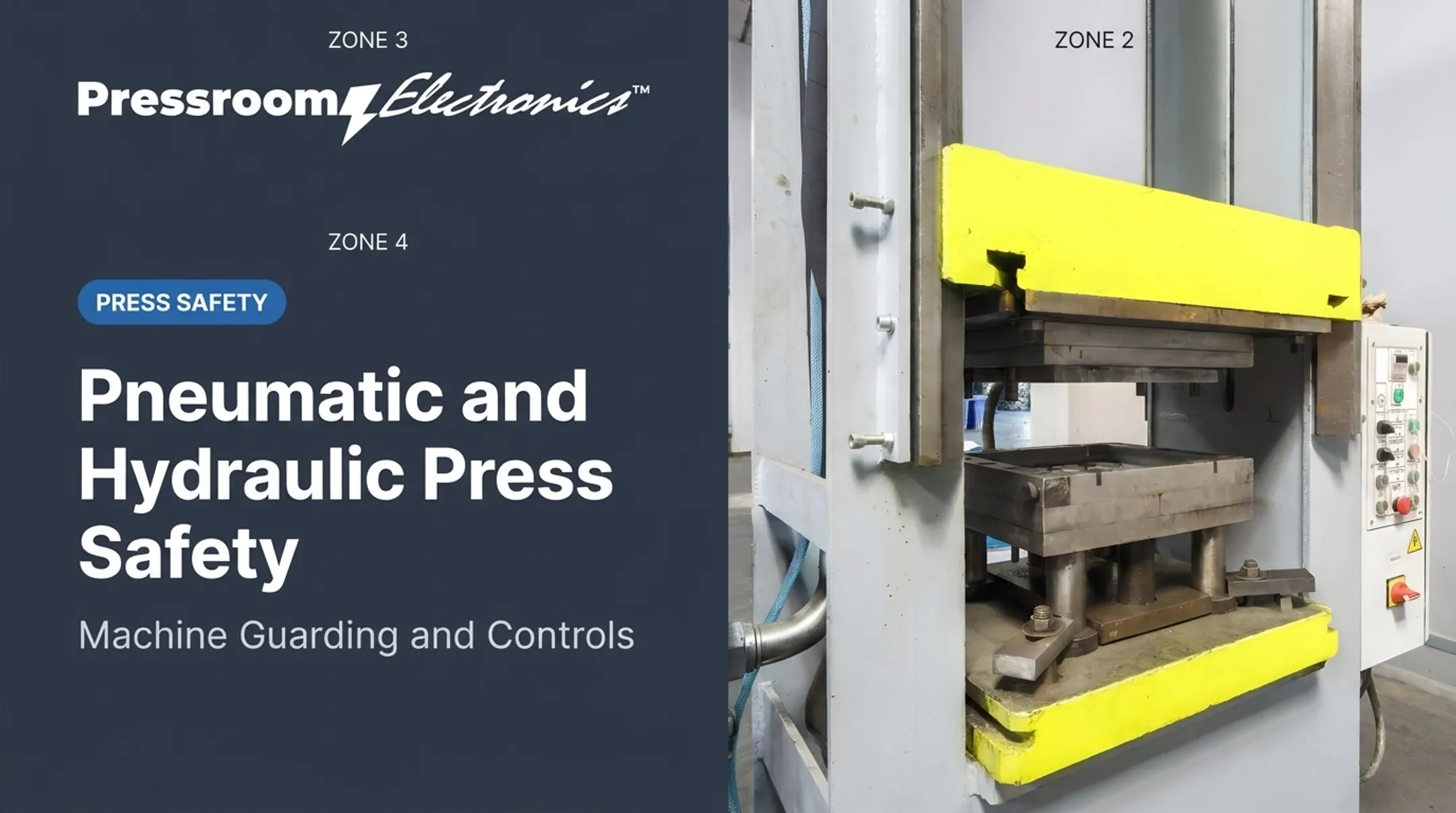
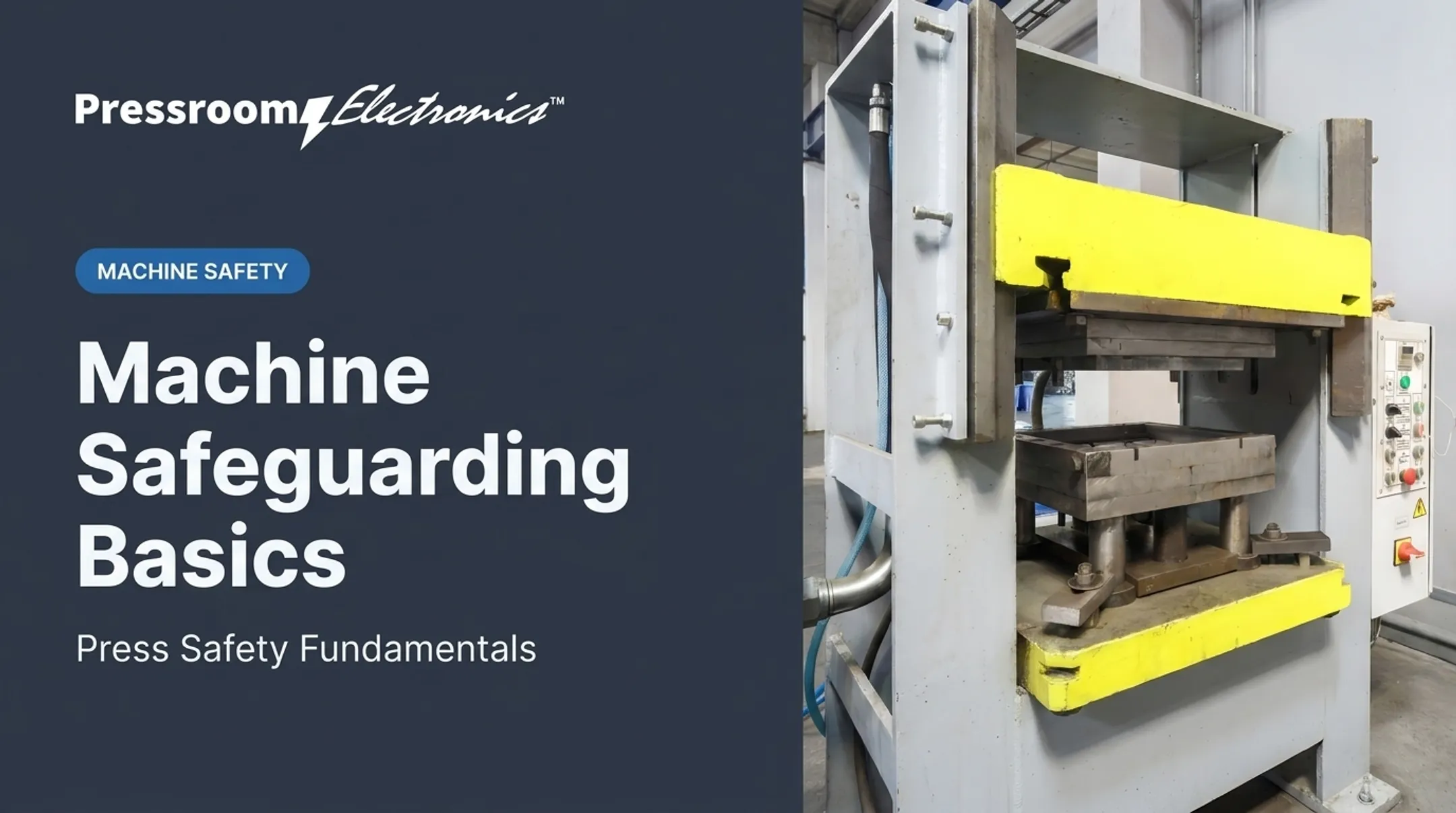
A press incident rarely harms only the operator. It also brings lost work time, a damaged die, unplanned downtime, an investigation, workers' compensation costs, and possible citations.
Mechanical power press safeguarding is a system, not a single device. It combines guards, presence-sensing devices, controls, braking performance, procedures, training, and validation. The risk is high whenever a worker can reach the point of operation or another hazardous motion.
Key Takeaways
- Identify press type, clutch/brake, operating mode, tooling, and access points before choosing a method.
- Protect the point of operation and every other accessible hazard with a suitable combination of safeguards.
- Verify stopping time and safety distance before relying on a light curtain or two-hand control.
- Never bypass safeguards or enter the die area without energy-control procedures.
Safety Guidelines for Mechanical Power Press Safeguarding
Start with a hazard assessment specific to the machine and the task. Choosing a familiar device by default is how mismatches happen.
The main hazards include:
- Point-of-operation crushing, amputation, and shearing
- Pinch points and ingoing nips
- Unexpected cycling
- Ejected material or safety blocks
- Rotating power-transmission components
- Die movement
- Stored mechanical, pneumatic, or electrical energy
Exposure changes with the task. Each of these activities puts hands in different places, so the safeguarding strategy has to cover all of them:
- Production and feeding
- Die setting and adjustment
- Troubleshooting and inspection
- Cleaning and maintenance
Safeguarding is also ongoing. Build a plan that covers:
- Inspection and function testing
- Maintenance and documentation
- Retraining when roles or methods change
- A fresh review after any process or tooling change
General Safety Precautions
Baseline rules apply to operators, die setters, maintenance staff, supervisors, and contractors who approach the press.
Personal Protective Equipment and Work Area
Match PPE to the material and task. OSHA's PPE standard, 29 CFR 1910.132, requires a hazard assessment, properly fitting equipment, and training on use and limits. Typical items:
- Eye and face protection
- Safety footwear
- Hearing protection
- Cut-resistant gloves where appropriate
- Close-fitting clothing that can't snag
Keep the area around the press clear:
- Control access to the hazard zone
- Maintain good lighting
- Keep emergency stops reachable
- Remove loose tools and scrap from the operator station
Pre-Use Review and Authorization
Before each shift, check:
- Guards, interlocks, and light curtains
- Two-hand controls and emergency stops
- Indicators and die condition
- Feeding equipment
- Any odd noise or movement
If something is wrong, stop and report it. Nobody should improvise a repair.
A painted floor line or warning sign is not a guard. Under 1910.217(c), guards must prevent hands and fingers from reaching through, over, under, or around them. Signs only warn.
Only trained, authorized people should operate, set up, inspect, adjust, or service the press. OSHA requires operator training before covered work begins, and die-setting procedures with safety blocks for work in the press.
Safety During Installation
Installing or retrofitting safeguarding exposes people to electrical, mechanical, pneumatic, lifting, stored-energy, and unexpected-start hazards. Require a documented installation plan and lockout/tagout under OSHA 1910.147.
The installer should:
- Identify every energy source on the press and auxiliary equipment.
- Secure dies and moving members.
- Verify zero-energy conditions.
- Use qualified personnel for electrical, control, and mechanical work.

Design Considerations
The design must account for:
- Stopping time and safety distance
- Control reliability, reset behavior, and restart prevention
- Side and rear access
- Interaction with feeders or automation
Don't proceed if the press type, clutch/brake configuration, access points, or stopping performance are unknown or can't be verified.
Positioning Light Curtains and Two-Hand Controls
Never place these by guesswork. OSHA's formulas use a hand-speed constant of 63 inches per second:
| Application | Minimum distance |
|---|---|
| Presence sensing | Greater than 63 × Ts (press stopping time, measured at about 90° of crankshaft rotation) |
| Two-hand control | Greater than 63 × Ts, same measurement |
| Two-hand trip | Greater than 63 × Tm (time to die closure) |
Presence-sensing-device initiation (PSDI) uses a separate, longer equation. Manufacturer manuals add terms for control response, curtain response, brake-monitor allowance, and penetration depth. Follow the device manual, OSHA text, and current standards such as ANSI B11.19 and ISO 13855.
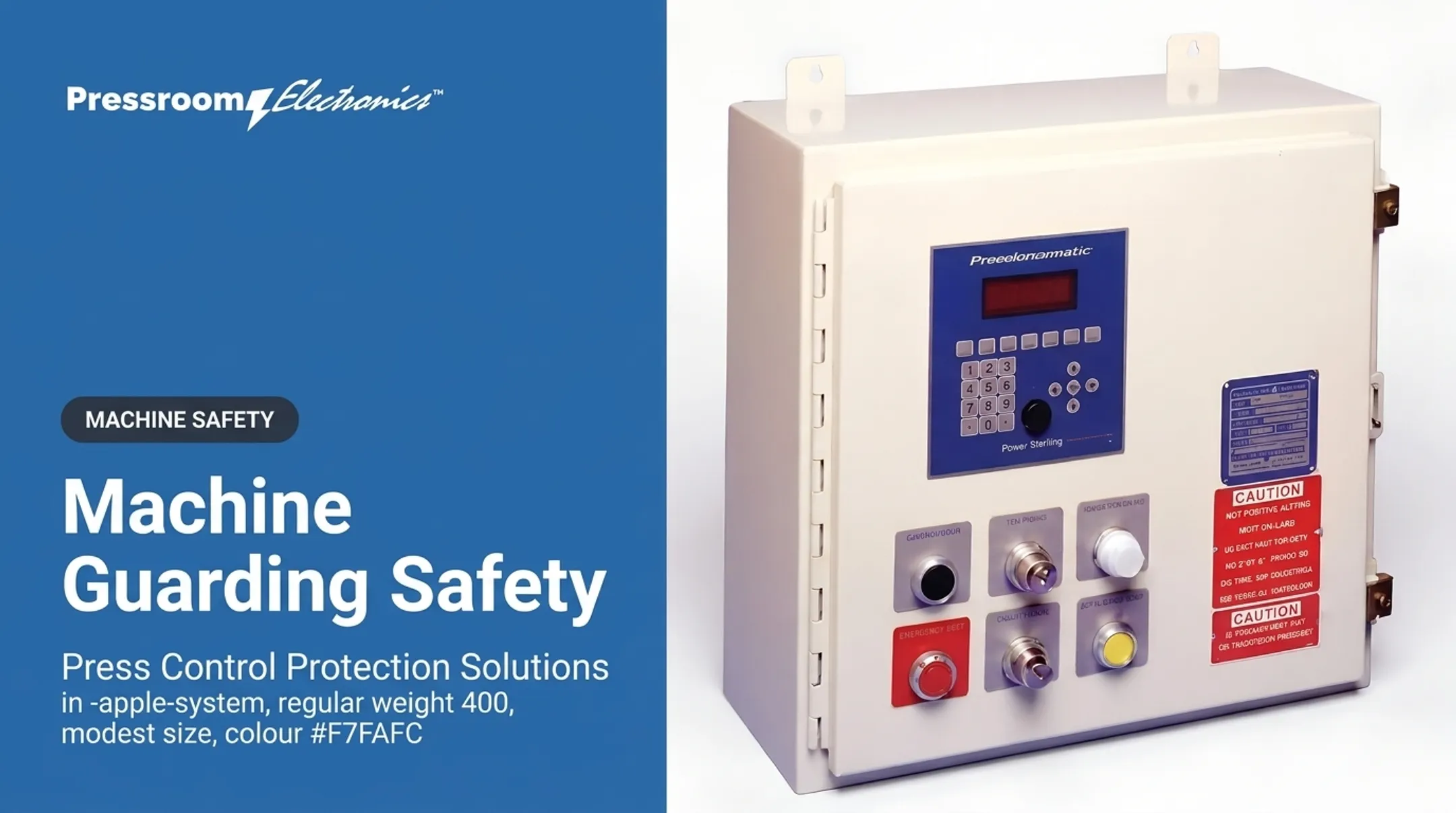
Pressroom Electronics makes press controls, clutch/brake controls, and brake monitors, including a time-based brake monitor that measures stopping time every stroke. These can support a retrofit, but the complete system still needs qualified design, installation, testing, and validation.
Safety While Using or Operating the Press
The point of operation is the primary concern. The safeguarding method must match the press design, production method, operator interaction, and required access.
Choosing a Safeguard
| Safeguard | Key limitation |
|---|---|
| Fixed or barrier guard | Suits operations without frequent access; must block reaching over, under, through, or around, without creating new pinch points |
| Interlocked guard or gate | Type B gates apply to part-revolution clutches |
| Light curtain | Prohibited on full-revolution clutch presses; can't initiate strokes outside full PSDI compliance |
| Two-hand control | Releasing a hand must stop the slide |
| Two-hand trip | Uses closure-time distance; full-revolution trips need anti-repeat |
| Pullback or restraint | Needs a separate device per operator; check at shift start, new die setup, and operator change |
A two-hand trip and a two-hand control are not interchangeable. One relies on closure time, the other on stopping when a hand lifts.
Presence sensing and two-hand controls also depend on:
- Adequate stopping performance
- Correct safety distance
- Reliable control integration
- Bypass protection
- Proper reset and anti-repeat functions
Hand-feeding tools are not point-of-operation guards, and OSHA says they can't replace required safeguards.
Testing and Intervention
Function-test safeguards per the manufacturer's procedure before operation and after changes, maintenance, die setup, or a fault. One manufacturer manual calls for checkout at shift change, power-up, and setup change, and at least every 24 hours during continuous runs.

Never reach into the die area to clear a misfeed, adjust, remove scrap, or grab a part while hazardous motion is possible. Use the approved interruption and energy-control procedure.
Emergency stops help in abnormal conditions. They don't replace point-of-operation safeguarding, isolation, or a validated stopping system.
Environmental and System Safety Considerations
Safeguard the whole production system, not just the front of the frame. OSHA's press eTool treats controls, dies, material handling, and auxiliary equipment as one system. Automatic feeds need protection at both the point of operation and the feed. Backs and sides need coverage too.
Inspect these areas:
- Side and rear access
- Coil feeds, straighteners, and conveyors
- Robotics, scrap chutes, and material handling
- Exposed rotating components and die movement
- Spots where a second employee could enter the hazard zone
Conditions That Degrade Safety Components
Manufacturer manuals document several effects:
- Dust and contamination: dirty optical windows reduce light curtain reliability.
- Reflections: reflective surfaces can prevent object detection.
- Vibration: may require attenuation.
- Temperature: each model has its own rated range.
- Electrical noise: can cause random trips or lockout, especially from motor wiring near sensor cables.
Damaged wiring and misalignment deserve the same attention.
Beyond the environment, safeguards must suit the clutch type, brake, stroke, operating modes, and auxiliary equipment. Brake wear, air supply, tooling weight, and cycle speed can all change stopping time.
New dies, altered feed rates, automation, or changes in operator access should trigger a fresh risk review. Where needed, remeasure stopping time, verify safety distance, and revalidate.
Common Safety Mistakes to Avoid
Treating Every Press the Same
Confirm these factors before device selection:
- Machine identification
- Clutch/brake type
- Operating mode
- Tooling
- Task exposure
Otherwise you get a safeguard that looks present but can't stop or block access under real operating conditions.
Choosing Devices Without Checking the Numbers
Selecting a light curtain, two-hand control, barrier, or interlock without verifying the numbers creates false confidence. Check each of the following:
- Stopping time
- Safety distance
- Other access points
- Manufacturer limits
Skip those checks and the operator or a coworker stays exposed.
An OSHA bulletin describes a 60-ton part-revolution press with two-hand controls and presence sensing. A worker clearing a jam suffered three finger amputations during double cycling. The cause was an incorrect schematic and a miswired sensing device, not brake failure.
Bypassing Safeguards
Taping, relocating, or disabling a safeguard to save production time invites:
- Unexpected cycling
- Exposure during the hazardous stroke
- Injuries to coworkers
- Equipment damage
- Loss of the safety function
Entering the Die Area Before Energy Is Controlled
A stopped press is not necessarily de-energized. In a New York FACE investigation, a worker actuated a 200-ton press with two safety blocks between the dies. One was ejected and killed him. Investigators found no press-specific lockout procedure, untrained operators, and blocks not interlocked with the press circuit.
Choose die blocks, blocking devices, and lockout/tagout that fit the task before anyone enters the die area.
Skipping Inspections and Validation
These conditions can undermine a system that once passed inspection:
- Brake wear
- Damaged sensors
- Worn interlocks
- Altered tooling
- Undocumented modifications
OSHA requires the brake monitor to prevent the next stroke when deterioration invalidates the installed safety distance. Keep records, train workers, and validate after every change.
Conclusion
Press safeguarding is a complete risk-reduction system: physical guards, protective devices, reliable controls, verified stopping performance, safe procedures, training, inspection, and validation.
Review each press by task and access point. Correct deficiencies before production resumes. Treat safeguarding as a routine operating responsibility, not a one-time installation.
Frequently Asked Questions
What are the safeguards for mechanical power presses?
Common options include point-of-operation guards, interlocked barriers, presence-sensing devices, two-hand controls or trips, pullbacks, restraints, and safe feeding methods. Pair them with reliable controls, inspections, training, and lockout/tagout based on the press and task.
What are the OSHA regulations regarding press brake guarding?
Press brakes are excluded from 1910.217 under paragraph (a)(5). OSHA applies 1910.212, the general machine-guarding rule, instead. Confirm current requirements and ANSI B11.3 before assuming 1910.217 applies.
What are the guarding requirements for a hydraulic press?
Hydraulic presses fall outside 1910.217; OSHA points to 1910.212. Still guard the point of operation, control access, manage stored hydraulic and gravitational energy, and use proper safety controls for your machine.
How often should a mechanical power press be inspected?
OSHA requires periodic and regular inspections, with repairs before use. Directed checks of clutch/brake, anti-repeat, and single-stroke mechanisms are due at least weekly unless (b)(13) and (14) apply. Include pre-use, post-maintenance, post-change, and manufacturer checks.
Why is stopping time important when installing a light curtain?
The device must stop hazardous motion before a hand can reach the point of operation. Stopping time, device response, and distance must be measured and calculated, not estimated.
When is lockout/tagout required on a mechanical power press?
Whenever servicing, maintenance, die work, adjustment, or troubleshooting exposes someone to unexpected startup or stored energy. Only routine, repetitive production tasks with effective alternative protection may fall outside it.